There has been much hype about the Occupy Wall Street movement lately. Although their frustration with the lack of economic growth, not to mention the collusion between Big Government and Big Business, is valid, frustration is insufficient in terms of implementing change. You need sound policy to back it up. Naïveté exists amongst these protesters, and an "unofficial" list of demands exemplified it. The first demand was to "restore the living wage," which entails raising the minimum wage to $20. But why stop at $20? Why not make it an even $100? The short response to this is that such an increase, whether to $20 or $100, would backfire.
And now, the longer answer.
One of the main issues is that minimum wage increases unemployment. In simple economic terms, the minimum wage is a price floor imposed on the labor market. If minimum wage were below the equilibrium point, minimum wage would have no effect. However, Leftist think tanks such as Economic Policy Institute admit that their wages would have been higher without the price floor, which is another way of saying that the price floor is above the equilibrium point. When a price floor is above the equilibrium point, it creates a surplus [of labor], which in this case, means that minimum creates unemployment. This effect is more pronounced because low-skilled labor is more elastic than skilled labor. Studies such as those from the National Center for Policy Analysis, Employment Policy Institute, and the United States Congress back up the economics.
Let's say that just about every study done on minimum wage is wrong, the laws of economics are wrong with regards to price ceilings, and minimum wage actually doesn't increase unemployment. You still have the other issue of minimum wage increasing the cost of production. Producers need to compensate for the loss in increased wages. They will do so by making the product more expensive, which translates into less consumption.
This especially hurts small businesses. Mom and Pop shops don't have the same advantage of economies of scale that a company such as Wal-Mart has. Especially with this recession, driving up production costs gets so ridiculous that the typical consumer will not want to shop at the Mom and Pop shop, even though the service is more personable. Minimum wage laws have thus adversely contributed to the closing of small businesses, especially during this recession. The same principle applies to non-profit organizations who cannot afford the current minimum wage. And even for large companies such as Wal-Mart, this incentivizes them to have human labor replaced by machines (e.g., automated checkouts).
Rather than helping those in need, minimum wage laws are hurting them (also see economist Greg Mankiw's thoughts), which obviously is the opposite of what was intended. This is pronounced on the global level, in which the United States has been racking up trade deficits for quite some years. In terms of foreign competition, the United States is at a disadvantage because China can charge whatever they want for labor, whereas the United States has to pay a minimum amount. The issues with this (i.e., increased labor costs and less workers) are more noticeable because you have to compete even harder to import quality products.
Although the minimum wage is not the sole culprit to current economic problems, it should be evident that minimum wage laws hurts those who it was intended to assist, is detrimental to labor markets by increasing unemployment, and impedes on America's ability to compete in the global market.
Saturday, October 15, 2011


Thursday, October 6, 2011
Political Digest for Week of October 2nd
Considering the fact that it's still High Holiday season, I don't have enough time to sit down and do in-depth analysis. However, I wanted to post at least one blog entry, so I'll just do a brief digest with some pieces that I found this week that were of intrigue.
- Cato Institute Associate Director Daniel Ikenson reviews how the China currency bill currently in Congress won't create jobs, and how it will backfire by actually destroying jobs.
- I don't think this is really news, but Obama has increased debt by more than all the other presidents combined. I'll concede that the figure is misleading because it does not adjust for inflation. However, as Heritage Foundation points out, the federal debt as a percentage of GDP under Obama has not been this high since WWII (also see Politifact analysis for further detail).
- Sarah Palin will not be seeking the presidential nomination this election cycle. I have three words for that: what a relief!
- The Wall Street Journal reports that approximately half of Americans receive some sort of government benefits. The upward trend is not exactly comforting for those of us who prefer freedom to "social 'justice.'"
- According to the Carnegie Endowment's Senior Associate Moisés Naím, China has the real potential to have its economic progress to be derailed, which would be worse than anything that is going to be going on in Greece right now. Original article in El País is here.
- A bit of political satire from Reason Magazine about the "Occupy Wall Street" movement.
Sunday, October 2, 2011
Is America Divided by the Haves and Have-Nots?
One of the great things I have found about America is that it during its founding, it left the old caste system of aristocracy behind. It was founded upon the concept that "all men are created equal." Obviously, it has taken a bit more time to put that ideal into practice, but the notion that we are equal before the law is of paramount importance. It determines how we interact with people in our daily lives.
After reading a recent Pew Research poll on the American people's perception of whether America is a country of "haves" and "have-nots," I began to wonder if America has wandered away from its ideals once again.
I certainly how this recession has deepened the perception of there being such socio-economic strata. However, I also believe that American consumerism and materialism have generated a self-entitlement mentality that has stunted the average American's ability to be thankful for what they have. How are you supposed to feel any sense of gratitude when the American hyper-individualism instills that you deserve everything that crosses your path simply because "it's you and you are the center of the universe?"
I'm not denying that there are some people that are richer than others, and that some people are loaded compared to those who have the quotidian task of making sure there is enough food on the table. As I recently discussed, consumption is more important to take into consideration because consumption measures the purchasing parity power of the income. Consumption-based poverty is considerably lower than income-based. Not only that, I find it intriguing to compare this "divide" on an international level. When considering cost of living in other countries (see this NYT article), the disparity of the richest and poorest in America is considerably smaller than countries such as China or Brazil. The richest in India have as much consumer power as the poorest in America!
When you look at the global picture, we actually have it pretty nice here in America, even if you are "considerably poor." So much of gratitude is a matter of perception. Being grateful is easily clouded by issues such as envy, trying to satiate physical desires in a materialistic society, or trying to perpetuate class warfare. Even if you don't have as much as the neighbors next door, if you can be satisfied with your own lot, you have something to be thankful for. It's not simply a matter of "compared to a Third World country, it's nice." It's a matter of not taking what you have for granted or as a given. It's about the ability to appreciate what you have while simultaneously figuring what you can do to strive for more. Rather than trying to keep up with the Joneses and being divisive in the process, let's focus on what we can do to make ourselves better individuals, as well as what we can do on the macrocosm to create a better society.
After reading a recent Pew Research poll on the American people's perception of whether America is a country of "haves" and "have-nots," I began to wonder if America has wandered away from its ideals once again.
I certainly how this recession has deepened the perception of there being such socio-economic strata. However, I also believe that American consumerism and materialism have generated a self-entitlement mentality that has stunted the average American's ability to be thankful for what they have. How are you supposed to feel any sense of gratitude when the American hyper-individualism instills that you deserve everything that crosses your path simply because "it's you and you are the center of the universe?"
I'm not denying that there are some people that are richer than others, and that some people are loaded compared to those who have the quotidian task of making sure there is enough food on the table. As I recently discussed, consumption is more important to take into consideration because consumption measures the purchasing parity power of the income. Consumption-based poverty is considerably lower than income-based. Not only that, I find it intriguing to compare this "divide" on an international level. When considering cost of living in other countries (see this NYT article), the disparity of the richest and poorest in America is considerably smaller than countries such as China or Brazil. The richest in India have as much consumer power as the poorest in America!
When you look at the global picture, we actually have it pretty nice here in America, even if you are "considerably poor." So much of gratitude is a matter of perception. Being grateful is easily clouded by issues such as envy, trying to satiate physical desires in a materialistic society, or trying to perpetuate class warfare. Even if you don't have as much as the neighbors next door, if you can be satisfied with your own lot, you have something to be thankful for. It's not simply a matter of "compared to a Third World country, it's nice." It's a matter of not taking what you have for granted or as a given. It's about the ability to appreciate what you have while simultaneously figuring what you can do to strive for more. Rather than trying to keep up with the Joneses and being divisive in the process, let's focus on what we can do to make ourselves better individuals, as well as what we can do on the macrocosm to create a better society.
Friday, September 23, 2011
Should the State Have Power Over Life and Death?
The execution of Troy Davis has made the news lately. It has revitalized the anti-death penalty movement. The reporting around this news made me think about the death penalty again. Although I used to be gung-ho in support of the death penalty, I have taken a position of ambivalence for quite some time.
Part of that ambivalence is due to researching the "Jewish position." The Torah proscribes the death penalty for multiple crimes, including first-degree murder, violating the Sabbath, and being a "rebellious child." However, when taking a look at how it was put into practice in Judaism, the rabbis did their utmost to make sure that it was never enacted. In the Mishnah Makkot 1:10, the oft-cited verse goes as far to say that "if we were on the Sanhedrin, we would have never used the death penalty." In terms of the death penalty, theory and practice seem to have a considerable-sized gap between them.
That got me to start thinking of why the rabbis would want to throw every obstacle in front of corporal punishment, making it virtually impossible to ever enact the death penalty in practice. Maybe the rabbis did so because no judicial court should have that much power over life and death. In secular terms, none of us are so concise all the time to consistently render fair and impartial verdicts. Especially with the DNA testing that is exonerating those who have been sitting on Death Row all these years, I can hardly believe that the death penalty has been consistently carried out since we have been using it. If I have been critical of other areas of government being imperfect, if not downright inept, why do I expect the government to carry out such a daunting task of determining who lives and who dies under our penal system? To quote William Blackstone, it's better that "ten guilty escape than one person suffer."
However, I am still having troubles fully dismissing the pro-death penalty side. What do you do when somebody with unquestionable guilt comes along, such as Timothy McVeigh or Adolph Eichmann? Eichmann's guilt was never doubted, and even with all the terrorist acts in Israel, he has been the only person executed (with a quick hanging, mind you) in the history of modern Israel. It is unambiguous cases such as Eichmann that I cannot completely go along with the anti-death penalty crowd.
Ambivalence still ensues, and I have yet a way to get around it. Hopefully, someone will make an extremely valid point that will keep me in one camp or the other.
Part of that ambivalence is due to researching the "Jewish position." The Torah proscribes the death penalty for multiple crimes, including first-degree murder, violating the Sabbath, and being a "rebellious child." However, when taking a look at how it was put into practice in Judaism, the rabbis did their utmost to make sure that it was never enacted. In the Mishnah Makkot 1:10, the oft-cited verse goes as far to say that "if we were on the Sanhedrin, we would have never used the death penalty." In terms of the death penalty, theory and practice seem to have a considerable-sized gap between them.
That got me to start thinking of why the rabbis would want to throw every obstacle in front of corporal punishment, making it virtually impossible to ever enact the death penalty in practice. Maybe the rabbis did so because no judicial court should have that much power over life and death. In secular terms, none of us are so concise all the time to consistently render fair and impartial verdicts. Especially with the DNA testing that is exonerating those who have been sitting on Death Row all these years, I can hardly believe that the death penalty has been consistently carried out since we have been using it. If I have been critical of other areas of government being imperfect, if not downright inept, why do I expect the government to carry out such a daunting task of determining who lives and who dies under our penal system? To quote William Blackstone, it's better that "ten guilty escape than one person suffer."
However, I am still having troubles fully dismissing the pro-death penalty side. What do you do when somebody with unquestionable guilt comes along, such as Timothy McVeigh or Adolph Eichmann? Eichmann's guilt was never doubted, and even with all the terrorist acts in Israel, he has been the only person executed (with a quick hanging, mind you) in the history of modern Israel. It is unambiguous cases such as Eichmann that I cannot completely go along with the anti-death penalty crowd.
Ambivalence still ensues, and I have yet a way to get around it. Hopefully, someone will make an extremely valid point that will keep me in one camp or the other.
Wednesday, September 21, 2011
Social Security Is Not a Ponzi Scheme, It's Worse Than That
Ever since Rick Perry called Social Security a "Ponzi scheme," people have been so uptight about usage of his "inflammatory rhetoric." It should be obvious that Perry was using the logical fallacy of false analogy to make his point.
I don't find Perry's analogy to be transferable to Social Security. However, when looking at Social Security, I would contend that it is actually worse than a Ponzi scheme.
The Left, like those at the Center for Economic and Policy Research, point out that there is no deception involved. The Social Security Administration (SSA) has annual actuarial publications showing how much money there is (for whatever that is worth). I'm all for transparency, particularly when it comes to my tax dollars. However, if that were the sole factor, I wouldn't have a need to kvetch.
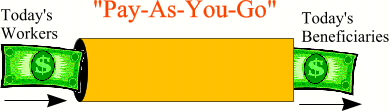
Many Americans are under the impression that it works exactly like a retirement fund, not a pay-as-you-go system. Hence the Ponzi-like deception that well-lauded, Keynesian economist Paul Krugman pointed out back in 1996. As the SSA illustrates (see below), Social Security is a pay-as-you-go system, not a Ponzi scheme. As I have explained before, Social Security does not mean you have a personal retirement account with your name on it. The money you put in now goes to fund today's beneficiaries, not you. Although the intent is not to defraud the beneficiary, the effect (i.e., the structure of having today's financiers pay for today's beneficiaries) is analogous.
I don't find Perry's analogy to be transferable to Social Security. However, when looking at Social Security, I would contend that it is actually worse than a Ponzi scheme.
The Left, like those at the Center for Economic and Policy Research, point out that there is no deception involved. The Social Security Administration (SSA) has annual actuarial publications showing how much money there is (for whatever that is worth). I'm all for transparency, particularly when it comes to my tax dollars. However, if that were the sole factor, I wouldn't have a need to kvetch.
Many Americans are under the impression that it works exactly like a retirement fund, not a pay-as-you-go system. Hence the Ponzi-like deception that well-lauded, Keynesian economist Paul Krugman pointed out back in 1996. As the SSA illustrates (see below), Social Security is a pay-as-you-go system, not a Ponzi scheme. As I have explained before, Social Security does not mean you have a personal retirement account with your name on it. The money you put in now goes to fund today's beneficiaries, not you. Although the intent is not to defraud the beneficiary, the effect (i.e., the structure of having today's financiers pay for today's beneficiaries) is analogous.
The fact that the SSA clearly illustrates this on their website does not change the typical American's deception. The demographic change of the Baby Boomers retiring means that you cannot take out more than you put into the Trust Fund forever. If you think that this is not an issue, the New York Times already reported last year that the Social Security's payout exceeded the pay-in. This reality will be more pronounced when Social Security disability is supposed to run out of money in 2017, whereas the Trust Fund is to be depleted in 2037.
Another point of deception is that Americans are guaranteed to their Social Security benefits. Contrary to popular belief, the Supreme Court already ruled in the case of Flemming v. Nestor (1960) that Social Security is not a guaranteed entitlement.
For those of us who find out the insolvency of Social Security, not to mention the sub-par rate of return, what happens if we don't want to put into the system? In Ponzi, once I figure out how the scheme works, I can say "no" and subsequently would be able to get out of it. Once the scheme is totally exposed, it collapses. Not so with Social Security. If I opted to not pay my Social Security taxes, I would go to jail. I already know that doesn't get invested in a personal retirement account (PRA). In short, I am de facto coerced into putting into the Trust Fund and paying for current beneficiaries.
Coercion coupled with insolvency do not bode well for future generations. I would like to see privatization of Social Security. Although that would give an individual the highest rate of return, this will most probably not be a politically salient option (e.g., Bush's failed attempt to privatize Social Security). What we'll most likely see are more short-terms solutions such as raise the retirement age, raise taxes (which has been done multiple times already), a decrease in benefits, or perpetuate the status quo. Whatever the United States government does, I know that I won't be relying on Social Security as a retirement fund.
Friday, September 16, 2011
Some Thoughts on the Census and Poverty Indicators
Since the release of the Census data on poverty, the media has pointing out the conclusion of the data, which is that nearly one in six Americans are poor (which is 46.2 million!). Even the British and the French have picked up on this bit of news. (This chart from CNN shows the state-by-state breakdown of poverty rate according to the Census data) With the prolonged economic issues, I can see why the release of these findings would spur hullabaloo. And it should be no surprise that the Left jumped on this data and essentially cried "class warfare." The Left-leaning Center for American Progress analyzed the Census' news, and predictably concluded that we need to pass Obama's American Jobs Act, as well as increase spending on entitlement programs and further tax the rich.
If we were to take the Census findings at face value, we would think that America is worse off than ever. I'm not going to say that this recession has not been a burden on the American economy, and thus, the American people. It has! However, to measure poverty based on income, even if that is based on inflation-adjusted dollars, is methodologically flawed.
As The Economist states, "The Census Bureau's definition of 'poverty' is about as informative as the Justice Department's latest definition of 'enemy combatant.' It's not to be taken for granted." The main gripe in the previously cited Economist article is that various forms of government assistance do not count. This would include such benefits as government-assisted medical care (e.g., Medicare, Medicaid), food stamps (as well as other forms of welfare), and the Earned Income Tax Credit (note pages 52-68 for distribution rates based on income). The fact that these benefits are not factored into the Census Bureau's definition of poverty already makes their findings of "one in six is poor" suspect.
If we were to take the Census findings at face value, we would think that America is worse off than ever. I'm not going to say that this recession has not been a burden on the American economy, and thus, the American people. It has! However, to measure poverty based on income, even if that is based on inflation-adjusted dollars, is methodologically flawed.
As The Economist states, "The Census Bureau's definition of 'poverty' is about as informative as the Justice Department's latest definition of 'enemy combatant.' It's not to be taken for granted." The main gripe in the previously cited Economist article is that various forms of government assistance do not count. This would include such benefits as government-assisted medical care (e.g., Medicare, Medicaid), food stamps (as well as other forms of welfare), and the Earned Income Tax Credit (note pages 52-68 for distribution rates based on income). The fact that these benefits are not factored into the Census Bureau's definition of poverty already makes their findings of "one in six is poor" suspect.
The even bigger distortion of the Census Bureau, thereby making their data misleading, is that their findings do not take consumption into consideration. Income is relative to the amount that one can consume. Freakonomics outlined this point out quite nicely a couple of days ago, and they even used data a recent study done by Professors Bruce Meyer and James Sullivan concurring with this idea. Even consumption reports from the U.S. Energy Information Administration show the consumption patterns of the poor from 2009. Looking at the EIA's data, I found some interesting facts, such as 98% of poor people (i.e., those with a household income less than $20K per annum) have at least one television, 83.5% have air conditioning, 48.1% have at least one computer, and a good majority have stoves, ovens, dishwashers, and refrigerators. When looking at the consumption-based measurements of the poverty gap, the gap is actually falling, not rising like it is in income-based.
This should certainly give us some thoughts in terms of how to handle poverty-related issues. Although we are currently in a "sluggish recovery," is it as bad as the media is making it out to be? Not at all. We should not give into the socialist impulse to want to give handouts out of some feeling of guilt. Rather than further burden the economy with entitlement spending that does nothing to resolve poverty in the long-run, we need to tackle root problems, mainly that of employment, education, and family composition. Once we recognize core issues, those who can be classified as genuinely poor can begin to see the light at the end of the tunnel.
Tuesday, September 6, 2011
Let's Shut Down the Post Office!
Not too long ago, the New York Times lamented over the possibility that the United States Postal Service (USPS) might not be operating as of the beginning of the next calendar year. The USPS has seen declining revenues for some time, mainly due to e-mail being a more-commonly used substitute good for going to the post office for first-class mail. The other issue is that 80% of the expenses for the USPS are in labor, as opposed to the 53% at UPS or 32% at FedEx.
The fact that the contracts for USPS employees comes with no-layoff clauses only exacerbates the situation when labor accounts for most of the budget. The USPS also has to contend with having to provide universal service, work six days a week, and keep open facilities, half of which, are not even needed. Although there are those who criticize the passing of the Postal Accountability and Enhancement Act (PAEA) back in 2006, which mandated that the USPS pre-fund retiree health benefits, it is rendered moot by the USPS' admission (p. 22 of GAO report) that these benefits would have needed to have been funded regardless of the PAEA. Therefore, it was not so much Bush's fault as it was the unionism of the USPS that put these lavishing retirement benefits in their contracts in the first place.
We also have to deal with the quasi-governmental nature of the USPS. Although the USPS is an organization that is set up on a business model, as well as not receiving government appropriations, it nevertheless has oversight from the Postal Regulatory Commission (whose members are selected by the President of the United States) and has a federally mandated monopoly on first-class and standard mail delivery.
The real question here is what is to be done with regards to this issue.
It should be obvious that passivity will do nothing but close down the post office. Cutting jobs by 120,000 has recently been proposed. The USPS would have to find a way to break the no-layoff clauses in the contracts. And even if they could, it would have a ripple effect by striking a coup fort to the labor movement. Raising the stamp prices is an option, but it would not be viable in the long-run since that would push people towards using the Internet all the more. Cutting out Saturday deliver service has been suggested before, but has yet to be implemented. Cutting back on the health-care benefits brought about by collective bargaining, benefits that the GAO (p. 28) recognize as "more generous than most other agencies," will receive too much retaliation to ever get scaled back. The backlash would be comparable for any attempt to close facilities that are costing the USPS money.
Being a libertarian, my prescription should not surprise any of us. Let's privatize the postal service! And I don't mean the quasi-private/quasi-governmental mess we currently have that ranks very low in terms of postal freedom. Let organizations such as UPS and FedEx deliver my mail. This idea is anything but original. Other countries have tried it and succeeded. Take Germany for example. The Deutsche Post privatized back in 2000. Guess what their profit report for 2010 was? The actually made a profit of €2.541 billion ($3.58 billion USD). The Dutch-based business that provides mail to Holland, also made a profit of €347 million.
As much as I would love to see a postal system incentivized by competition to innovate, thereby bringing postage costs down and deliver in a more efficient manner, I regrettably predict that this fiasco will end in another bailout done under Obama's watch.
Addendum 3-13-2015: The Cato Institute published an article on why the U.S. government should get out of the postal industry.
Addendum 11-2-2015: While I don't agree with the author's conclusion of keeping the USPS, I do overall agree with the Brooking Institution's assessment of the USPS' obstacles.
The fact that the contracts for USPS employees comes with no-layoff clauses only exacerbates the situation when labor accounts for most of the budget. The USPS also has to contend with having to provide universal service, work six days a week, and keep open facilities, half of which, are not even needed. Although there are those who criticize the passing of the Postal Accountability and Enhancement Act (PAEA) back in 2006, which mandated that the USPS pre-fund retiree health benefits, it is rendered moot by the USPS' admission (p. 22 of GAO report) that these benefits would have needed to have been funded regardless of the PAEA. Therefore, it was not so much Bush's fault as it was the unionism of the USPS that put these lavishing retirement benefits in their contracts in the first place.
We also have to deal with the quasi-governmental nature of the USPS. Although the USPS is an organization that is set up on a business model, as well as not receiving government appropriations, it nevertheless has oversight from the Postal Regulatory Commission (whose members are selected by the President of the United States) and has a federally mandated monopoly on first-class and standard mail delivery.
The real question here is what is to be done with regards to this issue.
It should be obvious that passivity will do nothing but close down the post office. Cutting jobs by 120,000 has recently been proposed. The USPS would have to find a way to break the no-layoff clauses in the contracts. And even if they could, it would have a ripple effect by striking a coup fort to the labor movement. Raising the stamp prices is an option, but it would not be viable in the long-run since that would push people towards using the Internet all the more. Cutting out Saturday deliver service has been suggested before, but has yet to be implemented. Cutting back on the health-care benefits brought about by collective bargaining, benefits that the GAO (p. 28) recognize as "more generous than most other agencies," will receive too much retaliation to ever get scaled back. The backlash would be comparable for any attempt to close facilities that are costing the USPS money.
Being a libertarian, my prescription should not surprise any of us. Let's privatize the postal service! And I don't mean the quasi-private/quasi-governmental mess we currently have that ranks very low in terms of postal freedom. Let organizations such as UPS and FedEx deliver my mail. This idea is anything but original. Other countries have tried it and succeeded. Take Germany for example. The Deutsche Post privatized back in 2000. Guess what their profit report for 2010 was? The actually made a profit of €2.541 billion ($3.58 billion USD). The Dutch-based business that provides mail to Holland, also made a profit of €347 million.
As much as I would love to see a postal system incentivized by competition to innovate, thereby bringing postage costs down and deliver in a more efficient manner, I regrettably predict that this fiasco will end in another bailout done under Obama's watch.
Addendum 3-13-2015: The Cato Institute published an article on why the U.S. government should get out of the postal industry.
Addendum 11-2-2015: While I don't agree with the author's conclusion of keeping the USPS, I do overall agree with the Brooking Institution's assessment of the USPS' obstacles.
Subscribe to:
Posts (Atom)