Monday, July 14, 2014

Taking Interest in the Export-Import Bank and Whether Its Charter Should Expire

There has been a lot of hullabaloo lately, particularly in the think-tank world and the libertarian blogosphere, about the Export-Import Bank, also known as Ex-Im. What is the Export-Import Bank? It is the official export credit agency of the United States federal government. What this means is that Ex-Im finances corporations with government-backed loans to finance the foreign purchase of United States goods for customers incapable of taking on the risk. Think of it as the IMF's role "lender of last resort," except on a national level. Although the Ex-Im has been around since 1934, its charter is up for reauthorization this September. Unless Congress votes to reauthorize the charter, the Ex-Im will cease to exist. Proponents of Ex-Im believe that the Bank serves a vital role of stimulating the American economy. Opponents view Ex-Im as a form of corporate welfare with little to no benefit to anyone else. Who is right? Should we even care about the fate of Ex-Im? Let's take a closer look as to what Ex-Im actually does.

Ex-Im subsidizes American exports through government direct loans and loan guarantees to other countries. According to Ex-Im, not only do they "turn export opportunities into real sales," but the idea behind this intervention is to "level the playing field" because if other governments are doing it, why shouldn't we? Ex-Im naturally wants you to believe that they make a positive difference. It's called self-preservation. However, since it is a financial institution that deals with numbers, it should be relatively easy to measure the fiscal magnitude of such government interaction.

The Congressional Budget Office (CBO) recently published a report on Ex-Im and its costs. When assessing costs here, one has to be able to differentiate between the FCRA's (Federal Credit Reform Act) method of accounting, which the Ex-Im uses, versus fair-value accounting. The CBO describes this in further detail. What fair-value accounting accounts for [that the FCRA does not] is the idea of market risk. The Wharton School's Financial Economist Roundtable, Price Waterhouse Cooper, and the Harvard Business Review also found fair-value accounting is preferable because the accounting process Ex-Im uses understates the costs of Ex-Im's programming. What the CBO found in its study on Ex-Im is that when using fair-value accounting, Ex-Im actually costs $1.6B over the next decade (CBO, p. 2), which is different from the $14B gain that proponents tout.

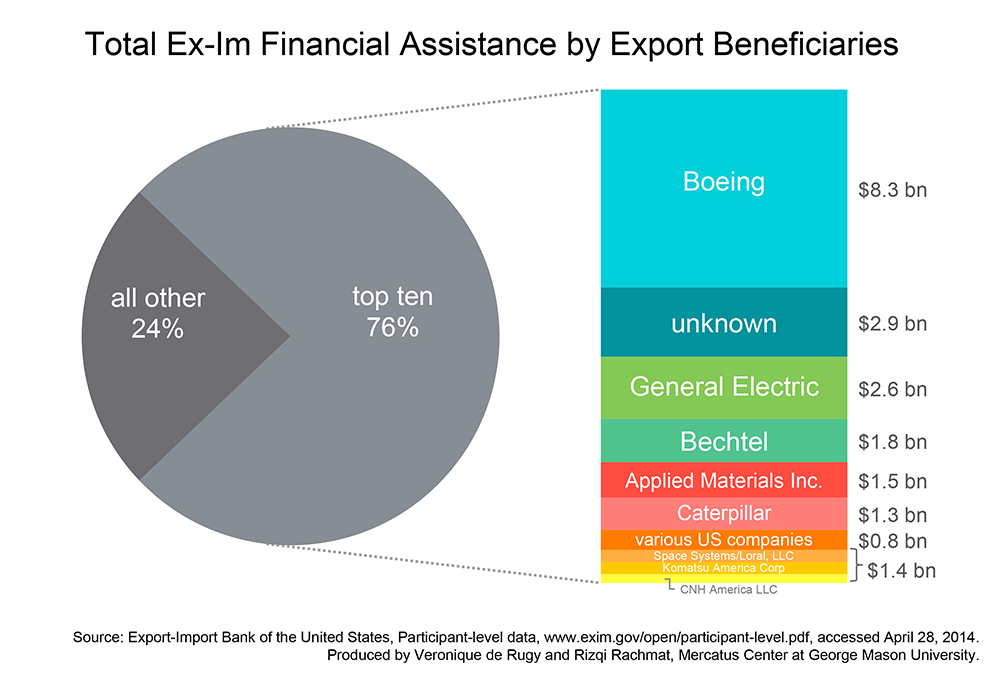
Furthermore, we should not substitute political decision-making for market-based decision making. Why? Because when you do that, you heavily subsidize large companies that milk the system to further line their pockets. In spite of Ex-Im's claim that 90 percent of its transactions are with small businesses, the vast majority of the money that Ex-Im loans goes to large corporations. Take a look at the firms that receiving funds, and it reeks of corporate welfare: Boeing, Caterpillar, General Electric, Ford, Exelon.


What doesn't help is the recent charges of fraud. It doesn't exactly help that only a third of its portfolio goes towards offsetting foreign subsidies, which is its primary goal. Even the jobs numbers that it claims are most probably overstated (General Accountability Office, 2013). What annoys me about proponent claims is that the claim of jobs numbers and export numbers assumes a static model, i.e., if Ex-Im, nothing would replace it, which is decidedly not the case. It's hard to see the victims because we cannot simultaneously compare the net economic benefits of a hypothetical world without the Ex-Im. If we take a brief look at the economics of export subsidies, export subsidies reduce world consumption and consumer efficiency. Looking at the evidence I have already presented, theory seems to line up with practice.

The 98 percent of the $2.2T in annual exports America already have private loans and function just fine. In a $1.6B loss in ten years is small in an economy that has a GDP of $16T a year, yes, this is relatively small. Even with its $107B portfolio ($113.8B according to the Congressional Research Service), it's a drop in the bucket compared to what the Federal Reserve Bank does. This would not be a solution to deal with the size of the federal government debt, but rather send the message that corporate welfare and crony capitalism, or what I like to call "crapitalism," are unacceptable. The symbolism behind Ex-Im acts more as a litmus test of small government than anything else.

It doesn't matter if we stop with the protectionism and other countries don't because they are still harmed. Just because other countries metaphorically jump off the bridge with their protectionist policies doesn't mean we should follow suit. There are better ways of going about improving the state of our exporters without subsidizing them, which is all the more true since the largest beneficiaries are large corporations that can easily adjust their financial practices. Reduce regulatory burdens. Make meaningful tax reform, particularly with the corporate tax. We don't need an Export-Import Bank financing large companies to improve upon our economic wellbeing, and that really should be the message behind allowing Ex-Im to end its charter.

8-27-2014 Addendum: The Mercatus Center presents a good argument against export subsidies in the video below.


Friday, July 11, 2014

A Call for China and the United States to Develop More Constructive Relations

It's the diplomatic event of the year as far as Sino-American relations are concerned. July 9-10, 2014 marked the sixth annual U.S.-China Strategic and Economic Dialogue (中美战略与经济对话). The purpose of such a gathering? To have high-level functionaries address the challenges of the political, geo-strategic, and economic issues between the two countries. While I would prefer them to have than diplomatic discussions over doing something like go to war, I still have to wonder how constructive such dialogues can be. This is particularly because one country views the party as adversaries in a zero-sum world.

Since it implemented the export-growth model, China has been very dependent on American consumption. China also fueled American consumption, which is why the two have developed an unhealthy dependence upon one another. There are also many issues that impede growth of Sino-American relations. Taiwan has been an issue for decades now, and given that Taiwan is more democratic in nature and Beijing is still hung up on its nationalism, I don't see that going away anytime soon. There have been increasing tensions in the East China Sea and South China Sea, not to mention the cyber attacks that have resulted in the indictment of five members of the Chinese army. National security issues such as these are contentious, and are more likely to be sorted out in a non-diplomatic arena, although if you are worried about balance of power, you'll need China's cooperation. Rather than focus on what cannot be achieved through these dialogues, how about what can be done to ameliorate Sino-American relations?

Economics seem like a good place to start. The United States should focus on helping China liberalize its markets instead of enacting tariffs or calling China a currency manipulator (because honestly, there are much more egregious culprits of currency manipulation going on out there). China should focus on liberalizing its markets, especially its capital markets, instead of giving into reactionary, corrupt politics. Giving a jumpstart to the bilateral investment treaty would do some good. The United States could remove its export controls on China, and China needs to stop erecting trade barriers. Protectionism only benefits the very few while causing net economic loss for many. Rather than view the other as adversaries or have conferences that cover too many topics for a two-day period, maybe they should view themselves as partners of engendering amicable relations via liberalized trade. A paradigm shift would go a long way in promoting proper economic interdependence.

Wednesday, July 9, 2014

Same-Sex Couples Can Parent Just As Well As Straight Couples, Which Means....

The legalization of same-sex marriage has been making headlines in America, but one topic that doesn't get as much attention is that of same-sex couples adopting children. What makes the issue of adoption intriguing is that you're not simply talking about a union between two consenting adults of the same sex. You are now throwing in another party, i.e., a child [or children]. As the thought-terminating cliché goes, "Think of the children!" Children are particularly interesting from a libertarian philosophy (see here, here, here, and here) because they aren't fully autonomous individuals with mens rea, but still deserve respect and consideration because they are human beings. As such, let's go with the assumption that the welfare of the child matters in this discussion.

Some will argue that it's because the optimal family arrangement is one's biological mother and father, and others will argue that having the biological differentiation of one mother and one father is best for the child as the basis for their claim. They argue that as such, same-sex parenting is not only not ideal, but can actually harm the child. I'll get into the probability of that being the case momentarily, but let's ask another question: what if they're wrong? What if by not allowing same-sex households to adopt, you keep the child in a considerably worse situation? If the anti-gay side is wrong in their claim, then they have actually caused damage of many children. There are many children who are in the foster care system. Although foster parents should be lauded for taking in these children, it's hardly a stable or emotionally healthy for the child. As Ezra Klein astutely points out, "The idea that there is something so wrong with same-sex households that it would be preferable for these children to go two or four or six years without parents--an idea, again, that has little to no evidence behind it, and that is in fact contradicted by most of the evidence--bespeaks a homophobia so deep that it is hard for me to believe it could persist long among people who actually know any children in the foster system, and who actually know many gay couples."

Whether we're talking about the social costs of carbon, whether guns kill people, or any other policy, we have to ask about burden of proof when someone is making a claim. In this instance, the anti-gay argument is that same-sex households are suboptimal. The burden of proof goes to whoever is making the claim of the existence of something, not the one being skeptical of the claim. If the burden of proof went to the skeptic, then we would have to accept the existence of flying unicorns and the Flying Spaghetti Monster. To avoid giving credence to unsubstantiated claims, we ask that people provide some sort of credible substantiation to support a claim. This is especially true when discussing public policy and peoples' lives are affected. One of the premises behind public policy is about being able to assess the risk of a "clear and present danger." Risk assessment, or more specifically, cost-benefit analysis, is vital to determining public policy, and if you're going to be spending taxpayer dollars or using the government to ban something, you better be able to come up with something other than your perception of what a family should like as a basis for policy, or G-d forbid, anti-gay biases. Otherwise, you'd open the floodgates of ridiculousness in the world of public policy, and we'd have to call on the government to prepare for a number of unsubstantiated threats, including an alien invasion, an infestation of leprechauns, the coming of the Rapture, or the invasion of Mozambique because you're under the misimpression that they are an actual national security threat.

If we're going to make a policy decision based on the claim that same-sex households are suboptimal, it better be backed up with evidence adequately describing the benefits and harms, or opponents should simply back off because they don't have a leg to stand on, which is also how I feel about those who say genetically modified food is bad for you. Asking for evidence to support a claim isn't to much to ask for, is it? I think not, but good politics has a propensity to get in the way of good public policy. With that out the way, let's take a look at that evidence, shall we?

For those whose raison d'être it is to undermine families with same-sex parents simply because the parents are homosexual, they go to the Regnerus study (2012) as "proof" because it's really the only study conducted that even can be misconstrued to suggest anything resembling evidence. First, I have to say it's ironic that the study is used this way because, even as Regnerus himself admits, his study provides no conclusions regarding the wellbeing of children in families run by same-sex couples. The issues with this study go beyond the fact that this was a study that was funded by a conservative anti-gay organization called the Witherspoon Institute, or that the peer-review process was rushed and poorly implemented. Regnerus' study did not have a sufficient sample size because all but two of the children did not from households initially led by different-sex couples. Those who are anti-gay want to complain about insufficient sample sizes. Is two a woefully small number for a sample size? For sure! And then there's the matter of not having a valid comparison group. You can't take children from unstable, opposite-sex households from "failed heterosexual unions" [that ultimately resulted in family dissolution] because the homosexual partner wanted to keep up the façade of being straight. Much like any of the other studies that have been fallaciously used to discredit same-sex parenting, they do nothing to measure the specific effects of same-sex parenting on the wellbeing of children.

If you're going to make an apples-to-apples comparison, you need the valid comparison group to legitimately make a claim either way (i.e., opposite-sex families with roughly the same means and resources as same-sex couples so we can isolate the sexual orientation of the parents), which is why I was happy to see this very recent study that came out of Australia (Crouch et al., 2014). As far as sample sizes go, it's the largest of any study ever conducted on the topic, not to mention that given the number of same-sex couples in Australia (Crouch et al., p. 1), it's a good representation of the demographic. Not only does this study negate any misconceptions on the anti-gay side, but the study went as far to conclude that even in spite of stigma that the children receive because their parents are homosexual, children of same-sex couples actually fare better. It might have something to do with same-sex parents taking on roles that are suited to their skill sets as opposed to traditional gender stereotypes, but it also might have to do with the fact that since one cannot "knock up the other partner" in homosexual sex, the same-sex couple makes a conscientious decision to have children because they are usually at a point in life where they can handle the responsibilities of childrearing.

Even if you want to argue that Australian cultural norms aren't 100 percent importable or that the study surveyed those who consented, the findings in the Australian study are consistent with years of methodologically sound social science research shows that there is no qualitative difference between same-sex parenting and opposite-sex parenting. If you need more examples of this consensus, then how about a thirty-year longitudinal meta-analysis by the American Academy of Pediatrics (Perrin et al., 2013) or a number of other studies representing the scientific consensus essentially concluding the same thing (e.g., Bos et al., 2014; Farr and Paterson, 2013; Goldberg and Smith, 2013; Lavner et al., 2012; Potter, 2012; Farr et al., 2010; Patterson and Wainwright, 2007; Short et al., 2007; Tasker, 2005)?

What goes into the wellbeing of a child are the relationship between the two parents, the relationship that the parents have with the child, as well as socioeconomic resources. As much as it kills social conservatives (especially those who use the nirvana fallacy only for studies that disagree with their viewpoint), the gender or sexual orientation of the parents are a negligible determinant in the wellbeing of children, especially in comparison to the aforementioned factors. Not only can we see that is the case in these studies, but the anecdotal evidence becomes apparent when people actually meet families with same-sex couples and realize that they function like any other family. It is the sort of compelling nature of the overwhelming evidence that helped the Supreme Court Justice rule 5-4 in United States v. Windsor that DOMA was unconstitutional, and it will continue to be the sort of evidence that will continue convincing people that same-sex couples can parent just as well as opposite-sex couples. What does this mean for the other side? It means that the shaky foundation upon which their arguments were based are crumbling at a faster rate than anticipated, and thusly have one less argument to relegate homosexual individuals to a second-class citizenry. Misconceived arguments based on shaky, tenuous evidence have no place in public policy, and I am glad to see that such arguments have less and less influence in American politics. May this sort of methodology extend to all areas of policy!

Monday, July 7, 2014

Being Able to Thank G-d for Our Struggles (And Not for The Reasons You Think)

It is not uncommon for Jews to view prayer as a way to communicate with G-d. To quote R. Jonathan Sacks from the Koren Siddur (p. xxxii), "In prayer, we speak to G-d. Through Torah G-d speaks to us. Praying, we speak. Studying, we listen." While I agree with the importance of verbalizing one's prayers, my apprehensions go beyond "If G-d is omnipresent and omniscient, doesn't it defeat the purpose of prayer?" While that question is important, there is the issue of G-d's Infinite Oneness. Since G-d is infinite, by definition, G-d is not finite. That might seem like a tautology, but it's worth uttering. Why? There is necessarily a gap between the infinite (i.e., G-d) and the finite (e.g., humans) because G-d exists neither in time nor space. That is what infinity, i.e. G-d, conceptually is. This means that the conversation actually turns into a monologue. Fortunately, this does not have to change the Jewish definition of prayer. When we talk about "prayer" in English, we are unsurprisingly taking it from the Christian definition. The word "prayer" actually comes from the Latin word precare (to beg). It would explain why Christians, and Catholics in particular, get on their knees to pray. In Judaism, it's different because we stand before G-d when we pray. The Hebrew word that is commonly mistranslated as "prayer" is תפלה. The word תפלה comes from the Hebrew reflexive verb התפלל, which means "to judge oneself." Using etymology, Jewish prayer is a moment of self-evaluation, self-reflection, and a medium to assess our relationship with G-d, what it means, and how we can improve upon that rapport.

It was during such a davening session that I had one of these epiphany-like moments. When one wakes up in the morning, there are a series of blessings that are recited. There are three that are in dispute between the Conservative and Orthodox movements. Although I'm not going to get into all three, one of them has to do with thanking G-d for one's Jewishness. Orthodox practice is to recite the blessing [in the negative] of "not making me a Gentile" (שלו עשני גוי), whereas the Conservative movement prefers the blessing of "making me a Jew" (שעשני ישראל). I don't want to get into the debate of which is "more halachic" or "are there other ways of reforming the blessing without 'destroying the halacha'" because it detracts from the insight I was able to glean from the modification in the blessing.

Before continuing with the insight, however, I do want to say that I prefer the more positive affirmation because I prefer emphasizing who I am versus who I am not. I find that affirming who I am without demeaning others in the process is preferable to essentially saying "Thank G-d I'm not one of them." [Side note: Given the historical context of relations between Jews and non-Jews when these blessings were created nearly two millennia ago (e.g., Jews were surrounded by pagans; the Jews were exiled by non-Jews in 70 C.E., which is an event that shaped Judaism as we know it today), it made more sense to frame the blessing as such. However, given that relations with non-Jews are better, it seems more sensical to opt for the blessing in the positive.]

What did I find about שעשני ישראל to be so intriguing? Although the word "Jew" being used in this blessing is Israel (ישראל), the word ישראל literally means "[he who] struggles with G-d." When I thought of being part of the people Israel in that way, I translated the meaning of the blessing in my mind to conceptualize it as "Thank you G-d who made me to be someone who struggles with G-d." Why in the world would I be thankful for struggle? Isn't struggle supposed to be difficult and arduous? Yes, which is why I found this realization to be so fascinating.

In Christianity, a Christian finds solace in accepting Jesus as their savior. In Buddhism, one strives to reach nirvana by detaching oneself from the suffering of worldly attachments. In Judaism, G-d has given us the opportunity to not only find spirituality in the everyday and the mundane, but to do so while struggling. While תפלה certainly has its emotive qualities, it's about processing what we know about what is going on in the world and how Judaism perceives G-d.

I don't subscribe to גם זו לטובה ("this too is for the best") or that G-d is testing me with life's challenges (Infinite G-d, remember?). I do, however, take life's challenges as an opportunity to learn and better myself. Although it is difficult, I am doing my utmost to take a negative and gain whatever positive lessons I can. I know there is a lot of evil in the world that is difficult to explain, but it is better than a world without pain or suffering. This might seem counterintuitive, but hear me out.

Imagine a world without pain or suffering. It sounds idyllic, but it would get boring really quickly. I think of struggles as a necessary evil because it helps give our lives meaning, as well as gives us a reason to connect to others because if we had all of our physical or spiritual needs provided for, why do we need others in our lives? Struggle is a great developer of character, and I find that I am a lot stronger and wiser as a result of what I have had to endure in life. In all honesty, which feels more meaningful: gaining something because you worked through it or because it was handed to you? As a result, I have also realized that life is not about ephemeral enjoyment of the physical, but also has a deeper spiritual understanding that comes with having an element of struggle in our lives.

In summation, religiosity and spirituality don't have to translate into complacency, passivity, or blind acceptance to G-d. It means that we keep the metaphorical conversation going with G-d. It means we continue to ask the big questions and go about our religious practice while grappling with the pains, travails, and difficulties that life has to throw at us. It paradoxically means that we live a much more meaningful life, and for that, I am thankful.

Friday, July 4, 2014

Let's Trash Plastic Bag Bans and Taxes

We've come a long way since the inception of the modern-day environmentalist movement. People recycle more, are modeling businesses to incorporate green practices, and are slowly but surely switching over to alternative fuels. The progression of environmental conscientiousness in recent years is quite astounding. An issue with it, however, is that there is a large element of feel-good environmentalism. What good is saving the planet when the only thing your actions are patching up is your ego? I have to ask whether a plastic bag ban or tax falls under that category, especially after reading a recent study from the Reason Foundation on the matter (Morris and Seasholes, 2014).

Let's start with what plastic bags are made of. Many think that plastic bags are solely a petroleum-based product. In reality, the vast majority of plastic bags are made of polyethylene. Polyethylene is derived from natural gas and crude oil. One of the other main issues with plastic bags is that they are  not necessarily reused, which means they create more litter. The plastic bag floating in the air or polluting our coastlines are illustrations as reasons for plastic bag bans or taxes.

When we look at what we should do about plastic bags, or any policy question for that matter, we have to keep in mind that we do not live in a perfect world. Any policy alternative is going to have its tradeoffs. Economics is the study of how to best allocate resources. Public policy is the study of finding the best policy in comparison to other policy alternatives. When looking at plastic bags and their alternatives of paper bags and reusable cotton bags, we should not ask if plastic bags have any costs because they do. What we should be asking is whether the overall costs of plastic bags are less relative to paper bags and reusable cotton bags or not.

In the grand scheme of things, how much do plastic bags contribute to the overall percentage of litter? On a global level, less than one percent of crude oil and natural gas are used to produce polyethylene, which says nothing about how much of polyethylene production is used for plastic bags. We should ask ourselves if there would be less consumption of plastic. Many use Ireland as an exemplar for action against plastic bags. However, the state of Connecticut Office of Legislative Research conducted research on the plastic bag tax, and showed a rebound effect. Although the plastic bag ban decreased plastic bag consumption in Ireland by 90 percent, it also substantially increased consumption of bin liners, which require more energy and crude oil to produce.

The chic alternative is using reusable cotton bags. Cotton bags come with some health issues that don't come with plastic bags, such as a 25 percent increase in ER visits related to food borne illnesses, not to mention that nearly half of reusable cotton bags contract coliform and that 12 percent of reusable bags contracted E. Coli (Klick and Wright, 2012; Williams et al., 2011; Gerba et al., 2010). There is also the issue of the number of inputs that go into making a reusable cotton bag. According to the U.K. Environment Agency (2011), the "global warming potential" impact of plastic bags (read as "the amount of resources needed to produce these bags) are a quarter of paper bags and 1/173rd of cotton bags, i.e., it takes 173 uses of the cotton bag to break even. How many people can honestly say that they use their cotton bag 173 times? The study shows that most people use their cotton bags a little over 50 times. And 173 times is merely the break-even point!

None of this goes into the complacency bred by feel-good environmentalism, the 31,000 jobs that would be lost in the United States if we banned plastic bags, the convenience factor of having plastic bags, the costs to consumers and retailers (Morris and Seasholes [2014], p. 53-56), or the fact that a plastic bag ban would do nothing to reduce municipal waste collection costs. There seems to be a certain evasion of personal responsibility here. When talking about guns, the mantra is "Guns don't kill people, people do." It's true in that case, and for plastic bags to be littered, they need to be discarded by human beings. "Plastic bags don't litter, people do."If there were to be an issue with the plastic bags, it would be the attitudes towards consumption and waste disposal of our throw-away society.

In summation, switching over to paper bags or reusable cotton bags is not going to help the environment. If anything, it will slightly increase humanity's footprint. If you want to address the root problem, address our materialism and our propensity to consume. Encourage people to reuse and recycle their plastic bags. Stop subsidies on oil so that we can have a better appreciation for petroleum products at fair market value. If people want to use reusable bags, that's their own prerogative. If people want to use plastic bags, that should be their own business, but enacting a plastic bag ban or tax to boost an environmentally-conscious ego is simply rubbish.

Wednesday, July 2, 2014

Harris v. Quinn: Can Public Sector Labor Unions "Do Business As Usual?"

There has been plenty of political commentary lately on the Supreme Court's decision this past Monday that for-profit organization cannot be mandated to provide contraceptive services for their employees. While I enjoy the controversy behind birth control, there was another Supreme Court ruling that day which piqued my interest even more so: Harris v. Quinn. By a 5-4 vote, what the Court did was state that health care workers cannot be forced to financially support a union that they would rather not join. This ruling was what the AFL-CIO is calling an "assault on wages and the middle class," but in reality, this ruling was limited in scope because these health care workers were not "full-fledged public employees," which means that this ruling does not apply to a vast majority of public union workers. Although I would have much preferred a blanket prohibition of mandatory union dues [via the overturning of Abood v. Detroit Board of Education], I am glad to see that the Supreme Court has at least some respect for freedom of association. Perhaps the Supreme Court will make a more sweeping ruling in the future.

While we wait for that possible future, let's ask ourselves something in the interim. Can unions keep doing business as usual?

Aside from being a political activity, to put it in economic terms, collective bargaining is a monopoly or cartel with similar effects to a price floor above the equilibrium point, which creates a higher wage (Schmitt, 2008) at the expense of inefficient allocation of resources (Anzia and Moe, 2013), as well as less profits and fewer jobs (Holcombe and Gwartney, 2010). If public sector labor unions are that great, the should be able to survive without mandatory fees. The fact that coercing union fees is required says a lot about the declining quality of labor unions. If public sector unions want to survive, they need to adapt to the 21st century. The public sector union compensation mechanisms need to be modified because they are making up for an increasingly large amount of government outlays.

Since businesses don't run themselves in a top-down fashion like they used to, perhaps employee involvement (EI) programs could work. How about relinquishing some of that collective bargaining power? Opening public sector unions to market forces would be a healthy thing. Relinquishing some bargaining power helped in Wisconsin and Indiana (Barro, 2012). Although there might was a time when worker abuses were rampant and unions were needed, public sector unions have reached the point of having too much power and function like labor cartels. Unless public sector unions become adaptable to a more competitive market, we won't even need to wait for another Supreme Court ruling to relegate public sector labor unions to the dustbin of history.


1-7-2018 Addendum: The American Economic Association just released a paper showing that teacher collective bargaining leads to students having average reduced earnings of $800 (2 percent) and decreases the average work week by 0.5 hours (Lovenheim and Willen, 2017). This indicates that in aggregate, teacher collective bargaining reduces annual total earnings by $196 billion in the United States.

Tuesday, July 1, 2014

How to Respond to Scumbags That Murder Innocent Israeli Teenagers

About three weeks ago, three Israeli teenagers were kidnapped by terrorists (well, one was technically American, but the news is still dismaying). Hope of returning the boys to their parents dissipated when their bodies were found yesterday. This sad news was overshadowed by the Supreme Court ruling on contraception and the World Cup, but the news wouldn't and didn't get past the Jewish people. The Jewish people, religious and secular alike, were appalled, mortified, and dismayed at what happened to these three teenagers.

My initial reaction was not quite that way. It was one of hopelessness and increasing apathy. It felt like the cycle of violence in that part of the world was never going to come to an end. "Hamas and Fatah will never stop hating Israel. It's just the way things are. Plus, murder is an unfortunate facet of human existence. It's statistically bound to happen. Any murder is a hate crime because it shows the individual's lack of respect for the dignity of man. The more things change, the more they stay the same." That's how I felt when I first heard the news.

Then I had some other thoughts that ran through my head, ones that were more along the lines of moral indignation. "Not only did they commit murder, but they maimed these young, innocent teenagers simply because they were Jewish. There are still people out there who hate Jews for simply being Jewish. Antisemitism is alive and kicking, and we shouldn't become numb and passive simply because it's reality."

So how is one to react?

First, if you feel that you need to go through a mourning or grieving process, go through the cycle. One has to process the hurt and loss that comes with this sort of tragedy. This is a fortiori true if you personally knew the victims.

As for the Israeli government's reaction, that one is trickier because international relations are inherently so, especially in that part of the world. Throw in halacha, and it's even more complicated. Normally, I would cite Berachot 10a and say that we should pray that the murderers repent for what they have done. However, murder is such an egregious act that not even teshuvah is particularly going to help in this case, and not simply because it is considered one of the seven Noachide Laws that even non-Jews should follow. Why the egregiousness? One of the prerequisites in the teshuvah process is being able to ask the individual you wrong for forgiveness. This doesn't work in the case of murder because the victim that needs to be recompensed is no longer alive. In Judaism, only the victim of a crime or sin committed bein adam l'chavero can grant forgiveness. Since the victim is unable to do so, murder is unforgivable and no matter what the perpetrator does, he can never fully atone for this particular sin. It's why murder is one of the three sins for which a Jew should rather martyr himself, and it's why the Torah proscribes the death penalty (Numbers 35:31), even though the death penalty has not been enacted in ages. Also, it's not as if this were involuntary manslaughter, for which the Torah proscribes a different penalty. This was callous, first-degree murder. Normally, I would not advocate the death penalty, but assuming that hell exists, there is a special place in hell for these ingrates to burn because they have squandered whatever divine potential they might have [had]. Once the Israeli government tries these suspects in a court of law, and if they find them guilty, I would have no problem with the death penalty in this case, given the heinousness of the crime.

If it were only an issue of a hate crime, I would confine the moral indignation to the murderers. However, Hamas fired rockets into Israel again, and given that Fatah recently formed a coalition government with Hamas, that makes the entire Palestinian, governmental entity culpable. It's as if Hamas were provoking Israel into war, at which point Israel would naturally be blamed by the vast majority of the international community because that is the pervasiveness of the anti-Israel bias in much of the world. Whatever response the Israeli government is, it needs to be firm and resolute. Offhand, I don't know what that should look like in practice, and I don't know how that will end up. What I do know is that Israel cannot continue to turn the other cheek, and the Israeli people should pressure its government to act accordingly.

Aside from that, the Jewish people should double down. What do I mean by that? For those of us not living in Israel, we should be more ardent supporters of Israel. Buy Israeli goods, send tzedakah Israel's way, act as advocates of Israel by informing the greater world as to why Israel is an overall good country that is worth protecting. Whatever is in our power to do to help, we should do.

We should also remember that these scoundrels murdered Jews simply for being Jews. Instead of shying away from our Jewishness, we Jews should double down on that, as well. If you haven't been observant in a while, I ask that you find a mitzvah, a single mitzvah, that you find meaningful, and incorporate that in your lives as a way to honor the memories of these boys. If you are practicing mitzvahs, find one that could use some work or find a way to enhance it, and do this life-affirming act to honor their memories. Even for those of you that are reading this and are not Jewish, I ask that you join the Jewish people in solidarity because murdering someone simply for who they are, regardless of religion, is unacceptable.

The best way for Jews to honor these slain individuals is to show that we value life and that will continue to hold to the values that make the Jewish people a light unto nations. I hope that the Jewish people find strength and unity in this tragic moment in order to affirm who we are, what we stand for, and that anti-Semitic scum of the earth cannot so easily get rid of the Jewish people. Am Yisrael chai!