Showing posts with label Face Masks. Show all posts

Monday, November 18, 2024

Public Health "Experts" Did Not "Follow the Science" During the Pandemic: 2024 Edition (Part II)

Misinformation was abound during the COVID pandemic. It did not come from the skeptics, but from the so-called public health "experts," as well as governments purportedly fighting misinformation to deflect from its own misinformation campaign. Speaking of which, the House Subcommittee on Oversight and Investigations recently released a report criticizing "We Can Do This," which was a $900 million HHS advertising campaign aimed at promoting various pandemic measures. Whereas Part I of this blog series focused on the scientific aspects that had public policy implications (e.g., natural immunity), this Part will cover the misinformation from the U.S. federal government that was masquerading as science. More specifically, I will use the aforementioned House report to illustrate the misinformation.

Vaccine misinformation. It is true that the Pfizer vaccines were shown to be 95 percent effective at preventing disease. However, the Food and Drug Administration made clear in its December 2020 emergency use authorization announcement that they did not know how long the vaccines last nor that it would prevent COVID transmission (House, p. 8). As I pointed out in October 2022, the Pfizer CEO did not know either. This misinformation is significant because the CDC was pushing vaccines to get back to "a pre-pandemic normal," even saying that "you will not get COVID if you get vaccinated" or that "vaccinated people do not carry the virus." This argumentation was the basis for COVID vaccine passports and vaccine mandates, and yet it turned out to be unsubstantiated.

Face mask flip-flopping. At the beginning of the pandemic, the Surgeon General, the World Health Organization, and even Dr. Anthony Fauci, the man who claims that he represents science, were against the use of face masks (House, p. 10). In April 2020, the CDC did an about face and campaigned for mask wearing, even though there was zero scientific rationale for the about face. 

This reversal set the scene for other inconsistencies in messaging, a topic I covered as early as May 2021. By the end of 2020, the WHO had limited and inconsistent evidence on face masks for healthy individuals, which is hardly "following the science." Although the data were becoming clearer in 2021 about face masks' ineffectiveness at preventing COVID transmission, it took until January 2022 for the CDC to admit that cloth masks and face coverings do not work. It was not until December 2022 until Biden's former COVID coordinator Ashish Jha to finally admit that "there is no study in the world that shows that masks work that well." Yet CDC Director Rochelle Walensky showed that she does not care about scientific evidence or rigor by continuing to advocate for face masks in February 2023. 

Mask mandate on domestic and international travel. Shortly after entering the White House, Biden imposed a face mask for most forms of international and domestic travel (House, p. 13). You can read my December 2021 analysis on why face masks on airplanes was especially ridiculous. 

School closures. Children were not at an elevated risk of transmitting COVID, a reality I pointed out as early as July 2020. Yet school closures were an integral part to the CDC's response to the COVID pandemic. Not only that, the American Federation of Teachers' President, Randi Weingarten, worked with CDC Director Rochelle Walensky to prolong school closures (House, p. 14-15). Not only did the school closures do nothing to help with COVID transmission, but it harmed children in terms of educational attainment, lower future earnings, and shorter life expectancy.  

Conclusion. If you are a taxpayer in the United States, you should be livid. Taxpayers coughed up nearly $1 billion for the government to spread COVID misinformation that ended up harming Americans and upending millions of lives. There was no discussion about the balances between the costs and benefits or a proper risk assessment conducted. There was only fear-mongering in the name of public health. This merits repeating. The government did not have our best interest at heart during the pandemic. 

If we want the American people to have trust in public health officials, an inquiry asking tough questions and holding actors responsible would be a good start. There should also be better oversight over evaluating the safety of vaccines, as well as better data collection on adverse vaccine reactions. Transparency and accountability would be great hallmarks, as well. Finally, the government should not be in the business silence dissenting opinions, especially given how off-base the government was on a myriad of pandemic-related topics. It will take a lot of work to reform HHS in such a manner, but it beats not learning from this pandemic and having the government make the same stupid mistakes during the next pandemic.

Thursday, March 21, 2024

Lessons Public Health Officials Should Learn from the COVID Pandemic But Probably Won't

Last week was the four-year anniversary of when the World Health Organization (WHO) declared the COVID-19 outbreak a pandemic. For those who have been reading this blog, you will know that I have been highly critical of the government's response to the pandemic. That is why it was nice to read this report from the Committee to Unleash Prosperity that is entitled "COVID Lessons Learned: A Retrospective After Four Years." The co-authors of this report include Steve Hanke from Johns Hopkins, Casey Mulligan from the University of Chicago, and former Trump advisor/current health policy fellow at Stanford University Scott Atlas. Here is a list of the lessons that they thought to be most important. 


  1. Leaders should calm public fears, not stoke them. This is good advice even when it is not a pandemic. If we exaggerate fears without considering the costs, we get the catastrophic impacts that fear-obsessed decisions wreak, as we will see in subsequent points. 
  2. Lockdowns do not work to substantially reduce deaths or stop viral circulation. This was established epidemiological knowledge and was part of pandemic guidance provided prior to the pandemic. Leaders and decision-makers across the world ignored the advice and gave into panic. Unsurprisingly, lockdowns did little to reduce COVID deaths. If anything, lockdowns increased excess deaths.  
  3. Lockdowns and social isolation had negative consequences that far outweighed benefits. Sadly, I called this one in May 2020, as well as pointing out in April 2020 how the lockdowns would adversely affect the economy. Lockdowns ended up causing or exacerbating multiple negative consequences, including deteriorating mental health, increased child and domestic violence, greater food insecurity, widened economic inequality, social polarization, unhealthy lifestyle choices, and erosion of liberal democracy. 
  4. Government should not pay people more not to work. Here is another one I called in early 2020.  The more the government pays to stay at home, the less likely they will want to work. As I wrote in 2023, that ended up being the case, much like it was during the Great Recession. 
  5. Shutting down schools was a major policy mistake with tragic effects on children, especially the poor. I expressed my issues with school closures in July 2020. It turns out that school closures ended up doing considerable harm to children. Even the Left-leaning New York Times got around to admitting as much this week. 
  6. Masks were of little or no value and possibly harmful. I was mildly for a temporary face mask mandate at the beginning of the pandemic, even in spite of conflicting information. That is because there was at least mechanistic plausibility that they could work, which is better than the lockdowns (See Point #2) or school closures (See Point #5). But my support waned to the point of being against the mandates. Then I was against using face masks to fight COVID because it became clear that face masks were ineffective in slowing the spread of COVID.  
  7. Government should not suppress dissent or police the boundaries of science. Attempts to shut down discussions under the guise of "fighting information" not only led to the erosion of scientific inquiry, but also democratic norms. 
  8. The real hospital story was underutilization. As the authors bring up, the real issue was that hospitals were underused because hospitals were doing as little as possible to treat non-COVID disease. Postponing preventative healthcare in 2020 has created problems to this day. A whole slew of preventible diseases went undiagnosed, which has resulted in a backlog that still affects our public health systems.
  9. Protect the most vulnerable. It was clear as early as March 2020 that COVID had a profound differential in risk between the elderly and the immunocompromised versus everyone else. We should have had different protection for the vulnerable while allowing everyone else make their own choices based on their own risk tolerance so we can avoid the societal disruptions and havoc that the blanket mandates caused. 
  10. Warp Speed: Deregulate but don't mandate. There were considerable regulations that existed prior to the pandemic that made our response to COVID worse. That is why it was nice to see the government cut red tape to make the vaccines happen. As the authors bring up, "the original vaccine was well-matched to then-circulating variants, and there was a sharp drop-off in hospitalizations and deaths." In spite of the earlier vaccines' success, the government had no business mandating vaccines, especially since the vaccines did nothing statistically significant to stop COVID transmission. 
As you can tell from this list, public health mandates in response to the pandemic were one fiasco after another. Former NIH Director Francis Collins eventually issued a mea culpa in which he realized he was too close-minded when it came to COVID restrictions. Fauci recently admitted that social distancing at six feet was bunk and that vaccine mandates increased vaccine hesitancy. Even so, I have not seen anything to suggest that public officials have asked the tough questions to the point of making significant change. I think in part, ego will play a role because it is difficult for a politician to admit they contributed to one of the worst peacetime public policy decisions in human history. Another factor is that it is election year and there are many other topics to focus on now that the pandemic is in the rearview mirror. As much as I wish they would learn from past mistakes, I would not be surprised if a similar level of stupidity took over during the next pandemic. 

Tuesday, February 21, 2023

CDC Director's February 2023 Testimony Reminds Us Why We Shouldn't Trust the CDC

A couple of weeks ago, various leaders from the Department of Health and Human Services (HHS) testified in front of Congress about the government's response to COVID. One of those leaders was the Centers for Disease Control and Prevention (CDC) Director Rochelle Walensky. A Congresswoman asked Walensky how evidence is processed to determine if the CDC updates, modifies, or withdraws current guidance. You can see Walkensy's response below. Ultimately, she says that "our masking guidance doesn't change with time." What can possibly be wrong with that statement?


If you noticed, she made her comment in reference to the Cochrane systematic review. I covered the topic of the Cochrane systematic review a couple of weeks ago. The findings of this systematic review were that face masks do not work, and that included the lauded N95 masks. While she did acknowledge the Cochrane review, she also diminished it in whatever way she could. 

For one, she said that the review only included randomized control trials (RCT). The RCT is considered the gold standard for public health interventions, so I am baffled as to why she would ignore that important detail. She complained that some of the RCTs were not for COVID. At the same time, there were 11 RCTs related to COVID. It is not as if the RCTs related to influenza-like illness were completely irrelevant. Then she says there were not enough studies in the meta-study or they were not robust enough. Who doesn't wish for more studies in a meta-study? She pointed out methodological flaws, as if all studies do not point out their methodological limits as a standard disclaimer. But as we shall see shortly, the Cochrane review is much less problematic than studies that the CDC has lauded as evidence.

And where does she get the chutzpah to complain there were not enough studies? She said in her testimony that the CDC did not conduct clinical trials because "there was not equipoise to the question." This is a fancy way of saying "it is so obvious that masks work that we did not bother conducting the studies." You cannot both shirk your responsibility to conduct clinical trials to see if the masks work and complain that there are not enough studies. 

In May 2020, the CDC hailed "the latest science" from a single case study from a hair salon in Missouri. Amazing how the CDC was able to draw such a sweeping conclusion from such a small observational study. The CDC then jumped on another case study of schools in Arizona that was so methodologically flawed that the Left-leaning Atlantic called out the CDC on its usage of shaky science. One or two case studies are much lower on the hierarchy of public health evidence. Systematic reviews and meta-analyses of RTCs are the gold standard for public health research. The CDC has jumped on much weaker evidence to advocate for masks, which implies that the CDC cares more about staying face than it does what the Cochrane study had to say.   

Walensky and other critics of the Cochrane review argue that the clinical trials conducted so far are not extensive enough to draw conclusions. While there is a theoretical possibility that further studies could show that masks could do some good, that is not where we are at right now. The argument they are making is trying to shift burden of proof onto the mask skeptics, not mask lovers. Change “face mask efficacy” with “Bigfoot.” The argument would sound like “we don’t have evidence of Bigfoot, but that doesn’t mean Bigfoot doesn’t exist.” Most people don’t use that logic to justify a position that Bigfoot exists, so why do mask lovers think they can get away with such flawed logic? The same argument would apply for Ivermectin and COVID. The issue is not absence of evidence, but rather evidence of absence. 

The reality is that three years of a pandemic, the best available evidence, whether in the form of RCTs or observational studies, shows that face masks are ineffective at curtailing COVID transmission. If an intervention is not proven to work vis-à-vis RTCs, it has been common practice in the medical world to abandon it. We should advise the public on health practices based on the best evidence, not on the fantastical whims of the most risk-averse, fearful members of society. 

If Walensky cared about scientific evidence or rigor, she would not base the CDC's recommendations off of some vague possibility that masks might work. She would follow the conclusions from the gold standard organization that conducted the systematic review of studies that are considered the gold standard of public health research. As the head author of the Cochrane review emphatically stated, "there is just no evidence that they [the face masks] make any difference. Full stop." 

When Walensky said "our masking guidance really doesn't change with time," what Walensky is effectively saying is that she does not care what the best available scientific evidence has to say. She does not care whether public health advice is supposed to be made based on strong evidence. The CDC's job is to be "the nation's leading science-based, data-driven, service organization that protects the public health." If she is going to do her job, she should follow the most science-based solutions instead of her wishful thinking. 

This is hardly Walensky's first faux pas as it relates to COVID. In November 2021, Walensky could not explain why the CDC did not conduct any clinical studies on natural immunity from COVID. Walensky greatly exaggerated the risk of transmitting COVID outdoors, as well as the threat of breakthrough cases. She recommended double masking by only using simulated data gathered in a laboratory instead of clinical data. She also said in July 2021 that there would not be a federal vaccine mandate, only for there to be one two months later. Not only did Walensky sign the John Snow Memorandum that advocated for the discredited lockdowns, but she lauded China's zero-COVID policy. That one aged really well! 

In short, the CDC is not committed to the most readily available data or anything remotely related to the scientific method. Much like former NIAID Director Anthony Fauci, Walensky has shown that she is not interested in following best scientific practice. Walensky would rather cling onto public health practices that are not shown to be effective. Ladies and gentlemen, my advice in May 2021 rings as true as it did back then: we should ignore the CDC and simply enjoy our lives because the CDC is incapable of providing best evidence when it comes to public health.

Wednesday, February 8, 2023

N95 Masks Are Not Shown to Be Effective At Preventing COVID Transmission, Either

The coronavirus disease of 2019, colloquially known as COVID-19, has been with us for over three years now. Since the discovery of COVID-19 in December 2019, we went through harmful lockdowns in 2020 and various restrictions since then. About 7 million people are in the official COVID death count, although the actual death count very well could be higher. At the same time, there has been progress. We have improved COVID-19 treatment, nothing to say of the creation and dissemination of a vaccine. On top of that, we have greater herd immunity. Researchers at Harvard University estimate that 94 percent of Americans had COVID-19 as of November 2022 (Klaasen et al., 2022). Many countries and jurisdictions have lifted COVID restrictions, which is a welcome move in the right direction. 

I remember I wrote a two-part entry almost a year ago on why mask mandates need to go (see here and here). I thought back then that it would be the last time I would ever have to write about masks. I thought we would have moved past it by now because it's 2023, yet here I am writing about masks. Why the argument about masks still matters will be made clear by the end of this piece. But first, I want to cover the evidence on face masks generally and N95 masks specifically.

There is at least intuition to face mask efficiency, which is that covering up the face could mitigate the spread of COVID. There was a strong enough of a mechanistic plausibility argument where I made a libertarian case for a temporary face mask mandate in May 2020, even in spite of the weak evidence base. As I saw the evidence come in, I realized that a) cloth or surgical masks did not have a statistically significant impact, and b) mask mandates did not have additional impact on transmission rates. Let's think why that would be the case:

  • COVID particles are small. COVID particles range from 0.15 to 5.0 micrometers. The size of a typical COVID particle is 20 times smaller than a typical bacterium. The small size makes it easier for particles to pass through masks. 
  • COVID is primarily airborne. Both aerosols and droplets can be generated during sneezing, coughing, talking or exhaling. However, droplets settle quickly, whereas aerosols can potentially travel in air currents for hours. If COVID were primarily transmitted by droplets, masks would have been more effective, but it is primarily airborne.
  • COVID is very contagious. On top of being airborne, COVID had a high rate of transmission (e.g., Mahmood et al., 2021). The high reproduction rate and rate of transmission made it easier to infect others and more difficult to contain the virus.

For those who are for masking, they might concede that the cloth masks or the surgical masks are not effective. But what about N95 masks? After all, N95 masks have better filtration efficiency because they can pick up particles more easily. Plus, the N95 fits better over the face, which means less face piece leakage. Intuitively, it would make more sense for an N95 mask to work, or at least work better than a cloth face mask or surgical face mask. Yet the emerging research on the topic has found otherwise.   

In December 2022, the Annals of Internal Medicine released a randomized control trial (the gold standard of health research) across 29 health care facilities in Canada, Israel, Pakistan, and Egypt (Loeb et al., 2022). This study compared medical masks versus N95 masks. This study is also significant since healthcare workers are most likely to wear the masks correctly. Even with universal masking policies and tracking potential exposure points, the study showed no real difference. Although it was a randomized control trial, there were nevertheless methodological flaws.

To cover my bases, I bring to your attention this meta-analysis that Cochrane released last week (Jefferson et al., 2023). For context, Cochrane is the gold standard for systematic review of health research, much like the Congressional Budget Office is the gold standard for federal legislative analysis. Cochrane's meta-analysis on physical interventions for respiratory diseases dates back to 2006. It is not some short-term project, but a long-term meta-analysis from one of the foremost health research institutions in the world. The latest 2023 version includes the COVID-specific RCTs. What are the findings from Cochrane? 

The pooled results of RCTs did not show a clear reduction in respiratory viral infection with the use of medical/surgical masks. There were no clear differences between the use of medical/surgical masks compared with N95/P2 respirators in healthcare workers when used in routing care to reduce respiratory viral infection...Harms associated with physical interventions were under-investigated.

A large group of international researchers looking through dozens of randomized control trials of physical interventions against respiratory diseases. With 276,000 participants in RCTs or cluster RCTs, the researchers at Cochrane cannot even conclude a "modest effect" on infection or illness rates. This finding was not only for cloth masks or surgical masks, but also failing to show that N95 masks work. The pandemic was the best time to collect this sort of data given the high level of mask wearing. If the efficacy of masks were that blatantly obvious, it would have shown up by now in epidemiological data, especially with transmission rates. Yet the most comprehensive research on the topic we have does not show that face masks are effective to fight against COVID-like illness or influenza-like illness. 

I can provide two additional explanations as to why N95 masks plausibly do not work. One is that the COVID particles are too small. The second is theory versus practice. If one were to perfectly and consistently wear an N95 mask, it could theoretically work. The problem is the incapability of having oneself masked like that 24/7. It matters much more how they fare in the real world than they do in mechanistic studies taking place in a laboratory. The implausibility of adhering to that rigid standard of mask wearing, whether it is healthcare workers or not, sheds some light onto why the current evidence shows face masks or mask mandates are ineffective.

You might be wondering why this still matters in 2023. This is more than an academic debate looking at past policy. It is not only about how the masking proponents used overblown fear without scientific backing in 2020, equated masking with "love thy neighbor," or how they accused you of being a self-serving libertine or of committing criminal negligence if you did not wear a mask. 

Biden's mask mandate was overturned on April 18, 2022. It has been the better part of a year since the overturning and we have seen the number of COVID cases, hospitalizations, and deaths remain relatively low, especially when comparing to previous years. 

Yet the Biden administration is still in court trying to appeal. Also, there are also school districts in such states as Pennsylvania, California, and Massachusetts reinstating mask mandates. To quote University of California-San Francisco professor of epidemiology and biostatistics Vinay Prasad and his response to the Cochrane study:

The proponents of masking had a burden. The burden was on their shoulders. You either show it works or you shut up and you take it away. Three years is far too long to continue a practice with no evidence. Not only should it not be mandated, but you do not have evidence to advise the community to do it. 

The CDC still recommends masking if you live in a "high transmission" area...in 2023! The government continues to keep us scared with its current recommendations. If "following the science" means "updating one's priors when new evidence becomes available," then the CDC should have already updated their recommendation based on this comprehensive research from Cochrane. But I wager that you will see the same doubling-down and cling to studies with small sample sizes and few controls. Is it really any wonder why I do not trust the CDC with public health advice?

This nation has not healed from the trauma inflicted by the pandemic itself, as well as the fear mongering of the government and the press. Data from market research firm Ipsos shows that as of early December, 60 percent of Americans are wearing masks occasionally. Ten percent wear the masks all the time. It is not only face masks. Research at the National Bureau of Economic Research found that 10 percent will social distance after the pandemic, with an additional 45 percent doing limited social distancing (Barrero et al., 2022). 

It was 16 months ago when I wrote that this pandemic would end when we as a society could accept risk again. It is clear that the pandemic and subsequent response to it has left its mark on an entire generation. As much as the United States and other countries have scaled back or removed various COVID restrictions, we are still reeling from the shock of the pandemic. It does not surprise me that we have remnants of COVID restrictions lingering into 2023, but it does dismay me. 

I want to end by saying this. If you personally want to wear a mask, that is your right and a matter of your personal autonomy. But no one can seriously lecture me or anyone about "following the science" on face masks when the world's foremost health research organization when it comes to systematic reviews found that face masks do not stop or slow the spread of COVID-19.

Monday, May 2, 2022

Unmasking Maskaholism: Why All Mask Mandates, Including the One for Public Transit, Need To Go (Part II)

Since the beginning of this pandemic, the face mask has been a highly contentious public health measure. Last week, I began my analysis on my mask mandates need to be a relic of the past. The first part of this two-part series covered the science of the face masks. After using randomized control trials (RCT) available and meta-analyses of RCTs, I concluded that face masks had very little, if any, effect on the transmission of COVID-19. Even if the face masks were an effective public health tool, it would not matter because we have reached a point where the pandemic is becoming endemic. Based on various epidemiological metrics and trends, we are no longer in a state of public health emergency that would merit such a mandate. Today, I cover two more facets of the face mask mandate debate. The first is whether the CDC had the legal authority to implement a public transit face mask mandate in the first place (Section III). Second, I cover the social and emotional costs, as well as the moral implications of face masks (Section IV).  

Section III: The Legal Argument Against Public Transit Face Masks

The question that Judge Mizelle was ultimately answering was not a public health question, but a legal question. Did the CDC have the legal authority to mandate masks on public transit? From where was the CDC claiming it had such power? It is not the Department of Justice. It is not President Biden. Per Article I of the Constitution, the CDC's statutory authority comes from Congress. What authority is the Biden administration citing? The Public Health Service Act of 1944, or more specifically, 42 USC §264(a). The statute permits the Surgeon General to "make and enforce such regulations as in [its] judgement are necessary to prevent the introduction, transmission, or spread of communicable diseases." These measures include "inspection, fumigation, disinfection, sanitation, pest extermination, destruction of other animals or articles found so to be infected or contaminated as to be sources of dangerous infection to human beings, and other measures." 

The thing is that during the CDC eviction moratorium case (Alabama Association of Relators et al. v. Department of Health and Human Services), the Supreme Court ruled that the CDC did not have the statutory authority to order landlords to house tenants who could not pay rent. The Biden administration tried using the same Public Health Service Act of 1944 in this case because it believed it had the authority to implement whatever measures necessary to stop the spread of COVID-19. Part of the majority ruling pertained to the phrase "other measures" phrase from 42 USC §264(a). The Supreme Court ruled that the CDC's powers were not that broad, stating that such a broad interpretation would "indeed give the CDC a breathtaking amount of authority. It would be hard to see what measures this interpretation would place outside of the CDC's reach." The ruling also points out that this statute has been rarely and narrowly implemented, either historically having used it to quarantine sick individuals or to prohibit the transmission or sale of animals known to carry disease (e.g., turtles carrying salmonella). 

So we already have legal precedence from the U.S. Supreme Court that 42 USC §264(a) does not give the CDC a carte blanche to do whatever it wants. Justice Mizelle made that argument in her ruling last week, yet some people take issue with that. NPR cherry-picked some legal experts to say "not even a graduate student in law school would be that careless," while chiding Mizelle for her interpretation of the word "sanitation" in the statute. Based on statutory context and common usage, Justice Mizelle opted for a narrower interpretation of "sanitation," that being measures aimed at cleaning something, which face masks do not do. NPR focused on Georgia State University professor Erin Fuse Brown. Professor Fuse Brown argued that "sanitation was just the old way in public health parlance of taking traditional public health steps to prevent the spread of disease." If "sanitation" were really a generic, catch-all term referring to any public health measure, why would the statute need another sentence to list other measures such as fumigation or pest extermination? Wouldn't those be part of public health measures to slow the spread? Because as the majority of the Supreme Court ruling on eviction moratoriums already pointed out, the list in 42 USC §264(a) is a list of specific examples. An argument of canon against surplusage, which is a longstanding rule of legal interpretation against redundancy in laws, thereby gives Mizelle's argument of interpreting the term "sanitation" narrowly more credence. 

Ultimately, Mizelle cited five reasons as the basis of interpreting the law narrowly: context of nearby words, contemporaneous usage, sweeping implications of the government's argument, history of the provision's application, and the fact it seems to be "limited to property." Additionally, she ruled that the CDC violated the Administrative Procedure Act [APA] by not allowing for the notice-and-commenting process. This is even less acceptable to bypass this democratic process as we are in our third year of the pandemic. Mizelle also made the argument that the mask mandate was too "arbitrary and capricious." The 11th Circuit Court does not need to accept every single one of Mizelle's arguments as ironclad in order to agree with her. One would suffice. Given that the a) Supreme Court already set a precedence in the previous case over the CDC's eviction moratorium and b) the Biden administration signaled a lack of public health emergency by not seeking a stay on the ruling, it would not be unreasonable to assume that Mizelle's ruling would ultimately be upheld if the appeals process goes all the way to the Supreme Court.  

But what is irritating the Biden administration and the maskaholics is they are not getting their way. The CDC cannot do whatever it wants in the name of public health. The executive branch overstepped its statutory authority, much like it did with the CDC's eviction moratorium and OSHA's vaccine mandate. The CDC had two years to ask the Democratic-majority Congress for statutory authority. If the CDC wanted to implement a federal mask mandate on public transit, it would have approached Congress by now and Congress would have enacted it. Whether the Biden administration and Fauci like it or not, that is how judicial independence and rule of law, which are two vital components of a democratic society, work. 
  

A Quick Word About Probability of Dying From COVID

The media, politicians, and the rest of the maskaholics did a fine job spreading fear throughout the pandemic (e.g., Sacerdote et al., 2020). Instead of discussing best practices, cost-benefit analyses, or "following the science," the default was panic. What are maskaholics panicking about at this stage? Dying? What are the odds of dying from COVID? Back in September, I brought up how a vaccinated person under 65 would be more likely to die from a bee sting (which has odds of 1 in 59,507) than from COVID, which at the time was 1 in 137,698. The odds might be even lower still. A study from researchers at the National Institutes of Health (NIH) tracked 1,228,664 vaccinated adults in America from December 2020 to October 2021 (Yek et al., 2022). How many died out of this sample size? 36 people. This would put the odds of dying from COVID at about 1 in 33,333. However, this comes with a huge caveat. 28 out of those 36 were over 65 years old and had at least four comorbidities. If you filter out that demographic and look at everybody else, including the elderly with one or two chronic conditions, the odds of dying from COVID is 1 in 150,000. Let's put that ratio in perspective. If you are vaccinated and have two or fewer chronic conditions, you are more likely to die from a lightning strike or earthquake, both of which are quintessential examples of statistical improbability. 

The odds of dying from COVID are low. The evidence base for face masks was never strong, a reality that becomes more apparent as we collect more data over time. The main epidemiological metrics show that we are over the emergency stage of the pandemic. Effective and readily available vaccines bolstered the case for returning to normal for most while still providing targeted, limited interventions for vulnerable individuals. So why are a significant percent of people still clinging to their masks? 

Section IV: Maskaholism, Social Costs, and Emotional Costs of Mask Mandates

I want to finally cover the idea of social costs surrounding masks since I think it will better answer the question "Why are we still masking?" Social costs are a consideration that economist Bryan Caplan brings up in his analysis on masks. While Caplan finds masks marginally uncomfortable, he hates wearing them and dislikes being around people who wear masks. He brings up the dehumanization of face masks. Faces are such major form of bodily expression. Masks erase our personhood, which makes sense because the number of instances that masks have been used to hide and obfuscate one's actual self, which can be observed in literature and in history. Masks also eliminate a form of non-verbal communication, which is to say that masks symbolically and functionally muzzle us. The considerations that Caplan brings up, particularly that of dehumanization, lead us to the concept of the known unknown, i.e., it cannot be quantified or monetized but it is very something that is in existence and worth taking into account. 

As you have noticed, I have been using the term "maskaholic" to refer to advocates of face masks and face mask mandates. Some of you hear the term "maskaholic" and think I am being unfair, insensitive, or mean to those who still wear masks when they are not obligated. I am using the term "maskaholic" because ever since I was introduced to the term "maskaholic" a couple of weeks ago, I have been looking at the advocacy of face masks through the lens of addiction. 

I can think of a few things that could cause a sense of addiction. One phenomenon is one that I observed when I was an Orthodox Jew: an addiction to stringency. Part of what led me to Orthodox Judaism is because they took it seriously. There was a zeal and a sincere commitment to Jewish life. What I learned quickly is that like anything else, there is too much of a good thing. It was one thing to have standards, but this went to a whole different level. I noticed people taking on personal stringencies, chumrot (חומרות), that went beyond the dictates of Jewish law. The ones who thought this way equated stringency and stricture with being a better Jew; it was a form of getting off on "stringency for its own sake." 

This stringency mindset carries over into the pandemic. Many countries went with the strict approach by implementing lockdowns because "we had to do something." It did not matter that pre-pandemic advice from experts was to not implement lockdowns. It did not matter the damage it caused to the economy, mental health, or the livelihood of millions. It also did not matter that lockdowns actually increased excess deaths. These stringencies show that you take the pandemic seriously and that you want to save lives. A similar "stringency for its own sake" approach has been taken with the face masks. It did not matter if you did not want to wear masks because simply they were too uncomfortable or if you had legitimate concerns about the efficacy of face masks, especially cloth face masks. From the maskaholic point of view, anyone who did not take the pandemic as seriously as you did were selfish assholes that wanted old people to die just so they could have the convenience of living their lives as usual.  

I do not think the "stringency for its own sake" crowd covers the majority of maskaholics, but it does account for a significant subset. A much larger contingency became maskaholics because of fear. I would like to elucidate upon this concept of fear further. In part, those who still want to wear the face masks want to feel a sense of security and certainty in what they deem "unprecedented and uncertain times." Let's forget that there have been pandemics before and life has always been uncertain. In spite of the low probability of dying from COVID, the pandemic has put the theme of death front and center. Prior to the pandemic, death was a topic that was avoided on a societal level. It was much easier to think about happiness, convenience, consumerism, and the rat-race than it was to be faced with the inevitable end that is death. Masks are either a subconscious expression that you are avoiding death in perpetuity or that you are avoiding thinking about death. 

Don't get me wrong. Fear can be a motivator in the short-run. If you are in the woods and a bear is behind you, fear is that emotion that can keep you alive. On on a more positive note, fear can motivate you to getting a promotion at work, pursuing a relationship, or buying a home. Fear can be helpful at times and has its place. The problem with fear in the context of this pandemic is that we have been on pandemic emergency mode for over two years. When your body is under prolonged stress, your body and mind begin to malfunction. The American Journal of Managed Care has a concise list of the effects of long-term fear, including mood swings, obsessive-compulsive thoughts, immune system dysfunction (e.g., headaches turn into migraines, body aches turn into chronic pain), being afraid to leave home because of paranoia, and distorted perception of sensory information, the latter of which makes it harder to make cogent and rational decisions. Is it any wonder that there was a 25 percent increase in anxiety and depression during this pandemic? Pandemic fatigue is real! 

To quote author and former monk Jay Shetty from Think Like a Monk (p. 67), "The problem with fear is that it's not sustainable. When we operate in fear for a long time, we can't work to the best of our abilities. We are too worried about getting the wrong result. We become frantic or paralyzed and are unable to evaluation our situations objectively or to take risks." With the symbolism behind the face masks, the mask and the mask mandates played their role in promoting a culture of fear. Even anecdotally, I generally noticed that my friends and family who did not internalize the fear were enjoying life during the pandemic more than those who did.

Dealing with this level of fear for two years is no way to live. The Egyptian writer Naguib Mahfouz said that "Fear does not prevent death; it prevents life," which is especially true when looking at the longer-term. Boxer Muhammad Ali opined that "He who is not courageous enough to take risks will accomplish nothing in life." Whether it is an addiction to certainty, a security blanket, the false notion that we can live forever, or a sense of purpose that comes from attaching oneself to stringency, the fear of COVID ended up being more paralyzing to society than anything else. 


Conclusion: Moral and Social Implications of Removing Mask Mandates

This is the social and moral argument against mask mandates. For those who take the masks seriously, interacting with people or even being near them triggers a fight-or-flight response. Instead of viewing others as fellow human beings, this culture of fear reduces other people to being viewed as vectors of disease. As long as mask mandates are part of our culture, they will continue to propagate the idea that we should be scared in perpetuity. 

As I already detailed, there is no legitimate public health rationale for face masks. Much like with the lockdowns, the burden of proof should be on the face mask proponents that face masks work. Arguing "why risk it", "what's the harm", or using worst-case scenarios that are divorced from reality does not do us any favors. Using arbitrary rules such as the mask mandates to perpetuate fear that is not based on epidemiological context so the CDC can maintain its power is downright irresponsible. So is making everyone's lives less pleasant because you have internalized overblown fears or because you cannot handle the risk that is an inevitable part of life. 

This might sound harsh, but that is because it is a form of tough love. Removing the mask mandate does not mean you cannot partake in some one-way masking if you feel like it. It just means that it does not compel those who do not want to wear a mask to put on a mask. While the decision to mask is up to you, I will say this. If your risk tolerance is extremely low or nonexistent, then you will have such a hard time adjusting back to living life fully like you did before March 2020. It will mean that you will continue to wear masks, socially distance, not take public transit, or not attend sporting events or concerts because fear of COVID, no matter what the actual risk level of contracting COVID is, becomes one of your most prevailing and defining values in life. This is why I said back in October 2021 that accepting risk once more is a prerequisite to going back to normal. 

Washington Post journalist Megan McArdle wrote that "They [the mask mandates] had to end sometime, and if not now, when?" It is a relevant question, and the answer is that "now is a good time." As McArdle points out, the mask mandates were meant to be a short-term solution to help flatten the curve, not a long-term lifestyle change. McArdle was right in saying that the more that politicians and public health officials move the goalposts in such a fashion (and I would add overstate the efficacy of face masks), the more they undermine their own credibility. 

Regardless of how you feel about face mask effectiveness, we have a high level of natural immunity and vaccine immunity. We have treatments that were not available in 2020. COVID has mutated into the milder Omicron variant. COVID hospitalizations have not been this low since this pandemic has started. Plus, so many of us have reached a level of pandemic fatigue that we are reassessing tradeoffs that we make in our lives. That pandemic fatigue is going to have an impact during an election year and how likely politicians are going to reinstate various COVID restrictions. Given all these trends I mention in this paragraph, I am cautiously optimistic that we are heading towards normalcy. 

Symbolically speaking, removing mask mandates will be a vital part of that transition. It means that we are not just tossing aside the face coverings, but the fear that too many internalized and made part of their being. It means that we accept that risk exists with COVID, much like we accept that anything we do in life comes with risk. It means we can physically and metaphorically breathe once more.

Monday, April 25, 2022

Unmasking Maskaholism: Why Mask Mandates, Including the One for Public Transit, Need To Go (Part I)

Last week, United States District Judge Kathryn Kimball Mizelle struck down the federal mask mandate for airplanes and other modes of public transit in her ruling, which you can read here. I use public transit to get from place to place. It was the last COVID regulation affecting my daily life. The timing of the Jewish holiday of Passover could not be more spot-on. While I do not equate mask-wearing with the grinding and grueling slavery that the Israelites underwent, I felt a comparable sense of liberation. Not only did it mean a sense of bodily autonomy, but more importantly, I could put the pandemic behind me. Call it a 21st-century application of the Exodus story to my personal life. I was hardly the only one that felt that feeling of liberation. 

There were airline passengers that took off their masks mid-flight because they were so sick of the mask-wearing, as well as cheering in airports. The Transportation Security Administration announced that very day that they would no longer enforce the mask mandate. The airlines immediately went from a mask mandate to being mask-optional. Even such transit authorities as Amtrak and the Washington Metropolitan Area Transit Authority (WMATA) removed the mask mandate. Keep in mind that the change did not happen in days or weeks. It only took hours or minutes for these entities to remove the mask mandate. 

Not everyone shares my enthusiasm. White House Press Secretary Jen Psaki called the ruling disappointing. NIAID Director Anthony Fauci said that the ruling should not have been a court issue, but a public health issue. As we will cover later in this piece, either Fauci does not understand the concept of rule of law or does not have respect for rule of law. Economist Paul Krugman is worried that those who still decide to wear masks will face masks will face harassment, if not violence, because "this was never about freedom." I am curious if Krugman is shares the same concern about all the instances that people were harassed throughout the pandemic for not wearing a mask. 

What those like Krugman do not understand is that many people do not want to wear masks. While an AP-NORC poll from last week shows that 56 percent of people want mask mandates on planes, that means the other 44 percent either do not want them or do not care either way. Left-leaning commentator Matthew Yglesias recognizes that airlines immediately switching to mask-optional signals that the airlines do not see a significant preference for masked flying. 

The same AP-NORC poll also shows declining support for mask mandates in other social settings; it also shows a decline in people "very worried" or "extremely worried" about COVID, a figure that is at a pandemic low of 20 percent. An April 2022 poll from market research firm Ipsos found that 9 percent think we should be in crisis mode over COVID, as opposed to 17 percent who could not care less (the remaining 73 percent view COVID as a manageable problem, which should tell you something right there). 

Thankfully, the trend is moving away from the heightened risk aversion that has been so prevalent throughout the pandemic. We are reaching a stage in the pandemic where the perceived relevance of face masks and mask mandates is waning. As the divide over mask mandates illustrates, there is a desire to get back to normal. 27 percent believe we should open everything up, and an additional 44 percent believe that we should open but with precautions (Ipsos). That is 71 percent of Americans ready to get back to normal. 

If you are one of those who either want continued restrictions or are on the fence about going back to living normal, then hopefully this piece could help you out. I am going to provide my take on the federal public mask mandate ruling and masking generally in four sections. First, I will cover why the science behind masks does not merit mask mandates. Second, I will show how we have reached a stage in the pandemic where we no longer need to be in panic mode. Third, I will cover the legal argument against a federal public transit mask mandate. Finally, I will cover the social costs and moral implications behind mask mandates and masking generally. The amount of information I covered regarding the face mask debate was so extensive that for the first time in my blogging, I had to divide a blog entry into two separate entries. The first part will include Sections I and II. I plan on releasing the analyses for Sections III and IV next week. 

Section I: Scientific Evidence Does Not Justify Mask Mandates

It is understandable if you were confused about masks. Public health messaging was mixed and incoherent at the beginning of the pandemic, nothing to say of dealing with mixed evidence (see my May 2020 analysis here). In spite of the mixed evidence, I thought at the beginning of the pandemic that in spite of the decidedly mixed evidence, the relatively low economic cost combined with what the World Health Organization (WHO) phrased it in its 2019 pandemic guidance as "mechanistic plausibility for the potential effectiveness of the measure (WHO, 2019, p. 14)" overrode the inconvenience of masking. As such, I was begrudgingly in support of a temporary, limited face mask mandate. 

As the pandemic progressed, my support for a temporary, limited face mask mandate got weaker and weaker. About one year into the pandemic, the WHO stated that the evidence for healthy people wearing face masks was "limited and inconsistent (WHO, 2020, p. 8)." The highly revered Cochrane, which is a global network of health researchers and professionals, released a meta-analysis of randomized control trials (RTC) and cluster-RTCs, which is as good as it gets in the world of empirical evidence in the medical field (see below). Cochrane concluded that "there is low certainty evidence from nine trials that wearing a mask may make little to no difference to the outcome of influenza-like illness compared to not wearing a mask (Johnson et al., 2020)." If you want more detail on how RTCs show that masks are ineffective, I recommend this piece from the Manhattan Institute. 

After the findings from these venerable institutions came out, vaccines became more readily available. Vaccines should have been the beginning of normalcy, but we know how well that one turned out. In the meantime, the Delta variant came along. At this point of the pandemic, my view on face masks went from "skeptical about the evidence but still in favor" to "skeptical about the evidence but against mandates." By August 2021, I wrote on how the mask mandates, as opposed to voluntarily masking, does not provide additional, statistically significant benefit. In December 2021, I became more frustrated because I came across a Cato Institute literature review showing that a) the available clinical evidence of face masks is of low quality, and b) the best available evidence failed to show efficacy. 

(5-2-2022 Addendum: In case the randomized control trials were not enough, here is a peer-review observational study from the Cureus Journal of Medical Science [Spira, 2022]. This study looked at 35 European countries from October 2020 to March 2021, which was during peak COVID time. As the study found, "These findings indicate that countries with high levels of mask compliance did not perform better than those with low mask usage." Although cause-effect conclusions could not be inferred there was still a lack of correlation. After all, you cannot have causation with correlation.) 

I also come across this piece from the University of Minnesota's Center for Infectious Disease Research and Policy, which had the following to say in October 2021:

"It should be well-known by now that wearing cloth face coverings or surgical masks, universal or otherwise, has a very minor role to play in preventing person-to-person transmission. It is time to stop overselling their efficacy and unrealistic expectations about their ability to end the pandemic." 

At best, face masks have minimal impact. At worst, we went around for two years covering our faces for nothing. Keep in mind that the aforementioned studies were released during the Delta variant or earlier. If the low-certainty evidence that pointed to little to no benefit during the Delta variant, one could a fortiori assume they did even less to prevent the more transmissible Omicron variant. 

Section II: Threat Level of COVID Presently Too Low to Justify Mask Mandates

To recap Section I, the evidence base for mandating that healthy people wear face masks is weak. The evidence we do have shows that face masks make minimal to no difference in terms of transmission. But let's assume for argument's sake that the evidence was less ambiguous. If the evidence were stronger or more conclusive, would that help out the argument for mask mandates? No, and I will tell you why. Although some people react to the threat of COVID as if it were still 2020, the problem with that mindset is that this is 2022. We have dealt with this pandemic for over two years now. As of April 22, 88.9 percent of adults have received at least one vaccine dose (CDC). On top of that, the CDC estimated in February that 43 percent of Americans have had COVID (4-26 addendum: The CDC now estimates that the percentage of U.S. citizens with antibodies due to being infected from COVID is now at approximately 60 percent). 

In addition to vaccine immunity and herd immunity, our access to COVID treatments has improved. The Omicron BA.2 subvariant became the dominant strain a month ago, which is significant in that Omicron is a milder variant than previous strains. The argument goes that "hospitalizations come a few weeks after cases," but how have hospitalizations fared? The "we need to flatten the curve" justification that was initially used for such measures is surely unjustifiable now because we are nowhere near the hospitals being overwhelmed. As a matter of fact, COVID hospitalizations in the U.S. in recent weeks have been at an all-time low since this pandemic began. That might have something to do with the fact that vaccines did a good job at decoupling cases from hospitalizations and deaths, not to mention COVID evolving into a less virulent strain.  

Additionally, Philadelphia was the first major U.S. city to reinstate its mask mandate but removed it in a matter of days. I have been primarily focused on the United States because I live here. At the same time, other countries are removing their travel restrictions. As of April 22, 2022, there are 34 countries that have completely removed COVID-related travel restrictions, nothing to say of the countries that are repealing their COVID restrictions more gradually. Local U.S. government agencies and federal government agencies in other countries are realizing that it is time to remove the face masks and other restrictions.

If the public health concern was so overriding, why did the Department of Justice not immediately file to appeal the ruling from Judge Mizelle? Why didn't the DOJ put the ruling on hold and reinstate the mask mandate pending the appeals process?  Why is the CDC still arbitrarily recommending face masks on public transit while it is recommending against mask mandates in almost every other indoor setting, most of which do not have as good of filtration as an airplane or even public trains? Also, if things were that bad, why did the CDC drop all of the countries from its highest-risk category of "Do Not Travel" on its COVID-19 travel advisory system earlier this month? Because there is no clear, overriding public health emergency to justify a mask mandate. The CDC recognizes that reality, even if it does so inconsistently and arbitrarily.

CNN admitted this appeal is not driven by public health when it stated the purpose of the Department of Justice's appeal of Judge Mizelle's ruling is "less about the current COVID-19 conditions and more about trying to preserve the CDC's authority in the future." The CDC statement in response to Judge Mizelle's first and foremost voiced concern about its authority, not public health concerns. It has become abundantly clear that this mask mandate is no longer about promoting public welfare, if it ever was. This is about the CDC maintaining control over the populace and keeping hold of its emergency powers as long as possible. 


To be continued...

Friday, January 21, 2022

Will Omicron Finally Have People Lose Faith in Cloth Face Masks?

In spite of mixed messaging at the beginning at the pandemic, most public health officials have recommended throughout the pandemic that people wear face masks to help slow the rate of transmission of COVID-19. What should have been a simple scientific question of efficacy became marred with politics. The pre-pandemic understanding of face mask usage was that healthy individuals masking up did nothing to stop spread (Desai and Mehrotra, 2020). It became apparent early on in the pandemic, at least for me, that N95 and surgical masks were more effective than cloth masks.  But maybe COVID was different from past respiratory infections. At the beginning of the pandemic, it made more sense to take on the precautionary principle until we knew what we were dealing with, both in terms of the disease burden of COVID and the effectiveness of masks. 

Some facets have changed and others have stayed the same since the beginning of the pandemic. One notable aspect of the face mask debate that has not changed is that the evidence base for cloth face masks is still low (see my analysis on the existing face mask research here, here, here, here, and here). As I pointed out in December, face masks have been shown to somewhat slow down droplet transmission, but lacks correlative evidence in terms of affecting infection outcome. While I was supportive of a temporary face mask mandate at the beginning, my agnosticism on face masks went from in favor of the mandates to being against them by the time that the Delta variant reared its ugly head. Given the low evidence base, I cannot state that they do not work, unlike with ineffective and harmful lockdowns. At the same time, I cannot say that they do work either. At best, the cloth face masks had minimal impact on COVID transmission. A University of Minnesota review of face masks concluded that "it should be well-known by now that wearing cloth face coverings or surgical masks, universal or otherwise, has a very minor role to play in preventing person-to-person transmission. It is time to stop overselling their efficacy and unrealistic expectations about their ability to end the pandemic." At worst, wearing the face masks was performative and an attempt to force compliance with government fiat to keep people in line. 

Whichever scenario it may be, I can say that two major features have changed since the beginning of the pandemic. One is our ability to respond to COVID is better for two reasons: improved treatments and vaccines. Vaccines are especially important because they are the single-most important public health measure that has helped reduce severe COVID cases, COVID hospitalizations, and COVID-related deaths. 

The other facet of this pandemic that has changed since the beginning has been the variants have been more transmissible. Delta was more contagious than the Alpha variant. I personally did not think that it would be probable, but there was a strain that is even more transmissible: Omicron. 

Thankfully, the preliminary data show that the omicron variant is less likely to hospitalize than Delta. Its increased infectivity show that it still remains a threat to healthcare systems in the short-run. But if the United Kingdom and nations in southern Africa, the places furthest along in the omicron wave, are an indication of anything, the omicron wave very well could drop as quickly as it rose. Omicron's high transmissibility can also mean that enough people will incur natural immunity that it can, combined with vaccine immunity, put us at a place of herd immunity, as the Lancet points out (Murray, 2022). 

But what about until we reach the point where the pandemic becomes endemic? Are the masks doing anything to help slow the spread of omicron or have we reached the point where cloth face masks are a form of public health theater or virtue-signaling? Arguments against cloth face masks only seem to have gotten stronger with the latest variant, and experts are starting to understand that cloth masks have minimal to no positive impact. CNN medical analyst Dr. Leana Wen, who has been strict with COVID-related public health measures, said last December that cloth face masks are nothing more than facial decorations and are not appropriate to fight COVID. The Kaiser Foundation admits that cloth face masks are not going to cut it with Omicron. The Mayo Clinic has begun requiring patients and visitors wear more effective masks in lieu of cloth masks. Although the CDC does not bother to quantify the effects, its latest mask guidance finally admits that cloth face masks are less effective than other mask alternatives.

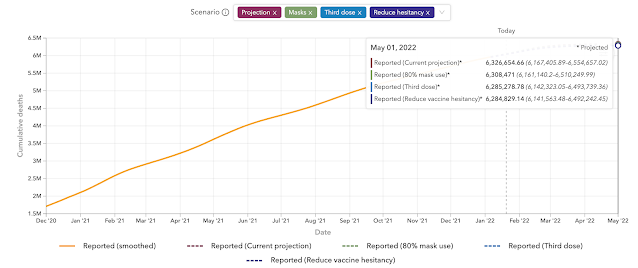
The projections at the University of Washington's Institute for Health Metrics and Evaluation (IHME) show a minimal impact. IHME has the COVID death count at 5,955,911 as of January 5, 2022. With its current projections, it predicts the global death toll will increase to 6,326,655 people. IHME projects that even with 80 percent face mask usage, it will reduce global deaths by 18,183. This means that at best, masks could reduce COVID deaths over the next four months by 4.9 percent. This would imply that face mask usage will have minimal impact, certainly relative to what face mask proponents would wish for. 


What does this all mean? Have we finally met a virus so transmissible that face masks make little to no difference? Can we accept that COVID is here to stay? England has at least realized the futility of face mask mandates and has lifted their mask mandate. Sweden never had a face mask mandate; it dropped its face mask recommendation last summer. The United States seems to be going in the opposite direction. Although the U.S. government had been hoarding 750 million N95 masks, it is looking to finally ship them out. That is subpar timing considering that the New York Times declared a couple of days ago that Omicron is in retreat. Yet one of Biden's campaign promises was to "shut down the virus." If I had to guess, the Biden administration is doubling down to seem tough on that campaign promise, although the upcoming midterm election cycle might change the administration's tune in the upcoming weeks. 

I cannot predict which direction the Biden administration is going to take. If I were to be cynical enough, I would surmise that Biden will declare victory over COVID shortly before the November elections to give the Democrats running for re-election the best chance. On the other hand, intransigence, lack of political will, and fear might keep this country on the stringent end of public health measures. 

I pointed out back in October that this pandemic will not formally end until we as a society can start to accept risk again. If the Biden administration's continued response to this pandemic and face masks is an indication of anything, it means that we as a society most likely have the majority of 2022 to deal with the fear-mongering, the inaccurate insistence that we can eradicate COVID, and the continued moving of goalposts to some unattainable utopia. The continued emphasis on face masks, in spite of highly questionable efficacy, signals that the U.S. government will be in pandemic mode after the metrics improve. I wonder how many more months or variants it will take for the COVID fear-mongers to realize the folly of their take on the pandemic. Time will tell, but given the Biden administration's handling of the pandemic, I am not optimistic. 

Wednesday, December 29, 2021

Recap of Top Libertarian Jew Blog Entries for 2021

This time of the year is a time of reflection on what has transpired during the current calendar year. Last year, I was hoping for less craziness than there was in 2020. Between the pandemic, economic downturn, and social unrest, last year was unhinged. While 2021 was not as bad as 2020, 2021 still had more than its fair share of insanity. 

As the pandemic continued into its second year, it remained a major topic in the media and among political pundits. On my blog, the pandemic was a topic that accounted for over a third of my blog entries for the 2021 calendar year. I was hoping that it would have been less considering that safe and effective vaccines were made available (see April 2021 analysis here). There was a brief moment in which the CDC said that the unvaccinated could go around doing normal activities unmasked. My response to that CDC recommendation in May was that the CDC has botched messaging throughout the pandemic and that going back to normal means ignoring what the CDC has to say by enjoying life regardless. Maybe now, we could stop people telling us to "follow the science" while ignoring the science. That was wishful thinking on my part. 

We went from "two weeks to flatten the curve" to "wait a little longer to help hospitals" to "wait until we have a vaccine" to "get enough people vaccinated." But along came the Delta variant, and with that, the goalposts moved once more. To keep Delta in check, President Biden called for vaccine mandates. I covered the topic no less than four times this past year in which I pointed out the problems with vaccine mandates (see here, here, here, and here). 2021 was also a year in which we procured enough data to conclude that the lockdowns were both ineffective and harmful from a public health standpoint. And let's not even get into the unhelpful travel bans or mask mandates (see here and here). All of this lunacy made me realize that the pandemic will not come to an end when COVID-related hospitalizations or deaths get low enough, but when we as a society get used to accepting risk once more. 

But don't you worry. There was enough craziness to go around that the pandemic did not need to hog all the spotlight. 

  • Cancel culture was another major news item. Take the Dr. Seuss controversy in which the Dr. Seuss Foundation cancelled the publication of six of Seuss' less-known works. I came to multiple conclusions on that debacle, most notably that the woke Left are the moral prudes of our time and that a small group of emotionally fragile and intellectually weak individuals should not have their sense of being offended determine what is acceptable for the rest of us. 
  • In a similar vein, there was cancel culture controversy surrounding comedian Dave Chapelle's Netflix special The Closer. He made jokes offending all sorts of people, but the jokes that got the most ire were those on the theme of transgender individuals. You can read my analysis here, but I was reminded of the value of comedy, the importance of free speech, and that the fragility of the woke Left is both at odds with learning to agree with those disagree with you and the essential pillars that make up a free, democratic society. 
  • In terms of economic disarray, I offered my takes on the supply chain crisis and the shortages in the labor market. 
  • And let's not forget the debacle with the Kyle Rittenhouse trial. While the woke Left tried to make it about race (which is odd considering the case was about a white guy shooting four other white guys in self-defense), it showed how little many on the Left believe that there is a such thing as a "good guy with a gun." The spoiler here is that defensive gun usage (DGU) is way more prevalent than the Left would care to admit. 
  • But if we do want to get into the topic of race, I tackled the topic of critical race theory (CRT). Contrary to what the Left would like to believe, CRT is not about simply about having a dialogue about race or making sure we are not ignoring the nastier parts of history. CRT is a simplistic, fatalistic worldview that believes that U.S. institutions are inherently racist and [one of] the only attributes of a human being that matters is the color of one's skin. 
  • On the brighter side of race relations, Juneteenth became a federal holiday. I wrote a piece on why we should all celebrate Juneteenth in the United States.
I wish you all a Happy New Year! May it be less out of whack than 2020 and 2021 were. 

Wednesday, December 22, 2021

Fauci Is Dead Wrong About Indefinitely Needing Face Masks on Airplanes

Dr. Anthony Fauci, who has been the Director of the National Institute of Allergies and Infectious Diseases (NIAID) since 1984, has played a major role in advising the U.S. public on pandemic measures. He has also been off the mark on numerous occasions. Here are but a few:

  • In February 2020, Fauci wrongly predicted that COVID would most probably have a fatality rate of 0.15 percent, which would have been on par with the common flu. In a matter of a few weeks, Fauci went from thinking the risk was minuscule to being supportive of lockdowns, albeit only for two weeks. It ceases to shock me how quickly "two weeks to flatten the curve" turned into months. He continued to push for strict lockdowns in the latter half of 2020. He was continually critical of states on multiple occasions that decided to open "too early." The scientific evidence ended up vindicating those states by showing that lockdowns are ineffective and harmful.
  • Fauci was wrong when he thought that schools should be shut down because he went under the erroneous assumption that allowing children to go to school would be superspreader events. It turns out that the science showed that COVID is a minuscule risk to children. 
  • Fauci admitted openly that his goalposts of herd immunity were not based on science, but "what the public was ready to hear." 
  • His flip-flopping on masks has been astounding. In February 2020, Fauci said "there is no reason whatsoever to wear a mask." He changed his mind in April 2020 supposedly because he was worried about the supply of face masks. Fast-forward to January 2021 where he went as far as saying that even the vaccinated should wear two masks, even though Fauci admitted in May 2021 that a vaccinated person wearing two masks was tantamount to pandemic theatre. 

I could list more not-so-endearing Fauci moments, but I want to move on to Fauci's latest faux pas. This one took place on a December 19, 2021 airing of ABC's This Week (transcript here). When asked if we will reach a point where we do not have to wear face masks on airplanes, Fauci's response was "I don't think so." In Fauci's mind, those who travel on airplanes will be wearing face masks for the foreseeable future. This response is problematic for a number of reasons. 

Let's begin with the efficacy of face masks generally. The pre-pandemic understanding behind face masks was that "face masks should not be worn by healthy individuals to protect themselves from acquiring respiratory infection because there is no evidence to suggest that face masks worn by healthy individuals are effective in preventing people from becoming ill (Desai and Mehrotra, 2020)."

At the beginning of the pandemic (i.e., May 2020), I was mildly supportive of a temporary face mask mandate. In spite of the mixed evidence that we had at the time, I figured a temporary measure that had low costs and potentially high benefits was good advice at the beginning of the pandemic when we had less understanding of face masks in the context of COVID. I started to change my mind as the pandemic progressed. 

About one year into the pandemic, the World Health Organization (WHO) said in December 2020 that "there was only limited and inconsistent scientific evidence to support the effectiveness of masking healthy people (WHO, 2020, p. 8)." A month earlier, the revered Cochrane examined multiple studies on the transmission of influenza-like diseases and found "there is low certainty evidence from nine trials that wearing a mask may make little to no difference to the outcome of influenza-like illness (Jefferson et al., 2020)." The WHO and Cochrane findings began my process of truly questioning face masks.

I continued to be begrudgingly supportive of face masks, but then came accessible vaccines. Looking at the vaccine process and the clinical data, I found that vaccines were safe and effective. Vaccines are much less riskier than contracting COVID. By the time we reached August 2021, I wrote a piece illustrating why we do not need face mask mandates. Aside from not being significantly responsible for lower case rates, I also argued that vaccines are a way more effective tool in fighting this pandemic than face masks. We also have to factor in that vaccines greatly reduce severe COVID cases, COVID-related hospitalizations, and COVID-related deaths (Scobie et al., 2021). It makes less sense to talk about COVID cases when vaccines have further severed the relationship between cases and disease severity. 

If that were not enough, a literature review from the Cato Institute shows that, as of November 2021, the available evidence of face mask efficacy is of low quality (Liu et al., 2021a). While masks are shown to reduce some measure of droplet transmission, what has not been demonstrated with available clinical data is a correlation with infection outcomes (Liu et al., 2021b). As a fun side note, CNN medical analyst Dr. Leana Wen said earlier this week that cloth masks are little more than face decorations in the face of a variant as contagious as omicron.

More specifically, the evidence for face mask usage in airplanes is even more scant than face masks generally. The 2020 Harvard study is not based on the gold standard of randomized controlled trials, but was done through modeling. An Irish case study of an international flight to Ireland suggests that in-flight transmission was the only possible solution (Murphy et al., 2020). Here is another case study, this one being a two-hour, domestic Japanese flight (Toyokawa et al., 2020). In spite of these studies, the evidence base is still that of low certainty. The evidence base for face masks slowing COVID transmission, whether in the general sense or specifically on airplanes, is weak.

I would like to talk about the risk of contracting COVID while on an airplane. What is the risk of flying the friendly skies during this pandemic? To quote the medical journal JAMA Network from October 2020, "the risk of contracting coronavirus disease 2019 (COVID-19) during air travel is lower than an office building, classroom, supermarket, or commuter train." Southwest Airlines CEO Gary Kelly testified in front of Congress saying that high-efficiency particulate air (HEPA) filtration systems capture well over 99% of airborne pathogens and converts the air every two to three minutes. The aforementioned comes from a finding in a 2020 Department of Defense study showing how low-risk riding in an airplane is. How low-risk? How good of a job are HEPA filtration systems on a plane? According to the DOD study, the HEPA filtration systems do such a good job that the risk of COVID is lower than being in one's private home or being in an operating room (see Figure below). Out of all of the indoor places one can be, being inside an airplane is actually one of the safest. 


Fauci does not care about how low the risk is on an airplane. He said as much in the ABC interview by stating that "Even though you have a good filtration system, I still believe masks are a prudent thing to do." Fauci is an eighty-year-old man for whom the only level of risk that is acceptable appears to be zero risk. After all, Fauci did say in that ABC interview that we cannot return back to normal until we finish this. 

Fauci does not care about how little evidence exists to support or refute mask-wearing. Fauci does not care about how mass vaccination has made COVID more manageable. He does not care that air filtration in an airplane is so high-quality that in terms of COVID-related risk, it is safer to be in in airplane than it is in an operating room. It does not matter that flying in an airplane without a mask is a low-risk activity. Fauci does not want us to go back to something resembling a pre-pandemic normal. What he cares about is fear of COVID and that we share his fear until the day we die.

Risk is a part of life. We do not have the luxury of living in a bubble and eliminating risk. Fauci analogizing the fight against COVID to fighting the Axis powers in WWII is another example of showing how out of touch he is. The U.S. government has declared a War on Terror, War on Drugs, and War on Poverty. Remind me again how well those "wars" are going. COVID is not going to go away. As I brought up in October, this pandemic will not truly end until we as a society can accept risk once more. If we cannot let up on pandemic regulations in the safest of conditions, such as wearing face masks on airplanes, what hope do we have of leaving the pandemic behind us? 

We should not give into fear. We should also not continue to push health regulations that have little to no evidence to support it, as is the case with face mask mandates. We cannot mask our way out of the pandemic. As the Cato Institute brings up, since the effectiveness of masks is uncertain, we should focus on practices that we know to be effective: vaccines, better ventilation systems, and discouraging crowding in closed areas (also see University of Minnesota review of masks here). I do not know whether President Biden will extend the face mask mandate on airplanes beyond the current mid-March expiration date. I certainly hope not. What I do know is that when government bureaucracy is entrenched with hypochondriacs, fear-mongers, and the most risk-averse who claim to follow science but effectively ignore the science, we end up in a dystopian society that values fear above else. This mentality that leads so-called experts to say we need to indefinitely wear face masks on planes to avoid the smallest of risks is no way to move forward and sure is no way to live.