Monday, February 12, 2024

UNRWA Is an Ineffectual, Anti-Semitic Organization That Exists to Perpetuate Victimhood and Conflict

As if there were not enough twists and turns in the Israel-Hamas War, this development has to do with the United Nations Relief and Works Agency for Palestinian Refugees in the Near East (UNRWA). UNRWA was founded in 1949 to provide humanitarian relief to Arab refugees as a result of the Arab-Israeli War of 1948. Remember this is the same war that the Arab nations started after the United Nations proposed a plan (UN Resolution 181) that would have allowed for an Israeli state and Palestinian state to live side-by-side.

The latest UNRWA controversy has to do with the October 7 attack, which was the single largest attack and murder of Jews since the Holocaust. Forget the report from UN Watch that shows a Telegram group of 3,000 UNRWA teachers celebrating the October 7 attack. According to Israeli intelligence, 12 UNRWA employees were involved in the October 7 attack (WSJ). Not only that, but 190 UNRWA employees are also Islamic jihadists. If that were not enough, 10 percent of the UNRWA employees in Gaza have ties to Islamic terrorist groups. Secretary of State Anthony Blinken found the sources to be "highly, highly credible." Apparently, it has been credible enough where several major donor countries, including the United States, Germany, Canada, Sweden, and France, have temporarily suspended funding to UNRWA. 

UNRWA replied by stating that if its funding does not resume, it could be forced to close down its doors by the end of February. The pro-Palestine side laments this, to be sure. From this vantage point, UNRWA is an "omnipresent municipal service provider." For UNRWA proponents, the humanitarian work of UNRWA should not be eclipsed by a few bad apples in the organization, even if those bad apples are alleged pogromists that participated in the worst slaughter of Jews since the Holocaust. 

Funny how the woke crowd thinks that we should give UNRWA more funding, but is the same Far Left that called for "defund the police" after a few bad apples and that we should eradicate racism (which apparently does not include Jew-hatred), but I digress on their intellectual inconsistency. I would contend that the rot in UNRWA goes beyond a few bad apples, especially since the pro-Palestine Al Jazeera reported on the abuse of power of UNRWA leaders. This includes Pierre Krähenbühl, the ex-UNRWA leader who was accused of nepotism, sexual misconduct, abuse of power, and bullying. 

Aside from corrupt leadership, UNRWA has supported terrorism and anti-Semitism for many years. This rot predates the numerous UNRWA employees who reacted positively to the October 7 attack. The European Parliament recognizes that Palestinian textbooks teach Jew-hatred, which is illustrated by the Georg Eckert Institute's report on Palestinian textbooks. This trend is confirmed by a November 2023 report from the Institute for Monitoring Peace and Cultural Tolerance in School Education (Impact-SE), as well as a report from UN Watch in March 2023 illustrating how UNRWA teachers incite Jew-hatred. These Palestinian textbooks have been so riddled with anti-Semitism that the United Nations admitted in 2019 that the anti-Semitism in these textbooks exists to "fuel hatred and may incite violence."

If the systemic anti-Semitism at UNRWA is not enough to convince you about how UNRWA contributes to the perpetuation of conflict in the Middle East, let us examine the nature of the organization itself. But first, some information on the role of the United Nations and helping refugees. The United Nations operates two organizations to the cause. The first is the United Nations Human Rights Commission (UNHCR), which is dedicated to the plight of refugees globally. The second is UNRWA, which is focused on Palestinian refugees. Here are some figures about UNHCR in comparison to UNRWA:

  • UNHCR has 18,879 staff (as of 12-31-2022) to help 29.4 million refugees under UNHCR's mandate. UNRWA, on the other hand, has 30,000 staff that cover 5.9 million individuals under its mandate. This means that UNRWA has over 11,000 more staff to help out over 23 million fewer people than UNHCR. 
  • This, of course, does not include the 70-plus million refugees and asylum seekers not covered under either organization. 
  • In terms of funding, that is for $10.80 billion for UNHCR and $1.47 billion for UNRWA in the year 2023. 
  • That would make the funding-per-refugee ratio $367 for UNHCR and $249 for UNRWA. 

As fun as it is to look through these data points, they beg the question as to why the Palestinians have their own separate refugee agency. Are their lives more important than the 2.5 million Sudanese that were displaced last year? That segues into how UNRWA treats refugees. With UNHCR, resettlement of refugees is one of the main goals of its mandate. For UNRWA, not so much. In UNRWA's own words, "UNRWA does not have a mandate to seek durable solutions for Palestinian refugees." 

The reason why UNRWA does not want to resettle Palestinians has to do with how UNRWA defines refugees. By UNHRC's definition, a refugee is "someone who has been forced to flee his or her country because of persecution, war, or violence." This lines up with how refugee was defined for Arabs displaced as a result of the Arab-Israeli War of 1948. However, that definition changed over time and has since applied to more people than the original 700,000 who were directly affected by displacement in 1948. In 1965, UNRWA's eligibility requirements extended to third-generation descendants of refugees. In 1982, that applied was expanded further to any descendant, regardless of whether they had been granted citizenship elsewhere. 

Under the 1951 U.N. Convention, specifically Article I(c)(3), a person is no longer a refugee if he or she "has acquired a new nationality, and enjoys the protection of the country of his new nationality." Not so with UNRWA. If the standard definition under international law were used, the vast majority of the 5.9 million that are covered under UNRWA's mandate would not be defined as refugees because they are not among those who left the modern state of Israel in 1948. Under UNRWA's definition, refugee status can be inherited over generations, regardless of where one lives or has citizenship. This helps ensure that its refugee rolls expand every year, which also provides a perverse financial incentive to ask for more funding instead of helping resettle Palestinians. 

This begs another question: How did other groups of refugees throughout history respond to displacement? During the Kashmir dispute, Pakistanis and Indians alike resettled. Germans after World War II resettled. Even Ukrainians who have been displaced in its current war with Russia are in the process of resettling. 

In response to Israel becoming a nation-state, the Arab nations ejected about 850,000 Jews from their lands. Talking about ethnic cleansing! Instead of claiming permanent refugee status, Israel and other Western nations absorbed those refugees. Israel also absorbed Arab refugees, which explains the Arab Israeli population of 1.7 million. Israel did so in spite of the series of wars that the Arab nations started in the hopes to wipe out the Jews. 

Every other refugee in history who has to leave their home for one reason or another finds a new home and resettles. Only the Palestinian "refugee" crisis has been perpetuated over the decades. UNRWA has been in existence for 75 years. You want to know how I know that UNRWA has failed in its mission? Because no other group of refugees has taken three-quarters of a century to get settled elsewhere. 

Even pro-Palestinian activist and blogger Ahmed Fouad Alkhatib acknowledged that UNRWA's presence [inadvertently] meant enabling Hamas to be reliant on UNRWA for governance. This, of course, means avoiding the inconvenient truths that Israel unilaterally withdrew from Gaza in 2005 and has been run by Hamas since 2007. 

If UNRWA were successful at helping refugees, UNRWA would have been dissolved years ago. The fact that it is still around only confirms that UNRWA exists to bolster Palestinian victimhood into perpetuity while being encouraged to blame Israel. By perpetuating and enlarging the "refugee" crisis, what UNRWA has done is keep the peace process more elusive while preventing Palestinians from living normal lives. As such, UNRWA should be abolished. If you want an organization to help the Palestinians, UNHCR or the World Food Programme (WFP) have a better track record than UNRWA. I will end with a quote from Spiked since they summarize the malaise so well: 

"In truth, UNRWA has helped to institutionalize a Palestinian politics of grievance, increase both local and global hatred for Israel, and provide spaces in which Gazan Islamists have been able to indoctrinate a new generation with the Jew hate that masquerades as 'Palestinian liberation.' Liberating Gaza from UNRWA ought to be at least a medium-term goal of everyone who cares about Israelis and Palestinians." 

Friday, February 9, 2024

The U.S. Needs to Grant More Green Cards to Immigrants with Advanced STEM Degrees

As we advance in the 21st century, there is a growth in technological advancement and societal change. Having current and future workers trained in various fields to help towards a better and brighter future are integral. This is especially true for the field of STEM: science, technology, engineering, and mathematics. These four disciplines will drive new innovations to help solve major challenges that we face. Whether countries have the adequate STEM workforce to move forward is a debate. 

The labor shortage that the United States is facing is going to have implications if not addressed. This is especially true in the STEM field. If a report from the National Science Foundation entitled The State of U.S. Science and Engineering 2022 is indicative of anything, it is that the United States is starting to fall behind in STEM. The United States is getting outpaced by China in terms of research papers published, patents produced, and graduating natural sciences PhD candidates. The issue with the STEM skills gap is not solely a problem in the United States. If there is indeed a shortage, then there has to a concerted effort to make sure that the gap shrinks over time. Why? An economy having enough STEM workers will be a major factor in whether a country can be a major player in the global economy this century. 

One surefire way to help close the gap, especially in the short-term, is to increase immigration of STEM workers. This is not merely based in economic theory. As I pointed out in 2017, hiring STEM workers with the H1-B visa program increases patent production, economic growth, and helps increase employment of native workers. A 2021 policy brief from the Mercatus Center shows how restricting STEM visas results either in offshoring for large companies or increases costs for small businesses that do not incentivize them to hire native workers.

There is another advantage for allowing more STEM workers into the United States: it will help the federal budget. I have sounded the alarm on the rising federal debt, most recently when the United States had yet another credit downgrade this past summer due to profligate spending. The Wharton School of Business, the premier business school, brings good news from a budgetary estimate it released last month. Exempting immigrants with advanced STEM degrees would reduce deficits by $129 billion from 2025 to 2034.


Between 2035 and 2044, it would be an even higher $634 billion. Why should we care? That sounds like the government's problem, not ours. Here is the thing. An increasing debt-to-GDP ratio means that the government has to pay more on interest payments for the debt. Per a 2023 report from the Congressional Budget Office, that would likely result in "slow economic growth, push up interest payments to foreign holders of U.S. debt, heighten the risk of a financial crisis and make the U.S. fiscal position more vulnerable to an increase in interest rates." Improving budgetary prospects means fewer debt interest payments and more economic prosperity for the American people. 

Lowering the debt-to-GDP ratio is yet another benefit of increasing immigration of STEM workers to the United States. As I brought up in December, more immigration improves macroeconomic growth, especially when this country is in the midst of a labor shortage both in the STEM field and the macroeconomy more generally. Contrary to the naysaying of nativists and other anti-immigration individuals, immigrants are not a drain on the economy. They are a net boon. The United States should not maintain restrictions on immigrants with advanced STEM degrees because it does so at its own peril. 

Monday, February 5, 2024

Social Conservatives' War on Porn Shows the Far Right Can Be As Puritanical as the Woke Left (Part I)

Disclaimer: This blog entry does not contain any pornographic images or links to pornographic websites. This blog entry functions as a criticism of pornography bans. 

Ultra Right Beer is a beer company created in response to Bud Light's increasing wokeness, particularly with the Dylan Mulvaney controversy. Last month, Ultra Right Beer released a 2024 calendar of various conservative women in sexually suggestive poses. This caused enough backlash from social conservatives where the incident was called Calendargate. This incident shows a schism on the Right between social conservatives and those with libertarian, "live and let live" tendencies. This reemergence of social conservatism on the political scene is not limited to calendars. It is a phenomenon that occurs with pornography.  

Alabama legislators have proposed age verification in an attempt to block minors from adult websites, which is already unconstitutional under Reno v. American Civil Liberties Union (1997). Last month, an anti-porn bill was introduced in Oklahoma is so extreme that it would make viewing "obscene materials" a felony. Such a bill would target sexting and social media sites that are accessed in Oklahoma. 

This is not a state here or there. Project 2025 is a coalition of over 70 conservative groups led by the Right-leaning Heritage Foundation. This Project includes a 920-page policy guide of what they would like to do if President Trump wins this election. Included in the manifesto is a call to remove pornography: 

"Pornography, manifested today in the omnipresent propagation of transgender ideology and sexualization of children, for instance, is not a political Gordian known inextricable binding up disparate claims about free speech, property rights, sexual liberation, and child welfare.....[it] has no claim to First Amendment protection...Pornography should be outlawed."

Social conservatives and religious conservatives have opposed pornography for a number of reasons, whether it is because it encourages non-procreative sex, abortions, sexual assault, or the assertion that it is bad for one's health. I made a case against pornography bans in 2015, and I will do so again today. I will also be using economic arguments from Economics Professor Art Carden throughout. 

1) What is pornography? What is obscenity? This might seem like a given or a no-brainer. As Supreme Court Justice Potter Stewart said with regards to obscenity, "I know it when I see it." However, it is not so cut-and-dry. Determining a neutral standard for sexual expression is impossible given the variety of sexual tastes and sensibilities. What constitutes pornography is in the eye of the beholder. Does it apply to certain hardcore pornography? Should a ban include softcore pornography? Would we ban romance novels or Game of Thrones? How about sexting on a dating app? Or is a photo of a woman who is showing her ankles beyond the pale? 

To quote the Institute of Economic Affairs: "Intractable definitional problems are inherent in any effort to single out for prohibition of any category of sexual expression based on its alleged harm to the minds of its viewers, in contrast with some more concrete, ascertainable harm. In effect, this kind of prohibition creates a 'thought crime'...Such thought crimes are inherently inconsistent with individual freedom."

That being said, I do want to scrutinize the notion that pornography could cause "concrete, ascertainable harm."

2) Pornography does not increase sexual assault. A concern from the naysayers is that pornography will lead to more sexual crimes because pornography would either create or encourage fantasies of sexual violence. From the 1990s to the 2010s, sexual assault rates were overall declining as porn consumption was increasing. More to the point, the University of Texas at San Antonio released a meta-analysis on the topic (Ferguson and Hartley, 2020). Guess what they found? After examining over 50 studies, there is no correlation between pornography and violent sex. No correlation means no causation, i.e., pornography does not cause an increase in sex crimes

3) Claiming that pornography is bad for one's health is mixed at best and inaccurate at worst. While some people undergo negative effects with [excess] pornography consumption, there is also research to show that there are neutral or positive effects:

  • Pornography can improve sexual comfort and self-acceptance, as well as reduce anxiety, shame, and guilt over sexual behavior. It also has been linked to increased arousal and orgasm responses (Hakkim et al., 2022).
  • Pornography can open communications and improve one's sexual relations (Kohut et al., 2018).
  • "Pornography use is associated with health-promoting behaviors, including increased intimacy, 'safer' sexual behaviors (e.g., solo masturbation), and feelings of acceptance (Nelson and Rothman, 2020)."
  • How the pornography is consumed matters. Research indicates that those who experience negative effects (e.g., sexual risk behaviors, mental health issues) could mitigate the harm with proper sexual education (Davis et al., 2020; Vandenbosch and van Oosten, 2017). Being able to distinguish between pornography and reality is a major factor into whether pornography is harmful. 
  • Watching more pornography is associated with greater sexual arousal, not erectile dysfunction (Prause and Pfaus, 2015).
  • Pornography does not degrade relationship satisfaction or closeness, nor does it affect loneliness (Hesse and Floyd, 2019).
  • Pornography can help with masturbation (Prause, 2019), which is important because masturbation can help with stress and anxiety. 
  • Contrary to previous research, more methodologically sound research found that pornography consumption does not diminish interest in one's sexual partner (Balzarini et al., 2017).
  • Pornography has the ability to help people explore their sexuality or understand their sexual identity (McCormak and Wignall, 2017).

Two researchers from Boston University outlined how pornography is not a public health crisis. They concluded that labeling pornography a public health crisis could actually make outcomes worse due to stigmatization. Even if there are negative health factors, it does not matter. I will elucidate upon that point further in Part II. 

Thursday, February 1, 2024

Some Inconvenient Truths In Response to the "Gaza Is an Open-Air Prison" Argument (Part II)

Last week, I began to scrutinize the argument that "Gaza is an open-air prison." In the first part, I pointed out a few inconvenient truths:

  1. The purpose of Israel's blockade and border fence is not to collectively punish Gazans, but rather to protect Israeli citizens from terrorist attacks.
  2. Israel withdrew from Gaza in 2005, which means that the "Israel was occupying Gaza" argument can readily be dismissed. 
  3. Hamas has been governing Gaza since 2007. As such, Hamas is responsible for the day-to-day well-being of Gazans, not Israel.
  4. Egypt shares a border with Gaza. Egypt chose to build a border wall on the Egypt-Gaza wall for the same reason as Israel: national security. 
  5. Neither Egypt nor Jordan are accepting Palestinian refugees, thereby closing off options to Gazans. 

I am going to continue with some other inconvenient truths in Part II, with particular focus on mobility, economic growth, and Hamas' corruption. Part of what makes a prison a prison is a [near] non-existent flow of people in or out of the confines. As such, net migration is another metric to determine whether or not Gaza is an open-air prison. Looking at data from the World Bank and the United Nations, what we see is that there is a net migration out of the country, which implies that Gazans have been able to leave the country. Gazans looking to emigrate to Turkey, for example, have to deal with Hamas' slow bureaucracy that makes it more difficult to leave Gaza.

It is not only in terms of migration or emigration in which the prison argument does not withstand scrutiny. As previously stated, the responsibility for governing the Gazans is Hamas', not that of Israel. Even so, Israel still helps out, which is impressive given the circumstances. Prior to the current Israel-Hamas War, Israel issued over 18,000 work visas for Gazan citizens to earn up to 10 times what they could in Gaza. This finding can be confirmed with data from the United Nation's Office for the Coordination of Human Affairs (OCHA). If someone is in a prison, that person is not allowed to leave and come back. Yet there had been a flow of Gazans entering Israel for work purposes prior to Hamas initiating a war against Israel.


It is not only people that are allowed to enter Israel to work, but also goods that are allowed to enter Gaza (see OCHA data below). During the current war, Israel has allowed humanitarian goods to enter Gaza. As we see from UN data, more goods were allowed to flow to Gaza in 2023 than it did in previous years. Here is another consideration. Israel providing what it does exceeds any expectations set in the Fourth Geneva Convention (Article 23) and the First Protocol of the Additional to the Geneva Conventions (Article 70). International law notwithstanding, on what planet is it normal or reasonable to ask a country to provide water and electricity to its enemy when that enemy has been using water pipes to create rockets that then kill Israelis? This brings me to my next point.....


Considering the adversarial nature of Hamas, it is generous that Israel would provide an economic lifeline at all. If Gaza were a true prison, Israel would have either greatly confined the flow of people and goods, or alternatively, completely shut off movement of labor or goods. Hamas refuses to "accept any international laws or set of rules that would allow peaceful interaction with its neighbors." Imagine what economic development there would be between Palestinians and Israelis if most Gazans did not hate Israel or Jews. My educated guess is that Gaza would not be nearly as prison-like if it were able to maintain positive relations with Israel instead of wanting to kill Jews. As I like to say, "those who trade together stay together." 

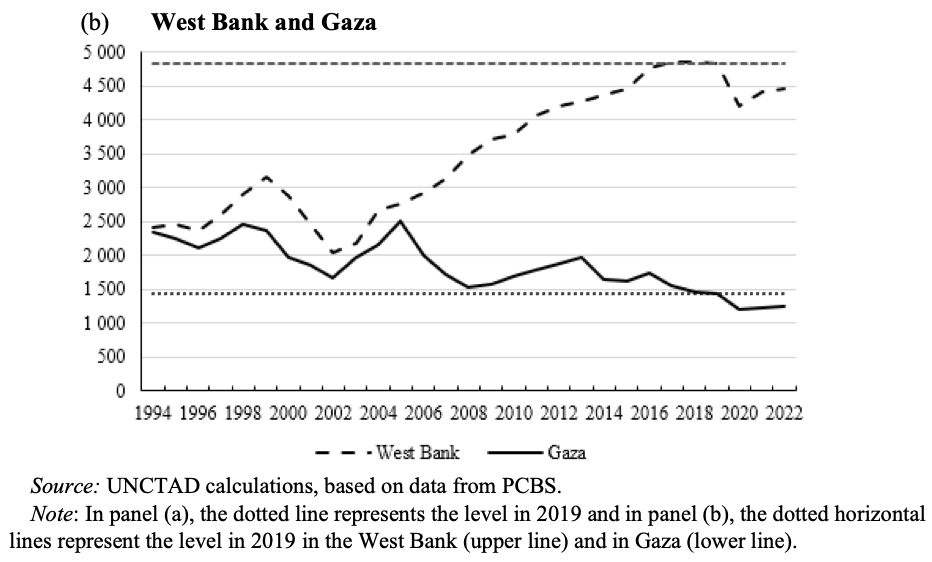
Speaking of economic development, Gaza's economy was on par with the West Bank's before Hamas got into power. Once Gazans elected Hamas, United Nations data (see below; UN, p. 2) show that economic growth in Gaza declined. The U.S. State Department recognizes that "businesses in Gaza have reported instances where Hamas courts and officials have employed coercion or have otherwise acted outside the legal system when engaging with private business." In layman's terms, an economy with corruption, bribes, fear, and intimidation break down economic growth. The fact that corruption erodes economic growth is commonly understood in the public policy world, as is illustrated by this research from the International Monetary Fund and Transparency International (also see Gründler and Potrafke, 2019Bai et al., 2013).


If there is a reason that Gaza has prison-like conditions, look at how Hamas rules Gaza. Per this report from Freedom House that examines Gaza's political freedom, Hamas is a corrupt organization that quashes the people's political and civil rights. Women, gay people, and whatever non-Muslims that may exist in Gaza's borders are oppressed. If Hamas did its job of governing over the Gazans instead of pouring its resources to kill Jews, maybe, just maybe conditions in Gaza would not be so dire. 

Postscript: Before there was the alleged "open-air prison," the argument over settlements, or so-called "occupied territories" (they are actually disputed territories), the majority of Arabs in the Levant region have hated Jews. As I brought up before, there have been multiple times where the Arabs were offered "land for peace." Palestinian statehood has been offered in exchange for recognizing Israel's right to exist and renunciation of violence. Apparently, co-existing with Jewish neighbors was and remains to be too big of an ask for most Arabs in the Levant region. 

Yes, Israel imposed a blockade and beefed up its border security. However, Israel did so in response to Hamas' terrorist activities that have become more and more of a national security threat to Israel. Labeling Gaza an "open-air prison" ignores Hamas' raison d'être of destroying Jews to the point of neglecting the needs of everyday Gazans. It neglects that most Gazans still support Gaza enough where Hamas has a higher approval rating in Gaza than President Joe Biden has in the United States. It avoids the reality that Egypt also has a border wall on its border with Gaza because Hamas is a threat to all of its neighbors, not only Israel. 

Calling Gaza an "open-air prison" is nothing more than a cudgel that attempts to shift all the blame to Israel while attempting to render Hamas and Gazan citizens as guileless victims. Yes, Gazan citizens lamentably face high levels of unemployment, poverty, and less mobility than other citizens in the world. Conversely, it is not so immobilizing to constitute as a prison, as is seen by mobility data of Gazans to and from Israel, Gazan migration data, and data of goods flowing in and out of Gaza. The extent to which Gaza is prison-like is primarily due to oppressive rule of Hamas, followed by the Gazans who voted Hamas in power and the Arab nations that refuse to help the Palestinians. While there is enough blame to go around, we should shift most of it to where it is due: in the direction of Hamas. 

Monday, January 29, 2024

Biden's Overdraft Fee Cap Would Harm the Consumers It Was Meant to Protect

As the election cycle commences, one would think that President Biden would be occupied with urgent matters. This is why I am perplexed by what his administration proposed. A couple of weeks ago, the Consumer Financial Protection Bureau (CFPB) announced a rule proposal that would close a loophole on bank overdraft fees. Yet it makes sense as an election move. While inflation is not what it was in 2021-22, inflation is still on the minds of the American people since consumer prices have not decreased to pre-2020 levels. The Biden administration attacking bank overdraft fees could be seen Biden fighting against price increases. Biden went as far as calling overdraft fees exploitation. Calling a policy exploitation is nothing new. It is a saying that has been made against sweatshops, donating one's organs for pay, price gouging, and privatized fisheries. Karl Marx believed that success was inherently exploitative. As nice of a sound byte as it makes, Biden's critique sidesteps the purpose of overdraft fees and basic economics.

An overdraft takes place when there are insufficient funds in an account to cover a payment or withdrawal. It is the extension of credit from the bank to the customer. The interest for this loan typically comes in the form of a one-time fee per overdraft. As I have brought up before, banks are financial institutions, which means their business literally is money. The fee helps a bank cover the payments that would otherwise be rejected. What would happen if an overdraft fee cap were to be imposed? 

First, we should ask what the purpose of overdraft fees. Yes, the overdraft fee provides the bank with a source of income. However, the primary function of overdraft fees is to lower and offset the risks of lending. Overdraft fees provide an incentive to not spend more than you have, much like late fees on credit cards provide an incentive to pay credit card bills on time. 

This is because instead of simply charging the fee on an ad hoc basis, it could mean shutting down the services completely, especially for those banking at smaller banks. A research paper from the New York Federal Reserve had the following to say (Dlugosz et al., 2023): "When constrained by fee caps, banks reduce overdraft coverage and deposit supply, causing more returned checks and a decline in account ownership among low-income households (p. 22)." This is not a call for exorbitant fees per se, but showing what happens when fee caps are imposed. What the research does show is that fee caps hamper financial inclusion for the people these caps are meant to help rather than enhance it. Even Biden's acting Comptroller of the Currency Michael Hsu warned that "limiting overdrafts may limit the financial capacity for those who need it the most."

We should ask ourselves what the alternative is if the banks get hit with an overdraft fee cap. Much like with what employers doing with minimum wage laws, banks can find a workaround to circumvent the fee cap. The banks could increase other fees. Banks could also remove such offerings as low-cost checking accounts or travel rewards. As previously mentioned, removing an option such as low-cost checking accounts could lead to more unbanked individuals. Why? 

An overdraft fee cap is an example of a price control, which is something that proponents readily admit. I have talked about price controls before, whether it is consumer loan interest rate capsrent control, drug pricing, price gouging, or fixed exchange rates. A price control below the equilibrium point, much like an overdraft fee cap, creates a shortage because the demand exceeds the supply. The shortage exists because some banks do not have the luxury of reducing or eliminating their overdraft fees. 

The Left-leaning Brookings Institution points out that it is smaller banks in particular that make the bulk of their profits from their overdraft fees (Klein, 2021). This leads to a valid point that the Cleveland Reserve Bank brings up in its research on the unbanked (Boel and Zimmerman, 2022). While overdraft fees exclude some from the system, the overdraft fees also provide the revenue stream to make low-balance accounts more profitable. This is all the more so for smaller banks. Banks are more incentivized to open accounts for a wider range of customers, including low-income households, when they have this revenue stream. It would explain how overdraft fees help lead to greater financial inclusion of lower-income households on net. 

Much like it is with landlords, it is politically expedient to malign banks, regardless of what they have actually done. What needs to be recognized is that banks are for-profit entities. If they continue to operate at a loss, they cannot stay in business. Banks thus have to make decisions as to whether it is worth it to have smaller accounts with smaller overdraft fees. Some of them decide it is not worth it, hence the shortage that price controls cause. At best, an overdraft fee cap is asking customers with stable finances to subsidize higher-risk customers. At worst, such a shortage can drive low-income households to such sub-optimal options as payday loans, pawn shops, loan sharks, or taking out a second mortgage on their home. This unfortunate phenomenon has been observed with consumer loan interest caps.


These arguments also need to consider the market trend of overdraft fees. Overdraft fees have been on the decline, from $30.9 billion in 2008 to $12.1 billion in 2023. With the rhetoric on the Far Left, you would think that banks only care about greed and lining their pockets by exploiting the working man more and more. So why the historical decline in overdraft fees? 


To quote the St. Louis Federal Reserve, "Competition, from other banks and nonbank providers such as fintech firms, arguably have affected overdraft practices more than anything else." This competitive pressure can incentivize banks to restructure how it approaches these fees. There have been multiple banks that have either eliminated or reduced their overdraft fees without government intervention, including Bank of America, BMO Harris, Capital One, Citibank, and PNC Bank. The bank Vero allows for up to $50 in overdraft and automatically takes that loaned money back when the customer adds more funds to their account.

As long as fraud is not occurring and people can freely opt into overdraft protection or other banking services, we do not need Biden's latest proposed rule when a competitive marketplace is already reducing overdraft fees. The most probable outcome of such a policy would be limiting the supply of financial services to lower-income households. An overdraft fee cap will only hurt the people it is supposed to help, which is a pattern with economic policies on the Left. Consumers should not have to suffer simply because the President wants to score political points in an election year.

Thursday, January 25, 2024

Some Inconvenient Truths In Response to the "Gaza Is an Open-Air Prison" Argument (Part I)

As the Israel-Hamas war in Gaza continues, the pro-Palestinian side naïvely advocates for a ceasefire thinking it will end the fighting in the Middle East when it will do nothing of the kind. Since Israel militarily responded to Hamas attacking, kidnapping, torturing, raping, murdering, and decapitating hundreds of Israeli civilians, pro-Palestinian activists have been on the warpath to make Israel look bad. It fallaciously lobs the accusation of Israel committing genocide, which has become especially en vogue since October 7. Other such untrue accusations as occupier, colonizer, and apartheid state have been part of the verbal arsenal of the pro-Palestinian side for some time now. 

An article from the Right-of-center Wall Street Journal, of all places, made another claim earlier this week: Gaza is an open-air prison. The premise of this argument is that the citizens of Gaza have such restrictions in movement, whether physical or economic, that Gaza de facto acts as one large prison. What this language invokes is the image of Israel acting as a warden oppressing Gazans. This argument is nothing new; it has been made by Human Rights Watch, Amnesty International, and the Left-leaning Slate, amongst others, over the years. The Gaza Strip was not always riddled with poverty, unemployment, and corrupt terrorists running the government the way it is now. How did we get here? 

The current version of fence between Israel and Gaza was built in 2002 and fortified in 2005 after the IDF's unilateral withdrawal from Gaza. In 2007, Israel imposed an economic blockade. Why a blockade? In early 2006, Hamas defeated its political rival, Fatah, in political elections. In June 2007, Hamas took over Gaza. Shortly thereafter, Hamas started attacking Israel. Hamas has not been what we would call friendly towards Israel. Since its founding in 1988, Hamas has called for the destruction of Israel and indeed all Jews. Since 1993, Hamas has employed suicide bombings against Israel. As for launching rockets, Hamas has been at it since 2001. And let's not forget the violent and death that came with the First and Second Intifadas. With that level of animus, it is understandable that Israel would impose a blockade and a border wall on its borders with the Gaza Strip to protect its citizens.

This leads to the first inconvenient truth: The purpose of the border fence and blockade is not to keep civilians locked in Gaza or to enforce "collective punishment" out of vindictiveness, but rather to prevent terrorists from entering Israel's borders and wreaking havoc. Hamas has posed a militaristic threat since it took over Gaza in 2007. This level of national security would be a basic precaution that any country with an antagonistic neighbor who is hellbent on wiping out one's entire citizenry would take. The United Nations, which has typically been antagonistic towards Israel, accepted in its Palmer Report that Israel's blockade exists for legitimate self-defense purposes (UN, p. 40).

This brings us to the second inconvenient truth: In 2005, the Israeli Defense Forces (IDF) unilaterally withdrew from Gaza, which means the accusation of Israel being an occupying force in Gaza loses any merit. Before the IDF left Gaza in 2005, American Jewish donors gave Gaza 1,000 greenhouses valued at $14 million. These greenhouses were producing millions of dollars of revenue in flowers and agricultural products. What did Gazans do? Shortly after the IDF disengaging from Gaza, Gazan citizens destroyed the greenhouses. This was before Hamas was ever in charge of governing over the Gazan people or before Israel imposed a blockade. 

Yet another inconvenient truth: Hamas has been running the show for well the better part of two decades, not Israel. Gazans voted Hamas into power in 2006. As the governing entity of Gaza, Hamas is the one responsible for the day-to-day well-being of Gazans, not Israel. Hamas could have taken that international aid it received from various countries and international organizations to build schools, hospitals, and infrastructure to provide amenities for its people. What has Hamas decided to do instead? It has mainly invested in rockets and building tunnels to attack Israel, meanwhile grinding everyday Gazans into a state of poverty when it is not using its citizens as human shields. Hamas continues to bombard Israel with rocket attacks to this day. Hamas leaders, who have a net worth of $11 billion, are living the high-life in Qatar while its people suffer. Ultimately, Gazans had two choices after the IDF's disengagement from Gaza: build a prosperous economy or use that newly found freedom to attack Israel because hating Jews is a bigger priority than living peacefully. The Gazans opted for the latter. The fact that was the choice they made is not Israel's fault. 

Here is an inconvenient truth that has to do with some basic geography. Israel is not the only country that shares a border with Gaza. Egypt also shares a border with Gaza. There has been a border wall on the Egypt-Gaza border for the better part of two decades. While it is convenient for the pro-Palestinian side to blame Israel, the reality is that the Egyptian government completes the enclosure. Why does Egypt make the choice to not let Gazans cross into Egypt? For a very similar reason that Israel does.


In January 2008, Hamas demolished the border wall that previously between Gaza and Egypt. Shortly after, Egypt started building a steel wall with the help of the United States. The concern was that Hamas would team up with the Muslim Brotherhood, which would have destabilized Egypt. Much like with Israel, Egypt realizes that securing one's land borders is a standard part of national security. Even now, most pro-Palestinian advocates have not even thought to ask why Egypt or other Arab nations are not helping out their Arab brothers and sisters in their hour of need

Non-rhetorically, that would be a combination of not being able to absorb the influx of refugees along with the instability that would come with allowing Hamas terrorists and sympathizers into the country. While I do not disagree with Egypt's or Jordan's decision to deny Palestinian refugees access to their countries, it does mean that the indecision of the Arab nations has been contributing and continues to contribute to the plight of Gazans. Yet you do not hear for the pro-Palestinian side accusing Egypt of committing genocide or being an apartheid state. The pro-Palestine puts all the onus on Israel while ignoring the fact that Arab nations (Egypt in particular) also place restrictions on Palestinians entering their countries. 


In the next Part, I will discuss additional inconvenient truths that undermine the "Gaza is an open-air prison" argument.

Monday, January 22, 2024

Mandated Gender-Neutral Toy Aisles Is Another Instance of California's Woke Virtue-Signaling

California started off the New Year with a mandate for retail stores selling toys or childcare items to have gender-neutral aisles. This mandate stems from a 2021 California law stating that any retailer with a physical presence in California and 500 employees is to maintain "a gender-neutral section or area to be labeled at the discretion of the retailer." Retail stores that fail to comply pay $250 for the first infraction and $500 for subsequent infractions. The idea behind this law is to allow children to express themselves without being hindered by traditional gender norms. That might sound congenial, but here are some issues:

  • Retail stores are attuned to the supply and demand of its customers. Retail stores not need such a mandate to tell them that California is a Left-of-center state in which there has been an increased demand for gender-neutral consumer goods. Target dropped its gender-specific sections in 2015, and other such stores as Toys 'R Us followed suit. Even toymaker Hasbro removed the "Mr." from its Potato Head line. 
  • You would think California has bigger problems to contend with, such as crime (including shoplifting in retail stores), homelessness, preventing dangerous wildfires, a population exodus, or its budget deficit. 
  • To properly enforce this law, the State of California would need to hire someone to regularly inspect toy stores to make sure they are compliant with this law. If the law is unenforceable, it ends up being superfluous virtue-signaling at best. At worst, enforcement is a waste of taxpayer dollars that needlessly punishes retailers. 
  • Why does the government feel the need to mandate how businesses display and market their merchandise? Such decisions should be left to business owners. 

As I already brought up, there are more pressing matters in the world than gender-neutral toy aisles. I wrote a piece seven years ago as to whether toys should be gender-specific or gender-neutral.  If parents want to buy gender-neutral toys for their children, they should be allowed to do so. The same goes for those who want to buy gender-specific toys for their children. It is partially the absurdity of the law that prompted me to write this blog entry on a solution in search of a problem. After all, satire website Babylon Bee called it before California legislators proposed the bill. What concerns me is not the overall influence this bill will have on the lives of Californians. It is setting an eery precedent and a tone that signals to woke lawmakers that they can feel entitled to manage every aspect of private commerce to their liking. I do not want to live in a world that encroaches on private businesses in such a fashion. Legislators should think twice before imposing their values onto customers and businesses in such a fashion.