Showing posts with label Finance Public Policy. Show all posts

Thursday, January 22, 2026

Trump’s Credit Card Crackdown and the Costly Consequences of His Price Controls

Credit cards are a convenient and safe way to make purchases, but they come at a cost. There are interest rates, annual fees, late payment fees, cash advance fees, balance transfer fees, foreign transaction fees, returned payment fees, the list goes on. These extra costs add up over time. Data from the Federal Reserve shows that U.S. credit card has increased over time and is now over $1 trillion. According to consumer intelligence company J.D. Power, 53 percent of current cardholders are carrying card debt, which is up from 51 percent the previous year.  

Trump has made affordability a top priority for his domestic policy in 2026. One aspect of affordability that Trump has eyed is credit cards. On January 9, Trump used Truth Social to announce his support for a credit card interest rate cap at 10 percent, which is even lower than what Bernie Sanders' 15 percent proposed in 2018. The following Tuesday, January 13, Trump said that he was in favor of the Credit Card Competition Act (CCCA), which includes a cap on credit card swipe fees. Three days later, the Senate reintroduced the CCCA. While capping credit card interest rates and swipe fees sound appealing or helpful on the surface, the truth is that they have unintended consequences for consumers and the credit market. 

Credit Card Interest Rate Caps Cannot Cap Economic Reality

President Trump's proposal to cap credit card interest rates at 10 percent for one year is rooted in affordability concerns. The Competitive Enterprise Institute (CEI) does a fine job at analyzing the empirical evidence and explaining how Trump's premise is based on a fundamental misunderstanding of how credit card markets work. Interest rates on credit cards are not arbitrary price gouging or profiteering by the "greedy credit card companies." They are the price of risk and operation costs for unsecured lending. Setting an artificial ceiling below the market rate does not make credit magically cheaper. It reduces availability by making lending to higher-risk borrowers unprofitable. CEI cites examples across borders and across time illustrating where interest rate caps constrained credit supply, showing that lenders retreat from offering loans when a price ceiling binds. This will mean fewer credit cards, reduced access for lower-income and subprime consumers, and unintentionally harming the everyday American that Trump claims that he is helping. 

Moreover, CEI points out that those who manage to keep their credit cards still pay in the form of higher fees, lower rewards, and reduced credit limits. This will parallel what happened with the Durbin Amendment's cap on debit card interchange fees, which resulted in higher checking account fees and lower rewards for consumers. An interest rate cap will punish consumers with the real potential of pushing Americans towards riskier alternatives, whether that is payday loans, pawn shops, or loan sharks.

Forced Routing Won't Solve Credit Card Woes

The 2026 Credit Card Competition Act (CCCA) continues the approach of earlier versions of the CCCA by requiring large credit card issuers to allow merchant to route transactions over multiple networks, inching at leas one network outside of Visa and Mastercard. The premise of this bill is to encourage competition to loosen the grip of the "Visa-Mastercard" duopoly, which arguably exists. According to the most recent market data, Visa and Mastercard account for about 90 percent of the market measured in purchase volume. While this aims to increase competition and put downward pressure on swipe fees, the bill does not impose a hard federal fee cap like the Durbin Amendment does for debit cards. 


Regardless of the market concentration, this forced routing is not a solution to the problem. Fortunately (or unfortunately, depending on how you view it), this forced routing has been proposed and scrutinized in the past, which gives more to say about the proposal. As International Center for Law & Economics (ICLE) Senior Scholar Julian Morris points out, this routing scheme would incentivize merchants to reroute transactions to the lowest-cost network, regardless of rewards or security. This would explain why a research paper from the University of Miami shows that if implemented, small businesses will lose access to $700 billion in access to revolving credit and $1 billion in rewards (Chakraborty, 2024).

This is plausible because we already saw with the Durbin Amendment's debit card interchange fee cap what happens, as CEI illustrates in its analysis. Rather than lower consumer prices, the cap primarily benefited large retailers while banks recouped lost revenue by charging higher fees and reducing free or low-cost banking services, all of which harmed the consumers that this was meant to help. Research from ICLE details historic examples of these price controls beyond the United States, including Australia, the European Union, and Spain prior to joining the European Union (Morris et al., 2022). 

The CCCA's forced routing mechanism is different than a hard cap, but it is an example of using federal power to try to engineer lower prices with price controls in a complex market, damn the unintended consequences. If this passes, do not be surprised if there are higher credit card fees, lower credit access, lower cash back rewards, and lower rewards points. 

Two Different Policies, One Failed Approach of Price Controls

In the 2024 presidential campaign, Kamala Harris proposed a ban on price gouging for groceries. Aside from me calling her out on economic idiocy, Trump called her proposed price control Communist and "Soviet-style." He was right to do so because price controls are a staple of a communist economy. 

Trump’s critique, however, loses credibility when he embraces that same Soviet-style thinking that price controls work because his intention is to help with affordability. It does not matter whether it is through an interest rate cap or the CCCA's forced routing. Price controls are government meddling that do not eliminate prices, but rather shifts prices and typically does so towards the very customers politicians are claiming to help. 

Smaller competitors like Discover, American Express, or fintech networks do not need government mandates to compete. They can grow organically by offering better rewards, lower fees, superior technology, and innovative consumer experiences that attract both banks and merchants. Meanwhile, the government can remove burdensome regulations, whether it is compliance costs for new entrants (e.g., AML, KYC, PCI), adjust risk-weighting rules to better reflect actual credit risk (especially in Basel III in Dodd-Frank), repeal the existing price controls in the Durbin Amendment, and simplify disclosure requirements for merchants. Real competition arises when incentives alight naturally, not when the government attempts to engineer outcomes. 

Markets do not become more humane when one political party adopts price controls versus another. And they sure do not stop being destructive when it is targeted at credit cards instead of groceries. Economic reality does not change for an election year, no matter how much politicians wish it would. 

Monday, October 27, 2025

The Bank Secrecy Act at 55: Costly, Ineffective, and Still Violating Your Financial Privacy

Today marks the 55th anniversary of the Bank Secrecy Act (BSA), a law that has immensely shaped the relationship between financial institutions, the government, and individual privacy. Enacted in 1970, the BSA was designed to help detect and prevent money laundering, tax evasion, and other financial crimes. The BSA mandates the reporting of large cash transactions over $10,000; suspicious activities that might indicate criminal behavior, regardless of transaction amount; and certain foreign financial accounts.

The BSA was initially meant to regulate banks only. In the 1980s, this coverage extended to casinos and currency exchangers to fight the War on Drugs. Securities brokers were added to the list with the creation of the Financial Crimes Enforcement Network (FinCEN) in the 1990s. The Patriot Act significantly broadened the BSA's reach by extending anti-money-laundering (AML) obligations to a wide range of financial institutions. In the 2010s, FinCEN managed to extend the BSA to such companies as PayPal, Venmo, and Western Union. The Anti-Money Laundering Act of 2020 significantly updated the BSA by expanding its scope to include digital assets, requiring the reporting of corporate beneficial ownership, and strengthening FinCEN's enforcement and data-sharing powers. 

By requiring banks, credit unions, and other financial institutions to collect this level of data, the BSA has turned private institutions into surveillance agents for the state. The purpose of the Fourth Amendment was to prevent government intrusion into private affairs without judicial oversight. With the BSA, the government can monitor, store, and analyze citizens' financial data without ever proving wrongdoing. The Supreme Court ruled in Miller v. United States (1976) that there is no reasonable expectation of privacy in bank records. As such, law enforcement can use this Supreme Court case as precedent to gain access to large amounts of financial data under the guise of crime prevention. For more on the constitutional issues with the BSA, you can read this Coin Center report here.

Speaking of crime prevention, how is that going? Financial institutions employ over 14,000 individuals and spend upwards of $8 billion annually to comply with BSA regulations. What do the American people get for that? Has financial crime dropped as a result of the BSA? It is difficult to tell. This is not simply because the FinCEN interim director said in 2022 that there are no precise metrics to answer that question. The Government Accountability Office (GAO), which is the legislative watchdog, had something to say on the matter. More specifically, in a 2022 GAO report, the DOJ said that there is such a data overload that they are unable to meaningfully prioritize the data. That lines up with a 2019 GAO report stating that it was unable to determine whether the reporting results in prosecutions. 

According to the Bank Policy Institute, less than 4 percent of Suspicious Activity Reports (SAR) that banks have to file per BSA mandate have any sort of follow-up. Only a small subset of these result in arrest or conviction. Looking at last year, out of the 27 million reports filed for the BSA, the IRS only initiated 372 investigations (or less than 0.001 percent). Not only are banks wasting countless hours and spending $8 billion annually to comply with the BSA, but there are many false positives or low-value leads. This minuscule benefit also undermines the justification for violating civil liberties. 

Plus, it has a chilling effect in the finance industry. As the Competitive Enterprise Institute (CEI) is right to point out, the BSA has the ability to discourage small banks and fintech firms from innovating since they are focused on regulatory compliance instead of serving customers or developing new products. This concept coincides with a 2022 Cato Institute report on the BSA's inefficacy: "These rules have also likely contributed to financial firms' hesitancy to work with emerging industries, such as cryptocurrency-related companies and blockchain-based technologies." Every dollar spent satisfying redundant filings is a dollar not spent building new financial products, expanding access to credit, or improving cybersecurity. The large compliance costs also make it easier for large incumbents to maintain market concentration.

The mission creep over the decades turned a narrow crime-fighting measure into a system of massive financial surveillance. The banks should decide what information they collect, who they do business with, and what risks they are willing to take on. If law enforcement wants to access the data, they should get a warrant. Increasing the threshold to adjust for inflation or removing the reporting requirements of the BSA would be inadequate because it minimizes, but does not eliminate the scope of its harm. The only prudent measure that would protect civil liberties while removing regulatory waste would be to repeal the BSA in its entirety, much as CEI has argued for 25 years. Letting it continue for another year would cost the American people much more than a pretty penny. 


Thursday, July 24, 2025

Dodd-Frank a Dud at 15: How Dodd-Frank Stifles the Financial Market

This week marks the 15th anniversary of the Dodd-Frank Wall Street Reform Act, or Dodd-Frank for short. Following the 2007-2008 financial crisis, Congress mistakenly believed that the Great Recession was caused by lax government regulation in the financial sector. In response, Congress passed the 2,300-page behemoth with 400 new rules and mandates for federal regulators known as Dodd-Frank. It remains the largest and one of the most complex pieces of legislation in U.S. history. As the title of today's piece indicates, Dodd-Frank has been a dud in financial regulation.

Dodd-Frank failed its central mission. One of the main purposes of Dodd-Frank was to prevent another systemic banking crisis. However, the United States experienced another crisis in March 2023 that involved bank runs and emergency bailouts. As I detailed in my response to the March 2023 crisis, there were plenty of regulations in place to possibly prevent it. Rather, it was the inability of federal regulators to perform their job of detecting the buildup of interest rate risk at several banks. 

Dodd-Frank increased moral hazard. The 2023 banking crisis is not surprising since Dodd-Frank's regulatory model encouraged banks to rely more on insured deposits instead of private market funding sources such as subordinated debt. With reduced market discipline, it disincentivized close monitoring of banks. The 2023 banking crisis is a fine example of higher moral hazard, which in turn increases the likelihood of another banking crisis due to Dodd-Frank regulations.

Impact on smaller banks. As with many other regulations, Dodd-Frank has disproportionately affected smaller banks. There were 157 major final rules and programs from Dodd-Frank that affected smaller banks. This creates a significant compliance challenge since smaller banks often have limited staff and expertise to handle the additional compliance. As a 2020 study from the Federal Deposit Insurance Corporation (FDIC) shows, these regulations contributed to a higher exit rate of smaller community banks (see below); a larger minimum size that discourages new community bank formation; and reduced their residential mortgage holdings, which is a major source of revenue for smaller banks. 

Debit card fees. The Durbin Amendment of Dodd-Frank capped interchange fees on debit card transactions. As the Americans for Tax Reform argues, this price control cuts off revenue for fraud protection; hurts consumers with rising account fees and fewer rewards programs; and did not deliver on the promises to lower prices. I made a similar argument when criticizing Congresswoman Ocasio-Cortez's argument for interest rate caps. After reviewing the academic literature, it turns out that the Durbin Amendment led to higher bank fees, increased reliance on costly credit cards, and caused one million Americans to become unbanked. 

Increased lending costs harm consumers. Another amendment of Dodd-Frank is the Collins Amendment. The Collins Amendment imposed strict capital and leverage requirements, especially when combined with Basel III standards. As the Institute for Financial Markets points out, these strict capital requirements increase lending costs. Why? Banks need to raise more capital to meet these capital requirements. As a result, the most likely outcome of high capital requirements such as those in Dodd-Frank is that consumers pay higher interest rates or fees (FDIC). These capital requirements also make it more difficult for borrowers to qualify for loans or afford them, thereby limiting financial tools to the everyday American.

Consumer Financial Protection Bureau (CFPB) harms consumers. To protect U.S. consumers from risky financial decisions, Dodd-Frank included a provision to create the CFPB. The CFPB is supposed to be responsible for regulatory oversight over consumer financial products. However, as I brought up this past February, the CFPB has been a disaster that needs to be eliminated. Forget that the CFPB duplicates the roles of existing state and federal regulators. CFPB policies, especially fee caps and credit reporting restrictions, distort market incentives, restrict access to mainstream financial services, and push vulnerable individuals toward riskier alternative financial options. Furthermore, the CFPB lacks accountability, operates without adequate oversight, and implements ideologically driven regulations that do nothing to protect the everyday consumer. 

Postscript. Given the sheer size of Dodd-Frank, there is plenty more I could cover, including, but not limited to, the Volcker Rule, Orderly Liquidation Authority (OLA), and the Federal Insurance Office within the U.S. Treasury. What I will say is the following. While Dodd-Frank was meant to avoid another financial crisis and maintain stability in the financial markets, it has been riddled with failure and unintended consequences. 

The regulatory framework was not only inadequate to prevent the 2023 banking crisis, but it increased moral hazard, harmed smaller banks, and increased consumer costs for financial services. Dodd-Frank has been more of a hindrance to the financial markets than a help. With its complexity, inefficiency, and lack of accountability, the 15th anniversary of Dodd-Frank should be spent repealing this dud, not celebrating it.

Monday, February 24, 2025

Consumers Will Be Fine If Trump Gets Rid of the Consumer Financial Protection Bureau (CFPB)

There has been a flurry of Trump attempting to curtail or eliminate entire departments, whether that is the Department of Education or the United States Agency for International Development. Another department is making its way to Trump's chopping block: the Consumer Financial Protection Bureau, or CFPB. On February 9, CFPB Chair Russ Vought told CFPB employees to not pass any new regulations and to desist any current investigations, as well as stated that the CFPB will not be drawing its next quarter of funds from the Federal Reserve. One federal judge ordered a temporary stay on Trump firing CFPB employees, but the case will be re-heard elsewhere on March 3. Why should we care?

CFPB was enacted in 2011 by Congress as part of Dodd-Frank in response to the financial abuses after the 2007-2008 financial crisis. The intention of CFPB was to the United States' consumer finance watchdog to protect U.S. consumers in the future. Admittedly, I have not written that much on the CFPB. I created a literature review in 2015, but did not come to any concrete conclusion about CFPB. In 2018, I scrutinized Dodd-Frank, including the fact that the costs with regulatory compliance overshadow the benefits that CFPB was claiming about its existence. Last year, I especially criticized a CFPB rule that put overdraft fee caps on banks, which upon examination, harm the consumers they were meant to protect. The fees exist to cover cost and mitigate risk. Banks will find other ways to account for these costs and risks. 

This does not get to the fact that we do not need a CFPB because it is redundant. For one, the state governments already have financial regulation and oversight, a reality that has played out in past prosecutions. Furthermore, the federal government already has numerous financial regulators (see below), including the Federal Trade Commission (FTC), Securities and Exchange Commission (SEC), the Commodity Futures Trading Commission (CFTC), and the Federal Deposit Insurance Corporation (FDIC). 


Aside from redundancy, the CFPB does not have an understanding of what it actually means to protect consumers. This goes beyond the previous example of overdraft fee caps that limit financial services to low-income households:

  • Ban medical debt from credit reports. In June 2024, the CFPB proposed to ban medical debt from credit reports to help out those who are burdened by medical debt. Thankfully, it has not been implemented yet. Low-income households are the ones most likely to have medical debt. Lenders are not going to ignore the absence of medical debt on the credit report, but instead will likely assume that there is undisclosed medical debt. This would lead to increasing borrowing rates, which could very well direct low-income households to less conventional forms of borrowing (e.g., payday lenders, loan sharks). Hiding information does not help, much like ban-the-box laws backfired and harmed African-American men who were not criminals and looking for a job.  
  • Credit card fees. In 2023, the CFPB wanted to go after credit card fees. The Cato Institute rightly criticized this policy. I also criticized Bernie Sanders and Alexandria Ocasio-Cortez (AOC) for proposing a credit card fee cap in 2018. After examining the history of interest rate caps, I concluded that a) high-risk borrowers will be cut off from the mainstream credit system, and b) lenders will find other clever ways to make up for the loss in their terms and conditions. 
  • Payday loans. In 2016, CFPB issued a rule on regulating payday loans, which was overturned in 2020. I am glad this was overturned. I wrote on payday loans a couple of years ago. While payday loans are not an ideal financial instrument, putting the squeeze on payday loans means that these consumers go to less savory options, such as loan sharks, pawn shops, or putting a second mortgage on their home.   
  • Anti-arbitration bias. In 2015, the CFPB tried to pass a law banning companies from instating mandatory arbitration agreements, instead of class action lawsuits. In spite of this rule being overturned in 2017, the CFPB continued with its anti-arbitration bias by creating a database in 2023 to help track which companies track arbitration agreements. Not only are private arbitration courts cheaper and quicker (7 months versus 3 years), but there is no evidence between arbitration agreements and being subject to CFPB action (Pham and Donovan, 2023), thereby implying that arbitration agreements are not a threat to consumers. 

I do not even want to get into how CFPB is de facto an unelected regulator with a blank check that has next to no oversight. The CFPB has spent years pushing consumer finance policy that does not protect consumers, but rather harms them and makes it more difficult to have access to mainstream credit. I will conclude today by quoting the illustrious Veronique de Rugy:

Rather than pouring more resources into this bureaucratic black hole, especially one that duplicates the work of other agencies and programs, officials should cut their losses and abolish the CFPB. Let's return to a system based on clear disclosure requirements, competitive markets, and the enforcement of fraud laws. Consumers should be empowered, not infantilized.

Monday, January 29, 2024

Biden's Overdraft Fee Cap Would Harm the Consumers It Was Meant to Protect

As the election cycle commences, one would think that President Biden would be occupied with urgent matters. This is why I am perplexed by what his administration proposed. A couple of weeks ago, the Consumer Financial Protection Bureau (CFPB) announced a rule proposal that would close a loophole on bank overdraft fees. Yet it makes sense as an election move. While inflation is not what it was in 2021-22, inflation is still on the minds of the American people since consumer prices have not decreased to pre-2020 levels. The Biden administration attacking bank overdraft fees could be seen Biden fighting against price increases. Biden went as far as calling overdraft fees exploitation. Calling a policy exploitation is nothing new. It is a saying that has been made against sweatshops, donating one's organs for pay, price gouging, and privatized fisheries. Karl Marx believed that success was inherently exploitative. As nice of a sound byte as it makes, Biden's critique sidesteps the purpose of overdraft fees and basic economics.

An overdraft takes place when there are insufficient funds in an account to cover a payment or withdrawal. It is the extension of credit from the bank to the customer. The interest for this loan typically comes in the form of a one-time fee per overdraft. As I have brought up before, banks are financial institutions, which means their business literally is money. The fee helps a bank cover the payments that would otherwise be rejected. What would happen if an overdraft fee cap were to be imposed? 

First, we should ask what the purpose of overdraft fees. Yes, the overdraft fee provides the bank with a source of income. However, the primary function of overdraft fees is to lower and offset the risks of lending. Overdraft fees provide an incentive to not spend more than you have, much like late fees on credit cards provide an incentive to pay credit card bills on time. 

This is because instead of simply charging the fee on an ad hoc basis, it could mean shutting down the services completely, especially for those banking at smaller banks. A research paper from the New York Federal Reserve had the following to say (Dlugosz et al., 2023): "When constrained by fee caps, banks reduce overdraft coverage and deposit supply, causing more returned checks and a decline in account ownership among low-income households (p. 22)." This is not a call for exorbitant fees per se, but showing what happens when fee caps are imposed. What the research does show is that fee caps hamper financial inclusion for the people these caps are meant to help rather than enhance it. Even Biden's acting Comptroller of the Currency Michael Hsu warned that "limiting overdrafts may limit the financial capacity for those who need it the most."

We should ask ourselves what the alternative is if the banks get hit with an overdraft fee cap. Much like with what employers doing with minimum wage laws, banks can find a workaround to circumvent the fee cap. The banks could increase other fees. Banks could also remove such offerings as low-cost checking accounts or travel rewards. As previously mentioned, removing an option such as low-cost checking accounts could lead to more unbanked individuals. Why? 

An overdraft fee cap is an example of a price control, which is something that proponents readily admit. I have talked about price controls before, whether it is consumer loan interest rate capsrent control, drug pricing, price gouging, or fixed exchange rates. A price control below the equilibrium point, much like an overdraft fee cap, creates a shortage because the demand exceeds the supply. The shortage exists because some banks do not have the luxury of reducing or eliminating their overdraft fees. 

The Left-leaning Brookings Institution points out that it is smaller banks in particular that make the bulk of their profits from their overdraft fees (Klein, 2021). This leads to a valid point that the Cleveland Reserve Bank brings up in its research on the unbanked (Boel and Zimmerman, 2022). While overdraft fees exclude some from the system, the overdraft fees also provide the revenue stream to make low-balance accounts more profitable. This is all the more so for smaller banks. Banks are more incentivized to open accounts for a wider range of customers, including low-income households, when they have this revenue stream. It would explain how overdraft fees help lead to greater financial inclusion of lower-income households on net. 

Much like it is with landlords, it is politically expedient to malign banks, regardless of what they have actually done. What needs to be recognized is that banks are for-profit entities. If they continue to operate at a loss, they cannot stay in business. Banks thus have to make decisions as to whether it is worth it to have smaller accounts with smaller overdraft fees. Some of them decide it is not worth it, hence the shortage that price controls cause. At best, an overdraft fee cap is asking customers with stable finances to subsidize higher-risk customers. At worst, such a shortage can drive low-income households to such sub-optimal options as payday loans, pawn shops, loan sharks, or taking out a second mortgage on their home. This unfortunate phenomenon has been observed with consumer loan interest caps.


These arguments also need to consider the market trend of overdraft fees. Overdraft fees have been on the decline, from $30.9 billion in 2008 to $12.1 billion in 2023. With the rhetoric on the Far Left, you would think that banks only care about greed and lining their pockets by exploiting the working man more and more. So why the historical decline in overdraft fees? 


To quote the St. Louis Federal Reserve, "Competition, from other banks and nonbank providers such as fintech firms, arguably have affected overdraft practices more than anything else." This competitive pressure can incentivize banks to restructure how it approaches these fees. There have been multiple banks that have either eliminated or reduced their overdraft fees without government intervention, including Bank of America, BMO Harris, Capital One, Citibank, and PNC Bank. The bank Vero allows for up to $50 in overdraft and automatically takes that loaned money back when the customer adds more funds to their account.

As long as fraud is not occurring and people can freely opt into overdraft protection or other banking services, we do not need Biden's latest proposed rule when a competitive marketplace is already reducing overdraft fees. The most probable outcome of such a policy would be limiting the supply of financial services to lower-income households. An overdraft fee cap will only hurt the people it is supposed to help, which is a pattern with economic policies on the Left. Consumers should not have to suffer simply because the President wants to score political points in an election year.

Thursday, July 20, 2023

Payday Loans Are Not Ideal, But They Should Not Be Banned Either

Quarrels can happen anywhere, and the public policy research world is no exception. Since 2010, Pew Charitable Trusts had been conducting research on consumer finance. This research has led Pew Charitable Trusts to dislike payday loans. For those who are unfamiliar, a payday loan is a small, short-term, high-interest, unsecured loan. Normally, they are paid on the next day, hence the name "payday loan." Per the consumer finance research from Pew Charitable Trusts, affordable small loans are preferable to the payday loans Pew considers to be suboptimal. 

What is wrong with payday loans? According to Pew, "single-payment payday loans are unaffordable and harmful for most borrowers. The repayment periods are too short, the required payments are too large, and the annual percentage rates are 10 times higher than traditional interest rate limits set by states." Most pay short-term loans within six weeks, which is why using an annual percentage rate (APR) is a misleading metric. Plus, the average APR for an average checking overdraft fee is over 1,000 percent, but I digress. 

The libertarian-leaning Southwest Public Policy Institute (SPPI) did not accept Pew's general premise about payday loans and fought back. Earlier this year, Pew released research about most major banks providing small installment loans that have better terms than payday loans.SPPI rebutted Pew with two reports: No Loan for You and No Loan for You, Too. SPPI points out that in response, Pew archived the Consumer Finance project and reassigned the project manager, Alexander Horowitz, to Pew's Housing Policy Initiative, although he has not published any housing research to date. I am going to cover at least some of this quarrel, but I independently want to ask whether these loans should be legal.

According to Federal Reserve data, 81 percent of Americans are "fully banked," which means that they have a bank account and did not use an alternative financial service (payday loans being one of those services) in the past 12 months. That leaves nearly one in five Americans that partially or fully rely on non-conventional financial services. 

It leads me to ask why people are not banked. The Cleveland Federal Reserve Bank conducted research last year on why people are underbanked or unbanked (Boel and Zimmerman, 2022). The most common reasons were inability to meet minimum balance requirements, lack of trust in banks, desire for privacy, and high bank account fees. There is a significant minority of Americans that either do not have access or do not want to have access to conventional banking services. These survey data indicate that there is a demand for such alternative financial services as payday loans. Given that the payday loans are taken out to deal with short-term shocks to their income or expenses, this would imply that the demand for such loans is inelastic. To quote the Journal of Law and Economics (Bhutta et al., 2016), "the fact that consumers switch to other forms of high-interest credit when payday loans become unavailable suggests that the demand for such loans is fueled by a general desire for short-term credit (rather than a decision-making bias that is unique to the design of payday loans)."

As for the impacts on consumer welfare, the findings in the academic literature are more ambiguous. One study suggests that payday loans increase likelihood of bankruptcy (Skiba and Tobacman, 2011), whereas another one suggests that payday loans increase financial distress (Meltzer, 2011). There are other studies that show that it does not harm or that improves one's financial situation. A study of U.S. Army members using payday loan services found that payday loan access has "few adverse effects" on credit and labor market outcomes (Carter and Skimmyhorn, 2017). One study found that payday loans have helped in times of natural disasters (Morse, 2011). Another study shows that they result in fewer bounced checks (Morgan et al., 2012). A study from Kennesaw University goes as far to suggest that payday loans improve overall consumer welfare (Priestley, 2014).

Does this warrant payday loans to be banned? Given the high interest rates, a payday loan would personally not be my first choice. I also acknowledge that my financial situation is not the same as that of other people and that some people do not care for dealing with banks. People should be allowed to make the best choice based on their circumstances, regardless of whether I think it is a sound financial decision for me or for them. 

For some people, a payday loan might be their best option, which is similar to a response I had with regards to sweatshops. Sure, I have moral qualms with sweatshops. However, for someone working in a developing country, a sweatshop might be the best option and are certainly better than the options of back-breaking agricultural labor or prostitution. The same concept of "beats the alternative" applies with payday loans. Here are some alternative options if payday loans are not available. One is to go to the underground market and ask a loan shark for the money, which is even more expensive than a payday loan and could come with getting your kneecaps busted. Another option is to simply not borrow, which could be bad if the emergency was acquiring medical care or avoiding eviction from your apartment. 

In 2019, I criticized Bernie Sanders for wanting to cap consumer loan interest rates to illustrate some examples of how payday loan restrictions played out in practice. What happened when Ohio tried to de facto make payday loans illegal? A proliferation of pawn shops and second-mortgage lending (Ramirez, 2018). In Oregon, payday loan restrictions led to bank overdrafts and late bill payment (Zinman, 2010), the former of which has an even higher APR than payday loans. And what happened with Arkansas in the 20th century when it tried to limit payday loans? Not only was there a surge in pawn shops, but many consumer finance companies simply stopped operating in Arkansas (Peterson and Falls, 1981).

The fact of the matter is that there is a demand for alternative financial services, especially for those who are underbanked or unbanked. Banks are typically unwilling to give a consumer loan for an amount as small as the average payday loan of $375. Payday loans are fast cash to help those cover an emergency situation, pay expenses, or avoid bankruptcy when conventional lending institutions fail to help. Even though payday loans are not perfect, depriving underbanked or unbanked individuals of such a lifeline and driving them towards more unsavory options is another example of harming the people that a policy was meant to help. If there is a need for a better product, lending institutions should create such a product. In the meantime, we should continue to allow for payday loans. 

Tuesday, August 6, 2019

Financial Transaction Tax: An Oversold Idea That Won't Die

The 2020 Democratic Party presidential primaries are bringing out a litany of horrible public policy ideas: the wealth taxbaby bondsexpanding national service programscapping credit card interest rates, and forgiving student debt. I have another one to add to the list: the financial transaction tax (FTT). Back in May, Senators Bernie Sanders (I-VT) and Kristine Gillibrand (D-NY) introduced the Inclusive Prosperity Act. This Act sets up a few FTTs: 0.5 percent for stocks, 0.1 percent for bonds, and 0.005 percent for derivatives. The United States is not the only country eyeing the financial transaction tax. Last month, France and Germany set out to persuade other European Union member states to enact a 0.2 percent FTT on equity trades in the EU from 2021.

What exactly is the FTT? It is like it sounds. It is a levy imposed on the buyer or seller of a financial instrument (e.g., stock, bond, FX, derivative, security). There are three common policy justifications: reducing financial market volatility, more tax revenue, and pay for the federal assistance to the institutions that are viewed by some as the source of the financial instability, a.k.a. Wall Street. In the case of Sanders, he would like to take the tax revenue to fund his proposal for free college tuition and erasure of college student debt. Sanders hopes that such a tax would generate up to $2.4 trillion over the next decade. Sanders would like to mitigate income inequality while "sticking it to Wall Street." What could possibly be wrong with a financial transaction tax? Non-rhetorically, I can think of a few reasons.

  1. It is not clear as to whether it would mitigate financial volatility. The main argument used is to prevent another financial downturn similar to the Great Recession. However, financial transaction taxes might not work so well. In 2012, the Bank of Canada released a study on FTTs. They concluded there is little evidence that it would mitigate financial volatility. If anything, it would likely "increase volatility and bid-ask spreads and decrease trading volume." Jared Bernstein, the former economic adviser of Vice President Joe Biden, came to a similar conclusion, as did the International Monetary Fund [IMF] (Matheson, 2011; also see Wang and Yau, 2012Habermeier and Kirilenko, 2001Hau, 2003).
  2. It is a poorly targeted tax. Sanders would like to target the more speculative aspects of Wall Street that supposedly got us into trouble. The problem is that the FTT would indiscriminately target speculative and productive trading, thereby disincentivizing investment. 
  3. Revenue Estimates are Too Optimistic. This is not the first time that Sanders proposed a FTT. He previously did so in 2016, and estimated it would bring in $3 trillion over a decade. The left-of-center Tax Policy Center found that Sanders' 2016 version would only bring in $400 billion. This means that Sanders exaggerated by a near ten-fold! The Congressional Budget Office also estimated the tax revenue back in December, and it was only $776 billion over ten years. This phenomenon is not unique to Bernie Sanders. The European Union has come across similar issues with rosy FTT revenue estimates. France and Italy also did not acquire the revenue they anticipated.
  4. It would negatively affect retirement savings. As the Tax Policy Center points out, financial transaction costs have lowered since the 1970s. This has made way for such retirement vehicles as the 401(k), mutual funds, and the IRA, which has made retirement more accessible for those who aren't rich. Sanders' FTT would increase transaction costs by ten-fold, which would make retirement more difficult for the working class that Sanders purports to help. This means that the FTT doesn't target Wall Street speculators like Sanders would like because the costs are passed on to the investors. 
  5. There would be significant tax avoidance. A paper from an economist at the University of Berkeley outlines how the FTT incentivizes tax avoidance, and uses Italy and France as examples (Coelho, 2016). Some forms of tax avoidance are portfolio substitution, market-making exemptions, platform and derivative shifting, and geographic evasion.
  6. This would negatively affect liquidity and price discovery. This might sound like some financial jargon, but ensuring liquidity, or the ability to purchase or sell an asset without causing a drastic change in the asset's price, is important. As the IMF found, a decrease in liquidity increases the price impact of trade, which increases price volatility (Matheson, 2011). This same paper also found that the reduction in liquidity makes it more difficult to "incorporate the effect of new information into asset prices," which only makes it more difficult to prevent asset bubbles. 
  7. European Case Studies. While the United States has yet to implement the FTT on the level that Bernie Sanders would like, there have been some European countries that have implemented the FTT. How did it fare?
    • Sweden: Sweden introduced a FTT in the 1980s, and it ended up reducing 60 percent of the trading volume (Umlauf, 1993). 
    • France: France's attempt at the FTT in 2012 resulted in lower trading volumes and reduced market liquidity (Colliard and Hoffman, 2017). 
    • Italy: The Italian government imposed a FTT in 2013. A 2016 report from the European Central Bank found a "reduction in liquidity for the stocks hit by the reform (Cappeletti et al., 2016)." Credit Suisse also estimated that Italy's stock trading fell 34.2 percent two years later as a result of the FTT.
    • United Kingdom: To be fair, the United Kingdom has had a stamp tax since 1694 [on stock transactions], and it doesn't seem worse for wear (Burman et al., 2016). On the other hand, a paper from the IMF shows that the market for "contracts for difference" in the U.K. grew rapidly when they were exempted from the stamp tax (Matheson, 2011). The U.K. stamp duty has also been found to depress share prices and distort how investors interpret share prices (Bond et al., 2004; also see 2008 European Commission paper).

Conclusion
In theory, a FTT could be broad-based and low enough where it could minimize damage to investing. What is observable in practice is that the FTT does not create nearly as much tax revenue as estimated. As Professor Moorad Choudhry from the Bank of Scotland points out, "An FTT would actually produce lower government revenue due to falling profits in the financial industry. And that benefits precisely no one." On top of that, the FTT depresses trade volumes, damages savings, incentivizes trading in other countries, and increases transaction costs. The irony is that those who advocate for the FTT do not realize that the FTT increases market volatility, which is the very thing they are trying to avoid. It would behoove the Democrats, and indeed anyone advocating for the FTT, to think twice before trying to enact this atrocity.

Thursday, May 16, 2019

Note to Sanders and AOC: Capping Consumer Loan Interest Rates Would Hurt Those You Want to Help

Senator Bernie Sanders (I-VT) and Congresswoman Alexandria Ocasio-Cortez (AOC) teamed up as a "'Dynamic' Duo of Leftist finance public policy" last week. Their legislative initiative du jour? The Loan Shark Prevention Act. The long and short of this legislation is that Sanders and AOC would like to limit the interest rates for credit cards and other consumer loans at 15 percent.

The argument for this bill, as presented in Sanders' op-ed piece in Medium, is that credit card debt has never been higher, and the credit card companies are making an "exorbitant amount" on credit card interest ($178 billion in 2018). For Sanders, modern-day loan sharks are not those who work in the criminal underworld, but rather those who work on Wall Street collecting interest rates on credit cards. That is not a hyperbolic description. That is the introduction paragraph of his op-ed piece.

Sanders then goes on to invoke Dante's The Divine Comedy and proceeded to cite a 1980 piece of legislation that enacted a 15 percent credit card interest rate cap on credit unions, which he thought worked quite well, although the legislation has allowed for the National Credit Union Administration to bypass it. Sanders showed an additional disdain for payday lenders that charge an average interest rate of 391 percent, a service that disproportionately affect the African-American and Hispanic communities. Essentially, Sanders wants to "create a financial system that works for all Americans," and to "stop financial institutions from charging outrageous interest rates and fees."

Sanders really wants to stop predatory lending and make sure that Americans are not consumed by credit card debt. At least his heart is in the right place. Like with so many of his proposals, I have to ask the question of whether there are good results to match the good intent.

Economics of Interest Rate Caps
Proponents of credit card interest rate caps believe that the financial market functions differently than other markets because people need access to credit in order to live a good life. While I believe that access to credit is important, it doesn't automatically necessitate a solution, and it doesn't mean that the credit card industry is different in market functionality. When I discussed student loans in 2013, I explained the purpose of an interest rate, i.e., how interest is the cost of borrowing money. Every business has a product or service. For a bank, its business is money, both the investment of its customers' bank deposits and the loans the bank issues. A credit card company is also a lending institution, and is similarly subject to the supply and demand of money. Consumers make choices on the supply and demand of money, just like they do with any other good and service.

With that being said, how does the interest rate cap function? In economic terms, the interest rate cap is a price ceiling. To quote Milton Friedman from his book Free to Choose (p. 219):

Economists may not know much. But we know one thing very well: how to produce shortages and surpluses. Do you want a shortage? Have a government legislate a maximum price that is below the price that would otherwise prevail. 

Standard microeconomic theory therefore suggests that demand for loans would exceed supply, assumedly because there would be enough lenders that would not want to loan money [to high-risk borrowers] at such low rates. How does the economic theory play out in practice?

Interest Rate Caps and Usury Laws in Practice
Usury laws are nothing new. As the Mercatus Center points out in its analysis on the arguments made by interest rate cap advocates (worth the read if you want more detail on the topic), such laws are the oldest and most tried government intervention in financial markets. Let's forget for a moment that payday loans have lower annual percentage rates (APR) than overdraft fees and bounce checks (Summers, 2013), that payday loans are short-term loans (hence the higher APR), payday loans do not adversely affect credit score (Bhutta et al., 2015), or that customers generally know what they're getting into when they take out a payday loan (e.g., Durkin et al., 2014Elliehausen et al., 2001). Let's see what usury laws similar to the Loan Shark Prevention Act look like in practice.

After the Great Recession began, Congress passed what is known as the Durbin Amendment. The Durbin Amendment put a cap on the fees that could be charged for using debit cards. This was done in order to lower consumer burden in terms of consumer cost. Did it help consumers? No, not really. Instead of debit fee income, the banks instead opted to charge new fees on the bank accounts and raised the minimum balances required on bank accounts, as a Penn State University research team discovered (Mukharlyamov and Sarin, 2019). Not only did the Durbin Amendment shift more people from debit cards to more expensive credit products (i.e., credit cards), but it made one million Americans unbanked, thereby limiting their access to the mainstream credit system (Zywicki et al., 2014).

The phenomenon of making up the loss of the lower interest rate is not confined to debit cards. It has played out in the auto loan industry, as a working paper from the Consumer Financial Protection Bureau [CFPB] illustrates (Melzer and Schroeder, 2017). In the case of the auto industry, it did not restrict loans per se. What happened in the auto loan industry was two-fold. Although auto dealer lenders issued similar monthly payments, they compensated for the loss induced by the usury lawny raising the mark-up on the product sale instead of the loan interest rate. Second, higher-risk borrowers who borrowed from non-dealers received lower interest rates, but also received smaller loans relative to the collateral, i.e., they had restricted access to credit.

Shifting the costs to make up for profit loss did not only happen in the auto industry. In 2015, a federal court issued a ruling that voided usurious loans (i.e., no obligation to pay on the principal) in New York and Connecticut. The good news was that there was no evidence of strategic default. However, a look a secondary markets found that investors priced the increased legal risk about the usury amount when a borrower is late on payments. It was also found that credit availability for risky borrowers decreased significantly (Honigsberg et al., 2016).

In Ohio, a de facto payday loan ban resulted in the proliferation of pawn shops (Ramirez, 2019). Why? Because the demand for these financial products doesn't disappear with the cap. In the case of Ohio, it simply incentivized people to sell valuable possessions to get access to that money. Arkansas had a similar story in the 20th century. Not only did Arkansas have a spike in pawn shops, but small loan credit was not readily available and many consumer finance companies stopped operating in Arkansas (Peterson and Falls, 1981).

Conclusion
As hard as lawmakers have tried, it is very difficult to eliminate the concept of interest. We see one of two main unintended consequences take place. One is that high-risk borrowers have their access to loans and credit limited, thereby isolating them from the mainstream credit system (see Zinman, 2008 as an example). The second is that lenders add clever elements within the loan deal in order to keep within the letter of the law while making up for the financial loss caused by the interest rate cap, as we saw with debit cards and auto loans (i.e., borrowers, especially high-risk ones, are de facto paying [close to] the same price in either case).

Much like with rent control or minimum wage laws, a credit card interest rate cap would simply hurt the people advocates are purporting to help. A very generous best-case, but nevertheless improbable, scenario of the Loan Shark Prevention Act is that it would do nothing to improve credit access for millions of Americans. The worse and more likely scenario is that credit will be more difficult to access, and that financial hardship will increase for a number of economically disadvantaged individuals. I hope that the American people can escape these jaws of death by not having Congress pass the Loan Shark Prevention Act.


Wednesday, January 16, 2019

Is Sweden's Path Towards a Cashless Society the Right One?

When we think of waves of the future, driverless cars and artificial intelligence (AI) come to mind. There was something that I recently came across that I did not think could become a relic of the past, and that was cash. For some, the idea of a cashless society might seem like something in the distant future. However, a cashless society might not be so distant. Sweden is well on its way to having a cashless society. In November 2018, the New York Times reported that a fifth of Swedes do not use ATMs, and that cash only represents one percent of the Swedish economy (compared to eight percent of the U.S. economy or ten percent of the European economy). It has reached the point where half of Sweden's 1,400 commercial bank branches do not accept cash deposits. While the Swedish financial market is trending more towards the e-krona and more away from traditional cash, it makes me wonder if the benefits of a cashless society outweigh the costs. I'm not going to be able to cover every single point in great detail here, but I hope to provide an overview in attempts to answer the question.

Advantages of a Cashless Society

  • Reduced business risk. Cash comes with a certain amount of risk, including robbery of cash, theft of cash from employees, and counterfeit money. If cash gets stolen, it is gone. If a credit card or some form of e-payment gets stolen, it has a better chance of getting recovered.
  • Reduced crimes. A cashless society would make it more efficient for governments to collect money. This would not only reduce the size of the underground market, but it would also reduce rates of tax evasion and money laundering.
  • More efficient method of paying. With the removal of cash, it would mean not wasting time at the checkout line for customers, improved customer experience for businesses.
  • Simplification of international transactions. When you travel abroad, you don't have to worry about exchange rates: the mobile device can calculate it for you. 

Disadvantages of a Cashless Society

  • Identity theft and data breaches. The 2018 Cambridge Analytica scandal made us realize just how vulnerable our data can be to hackers. If successful, hackers could potentially wipe out savings with a few keystrokes. This vulnerability is especially problematic with the retail industry, which is more dependent on electronic payment transactions. Cash payments have the advantage of being able to work with minimal infrastructure when there are breaches or outages. Speaking of outages.....
  • What happens if the Internet or electricity is down? As Sweden's central bank (Riksbank) explains, ATMs need electricity. The Riksbank also acknowledges that alternative forms of payment would need to exist in order to deal with times of crisis. 
  • Financial crisis. Some would view cash as more reliable during a financial turndown. On the other hand, the odds of there being adequate cash reserves are slim to none (Bank of Canada).
  • Smartphone Issues. This disadvantage assumes that transactions are conducted with smartphones. If so, this would make losing your smartphone or having it stolen all the more damaging.
  • Could lead to more overspending. A premier research paper showed how people react to certain types of payments (Raghubir and Srivastava, 2008). The more transparent the payment outflow, the more aversion towards spending. In short, it means that people feel "the pain of paying" more when using cash than when using electronic funds. This would be troublesome for a country with a low savings rate, such as the United States.
    • A study from the Journal of Consumer Research (Thomas et al., 2011) showed that those who use electronic payments are more likely to purchase unhealthy foods, whereas another study from the JCR shows a better attachment to the products purchased with cash (Shah et al., 2016). 
  • Increased inequality. It can lead to the vulnerability of the elderly because they are not used to digital media (see U.K.-based "Access to Cash" report). Immigrants are also less technologically savvy. Beggars typically receive their alms in cash. The Riksbank is confident that it can market to the elderly and get them more capable of managing day-to-day transactions digitally. That's for Sweden. On a global level, there are currently 1.7 billion people without a bank account. In the United States, 8.4 million households were unbanked, with an additional 24.2 million that are underbanked (FDIC 2017 Household Survey). This would mean that a quarter of U.S. households are inadequately banked, which could spell trouble for transitioning over to a cashless society.
  • For more detailed skepticism on a cashless society, read the Cato Institute's 2018 policy analysis here
  • Also read the argument as to how the "war on cash" is an assault on freedom.

Postscript
It is difficult to predict the effects of a cashless society at least in part because there has yet to be a cashless society. The overall trend line towards a cashless society also depends on the dynamics of each country. Swedish demand for cash has declined over the years. A country like Canada, on the other hand, has its demand for cash growing at a similar rate to its nominal GDP (Bank of Canada). The Bank of Canada also notes that the declining demand in Sweden is an outlier. Sweden also has developed a cultural shift away from cash in a way that other countries have yet to develop.

Given technological advancement, I would say that as time passes, there will be less cash in the world. I would surmise that at least for a while, it would not be a straight-up cashless society, but I can certainly see less cash. This trend could be comparable to printed books versus e-books in that in spite of the technological gains, there is still a preference for doing things "the old-fashioned way." In the meantime, we'll see how quickly the change happens.

Thursday, December 6, 2018

The Yield Curve Inverted: Does That Mean a Recession Is Coming to the United States?

This week has not been good for investors on Wall Street. It is not simply a matter of the Dow dropping 800 points on Tuesday. On Tuesday, it was also announced that the yield curve between two-year Treasury bonds and five-year Treasury bonds inverted. Hearing the words "inverted yield curve" can be quite scary for investors, but for everyone else, it might mean little or nothing. What has investors so frightened?

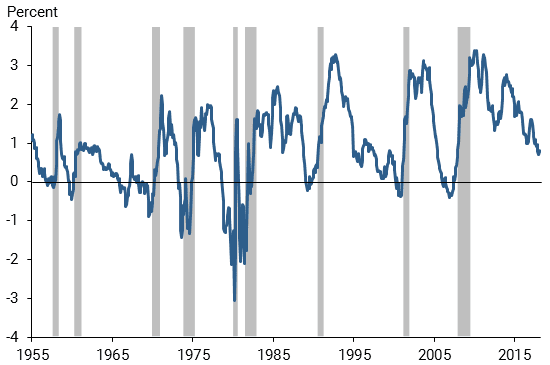
First, a brief explanation of an interest rate. The interest rate is the amount, either in percentage or dollar amount, charged by a lender to a borrower for the use of their assets. Essentially, it is the cost of borrowing money. There are multiple factors that go into account for the interest rate, whether that be for a loan on a house, on stocks, and on bonds. One of the factors is that of time, and this is where the yield curve comes in. Typically, a ten-year Treasury bond has a higher interest rate than a two-year Treasury bond to compensate the lender for the time difference. The difference between the two interest rates is referred to as the "spread." A positive spread means that the interest rate for the ten-year bond is higher than that of the two-year bond. The normal spread will take the shape of an upward-sloping yield curve, as is depicted below.


That is what happens with a normal yield curve. That is not always the case. Sometimes, there are moments when the short-term bonds have higher interest rates than long-term bonds. This moment is referred to as an inverted yield curve. What an environment with a negative spread would mean is less profitability for banks. While you might not necessarily care about banks or the U.S. Treasury, this has investors spooked. 

Likelihood of a Recession
This is particularly irksome for investors because an inverted yield curve is related towards higher risk of a recession. How much higher exactly? A 2018 economic paper from the Federal Reserve Bank of San Francisco (FRBSF) points out a scary fact: every recession in the past 60 years was preceded by an inverted yield curve. This trend is not only true in the United States, but in other developed nations. The FRBSF goes as far as calling the yield curve "one of the most reliable predictors of future economic activity."


There are a couple of things worth noting. The first is that FRBSF found that the recessions take place six to twenty-four months after the yield curve inverts. Assuming 100 percent accuracy, that means we could have until the end of 2020 before the United States experiences a recession. The Federal Reserve Bank of Cleveland (FRBC) indicates in its analysis that there were two false positives: one inversion in late 1966 and one flat yield curve in late 1998. This would imply that treating the yield curve as infallible is not accurate.

The FRBC is also hesitant on using the yield curve as a predictor for two reasons. The first is that the probability itself is subject to error. The second is that yield curves do not function in the same way as they did in the past, and that is due to different underlying determinants. For example, yield curves have historically been brought on by tight monetary policy. Right now, we have lower interest rates than the historic average, so that case is hard to make. The quantitative easing has distorted the long end of the yield curve. To adjust for it, the Federal Reserve came up with the alternative measurement of the "near-term forward spread," which seems to have better predictive power. Fortunately, this spread has not indicated a recession as of yet. Also, the spread between three-month and ten-year bonds is a more accurate predictor than with the two-year-bonds, and fortunately, there has not been an inversion between three-month and ten-year bonds.

Conclusion
Historic data suggest that a recession is coming soon. Even if we were to set aside the yield curve, we could be worried about contagion from Italy's budgetary woes or the Brexit. We could be worried about Trump's trade policy or the Fed's monetary policy. On the other hand, there are multiple positive economic indicators, including GDP growth, low unemployment, and high consumer confidence. We could fret over the fact we're in the longest bull market in history by saying "we're due for another recession" or we could learn how to keep the bull market going for even longer. I do worry about a recession because a) economies have booms and busts, and b) we have indicators in the global economy that could derail the bull market. At the same time, I am not quite ready to say that this yield curve inversion signals an imminent recession. Even the Federal Reserve of New York predicts an 11 percent chance of a recession in the next year. At this juncture, I will take a "wait and let's see" approach to see what happens within the next year.

Tuesday, May 29, 2018

Dodd-Frank Reform a Huge Dud: Why We Need to Repeal Dodd-Frank

The Great Recession was the worst financial crisis since the Great Depression. It hit millions of people across the globe as jobs and wealth disappeared. In response to this catastrophe, the United States government passed the Dodd-Frank Wall Street Reform and Consumer Protection Act (Dodd-Frank). This bill was the most significant financial reform to take place in the United States since the Glass-Steaggal Act (see my analysis on that Act here). The purpose of Dodd-Frank, according to the Act itself, was to "promote the financial stability of the United States by improving accountability and transparency in the financial system, to end "too big to fail," to protect the American taxpayer by ending bailouts, to protect consumers from abusive financial services practices, and other purposes." What I would like to do today is see if Dodd-Frank accomplished its primary goals (Congressional Research Service primer on Dodd-Frank here), whether there were unintended consequences, analyze the Dodd-Frank reform bill that passed last week (S.2155, also known as the Economic Growth, Regulatory Relief, and Consumer Protection Act), and subsequently determine whether this reform bill was the best course of action.

There have been some good things to come out of Dodd-Frank. The Minnesota Federal Reserve Bank found that Dodd-Frank reduced the probability of a bailout in the next 100 years from 84 percent to 67 percent. The Wharton School of Business points out that Dodd-Frank provided oversight over payday lending, includes measures to protect retirement money savers from abuse, and has disclosure requirements on derivatives and for oil companies on their payments to foreign government. For another, the Left-leaning Center for American Progress calculated that for every dollar of funding provided to the Consumer Financial Protection Bureau (CFPB), it has returned $5 dollars to victims of financial wrongdoing (or $12 billion in total). If you want a better view of CFPB, here is my literature review of CPFB from two-and-a-half years ago.

Nevertheless, there are multiple issues to take with Dodd-Frank, as are pointed out in detailed criticisms from the Heritage Foundation and Mercatus Center (also see Brookings Institution analysis here for a mix of praise and criticism). Here are but a few I found while conducting research on the topic:

  • Effects on community banks and credit unions. In December 2015, the Government Accountability Office (GAO) found that community banks and credit unions are disproportionately hurt by Dodd-Frank because they do not have the same capacity that larger banks do to handle compliance. As a result, these smaller financial institutions have reduced the availability of credit to their customers. A working paper (Lux and Greene, 2015) from Harvard University confirms the GAO findings. This paper calculated that commercial banks' assets declined at a rate more than double than that between 2006 and 2010. The authors contributed this decline to Dodd-Frank. 
  • Cost of borrowing for small businesses. Evidence suggests that borrowing for small businesses became more expensive since 2010, which hampers job creation and investment (Chen et al, 2017). Another study from the National Bureau of Economic Research confirms that commercial and industrial loans dropped nine percent since Dodd-Frank, and was due to said regulations (Bordo and Duca, 2018).
  • Price tag of regulatory compliance. According to the American Action Forum, eight years of Dodd-Frank has cost $38.9 billion and 82.9 million man-hours. That exceeds the $12 billion recovered by CFPB. 
  • Cost to Consumers. The American Action Forum also found that Dodd-Frank is responsible for cutting revolving credit by 14.5 percent. This is important for consumers because as the World Bank discovered, there is a strong correlation between financial inclusion and economic growth or employment (Cull et al., 2014).
    • Middle-Class and Mortgages. Another cost is squeezing the middle class out of the housing market. According to a study from the University of Maryland (D'Acunto and Rossi, 2016), the combination of a 3 percent cap on mortgage-related service fees and a more costly process for verifying customer's income. This change in underwriting incentivized banks to slash the number of loans at the median income and target wealthier individuals.
  • Less competition in the banking sector. There is a study that took a look at Dodd-Frank's effects on bank acquisition behavior (Bindal et al., 2017). This study is important because it shows unintended consequences of Dodd-Frank creating more regulations for banks with more than $50 billion in assets. On the one hand, very small banks are more likely to partake in acquisitions. On the other hand, they make sure to stay below the $50 billion mark so that they do not get hit with Dodd-Frank regulations. This is significant because it creates a barrier to entry in the mega-bank submarket, which solidifies market share and overall power for the already-existing mega-banks. It is another example of how regulations squash the smaller business owner, protect big business owners, and artificially encourage business consolidation, thereby perpetuating the cycle.  
  • Big banks are not safer. A study from Lawrence Summers, a major supporter of Dodd-Frank, concluded that big banks are not safer, even in spite of decreased leverage (Summers and Sarin, 2016).
  • Financial sector not healthier. A study from the National Bureau of Economic Research suggests that it was post-crisis regulations that are strangling financial sector growth (Chousakos and Gorton, 2017).
Dodd-Frank Reform Bill and Conclusion
If you look at the reform bill, there was not much that was reformed relative to what was initially enacted in 2010. Yes, the bill is going to ease up on supervision, which is one of the major contributors to Dodd-Frank's regulatory costs (see above). It is also exempts smaller banks [with $10B or less in assets] through the community bank leverage ratio. The SIFI (Significantly Important Financial Institution) threshold increased from $50B in assets to $250B, although there are multiple caveats attached in the Senate bill. There will also be some deregulation on stress testing, i.e., companies only have to perform two stress tests instead of three. In short, the bill primarily provides targeted relief for smaller banks.

In its analysis, the Congressional Budget Office (CBO) finds that the bill will slightly increase probability of financial crisis, although it fails to qualify that further. Former Congressman Barney Frank, who was a co-author of the bill, thinks that the reform will not make a big dent into the impact of Dodd-Frank. From Frank's standpoint, that's probably a good thing. The good news is that it doesn't like the bill is going to cause catastrophe to the U.S. financial system.

I will say that although the bill goes in the right direction, it is still inadequate. Being an 849-page bill with over 27,000 regulations, Dodd-Frank still has a stranglehold on the financial markets. Even the GAO admitted that Dodd-Frank did nothing to simplify oversight over the financial sector (see below). I know that this compromise bill was passed because they could not get votes for downright repeal. However, I still contend that even in spite of certain advantages to Dodd-Frank, repeal is still a desirable goal.


For more on financial regulation reform, see analyses from Manhattan Institute and Heritage Foundation