Showing posts with label United Nations. Show all posts

Monday, July 6, 2026

United Nations Falsely Accuses Israel of Genocide: Targeting Children Edition

Astronomer Carl Sagan once said that extraordinary claims require extraordinary evidence. That principle is especially relevant when the claim in question is not merely whether a military has committed wrongful acts in war, but that it has deliberately targeted children as a part of a broader strategy amounting to genocide. In both moral and legal terms, this is among the most serious accusations that can be leveled against any state or armed force. The accusation of targeting children heightens the claim because under humanitarian law, children are treated as a protected category. It also implies a level of moral depravity and legal culpability that international law reserves for the worst of the worst.

Yet a recent United Nations Commission report precisely makes that allegation against Israel in the context of the war in Gaza. It concludes that Israel not only caused widespread death and suffering, but that it formed part of a broader strategy to destroy the future of the Palestinians in Gaza by targeting children as a "biological and social continuity" of that group.  

This is not the first time that the UN has advanced sweeping claims against Israel that later proved controversial or methodologically fragile. The UN falsely accused Israel of causing food shortages of Gaza, implying it was part of some master strategy to starve Gazans. The UN also blindly accepted Gazan casualty statistics that exaggerated children fatalities, with the effect of making it look like the Israeli Defense Forces (IDF) were targeting women and children. The UN perpetuating refugee status and Jew-hatred under UNRWA also does not help matters.

This does not by itself prove the UN's latest allegations false, but it does warrant extraordinary caution of what the UN claims. Therefore, it is necessary to determine whether the Commission's findings themselves actually confirm if the IDF deliberately targeted children in Gaza or not. 

To conclude that Israel deliberately targeted children, the Commission would need produce evidence of intent, not merely evidence of harm. In the law of armed conflict, intent may be established from direct proof, whether it is orders, directives, or communications. This was the sort of thing observable during the Nanjing Massacre, the murder of children during the Holocaust, ISIS targeting Yazidi children in Iraq, and the Srebrenica massacre. Alternatively, such intent could be inferred through highly compelling circumstances evidence that excludes reasonable alternative explanations. 

The Commission does not present this kind of evidence. Instead, it infers intent from the scale and pattern of child casualties, assuming that a) each child killed in Gaza was killed by the IDF, and b) the child was targeted simply because a child died. Another way to put it: what the UN Commission does is it makes the evidentiary leap from "children have died in this war" to "Israel is targeting children." But even if one were to acknowledge the existence of large-scale harm, that by itself does not prove intent. 

As I have explained before when refuting false claims accusing Israel of committing genocide, for something to be considered genocide, one would have to be able to infer that genocidal intent is the only reasonable inference from the evidence. Here are some things that the United Nations conveniently leaves out of or minimizes in its reporting that show that is far from the case. 

We have to remember that it was Hamas that started this war by raping, kidnapping, torturing, and murdering over 1,200 civilians. Since 1948, Israel has been surrounded by Arab entities that want to wipe it off the map, including the genocidal entity known as Hamas. That by itself does not give the IDF a carte blanche to do what it wants in response. But what follows points out that genocide is not a reasonable conclusion based on the evidence. 

Civilian casualties are sadly a consequence of armed conflict. Children casualties are going to be an outcome given that about half of Gaza's population is under 18. More to the point, Gaza is one of the most densely populated battlefields in modern history, making this outcome even more inevitable.

There is one other sad truth to acknowledge: not all individuals under 18 in this conflict zone are necessarily noncombatant casualties. Armed groups in Gaza have been known to recruit and train minors to participate in hostilities against Israel. This further underscores why aggregate references to "child casualties" is insufficient, and is one other area in which the UN overstates their case. 

Even if one were to accept the Commission's casualty figures (which again, I would hesitate since the UN has accepted exaggerated casualty numbers before), neither a high civilian death toll nor a particular civilian-to-combatant ratio can substitute for genocidal intent. 

Hamas has a long-standing practice of using its civilians as human shields. The UN also ignores that Hamas has embedded vast tunnel networks, weapons stockpiles, booby-trapped buildings, and command facilities in civilian infrastructure. Without this context, the UN does not capture the complexities that the IDF faces while fighting Hamas and dismisses that these deaths could have been caused by crossfire, militant Hamas activity, or an unfortunate consequence of urban warfare. 

Furthermore, Israel's conduct is inconsistent with genocidal intent. The IDF has put warnings to civilians out before strikes (e.g., evacuation notices, phone calls, text messages), which no other military in history has done because they would lose the tactical advantage and incur military cost. The IDF has also allowed for humanitarian corridors and humanitarian aid to enter to reduce civilian suffering. 

Another point: Israel has a multi-ethnic and multi-religious population that includes about 2 million Muslims who are given equal rights under the law. It would be an odd policy for a government that was intent on exterminating Muslims to simultaneously extend full legal equality to Muslims in its borders. But then again, these are the sort of loops that the anti-Israel side jumps through to believe in this accusation. 

Ultimately, the UN does not prove evidence showing its headline allegation that the IDF is targeting children. All of this context in the previous paragraphs provides a reasonable, alternative explanation for the scale of child casualties in Gaza. However, the report gives those alternative explanations insufficient considerations and jumps straight to genocide as the only explanation, which is out of touch with the reality on the ground. This sort of inferential leap without sufficient evidence not only should give us reason to pause, but for any rational and sane person, it is yet another example that puts the UN's supposed objectivity and impartiality into question.

Monday, January 5, 2026

Israel Recognizing Somaliland and the Awkward Truth About Secession

For most of the world, Somaliland is not even a blip on the radar when it comes to international politics. Formerly a British protectorate, Somaliland voluntarily united with Italian Somaliland in 1960 to form what is known as Somalia. But after years of dictatorship and civil war, Somaliland declared independence in 1991. Out of the wreckage of Somalia's collapse emerged the semi-free, democratic, mostly peaceful nation of Somaliland. It has held elections, collected taxes, and policed its borders. In spite of governing itself for over three decades, the international community has largely pretended that Somaliland is not a real state. 

Israel changed that equation a little over a week ago by recognizing Somaliland. By becoming the first country to acknowledge the nation, Israel took a step that other countries have avoided for years. To be perfectly clear, Israel is not doing this out of the kindness of its heart. It is a geopolitical move in which two rational actors voluntarily enter diplomatic relations. 

Why Recognition Benefits Both Parties

Somaliland sits on the Gulf of Aden, which would give Israel better access to the Bab el-Mandeb Strait. This is more useful given that Yemen lies along the Gulf, which would help Israel with maritime security and intelligence gathering. Generally speaking, Israel's diversification of its diplomatic and economic relations has been a part of its international policy. I pointed it out in 2017 with Israel and India, and I would point out that the Abraham Accords are another example of that. 

Israel is not the only one that stands to benefit. For Somaliland to receive recognition from even one state can break the years of diplomatic isolation that has plagued Somaliland. This recognition and subsequent recognition from other nations could improve foreign investment and trade relations, all of which can integrate Somaliland into the global economy and the diplomatic community. This recognition is another reminder that Jews and Muslims can indeed get along, but I will set that aside for the moment. 

The Objections: Borders, Precedent, and Institutional Norms

Mutual benefit is a feature of sound foreign policy, but that did not stop critics from coming out: 

  • Somalia believes it is aggression and a violation of their sovereignty. Its claim has nothing to do with governance, consent, or control. It is solely based on legal continuity, not the reality of Somaliland's governance, which I will cover more momentarily. 
  • The African Union objects because the borders at the time of independence should be preserved. This is in spite of the fact that Somaliland's borders are by and large the same as they were when it was a British protectorate prior to its unification in 1960. 
  • China is upset for two reasons. One is that it has significant investments in the region, and does not want to risk losing money. The second is that it could set precedent or inspire Taiwan or Tibet. 
  • The United Nations is less than thrilled because Israel and Somaliland bypassed their institutional norms. I can hardly blame Israel for not wanting to deal with the UN given its long-standing bias. And it is not exactly as if the UN has been there for Somaliland in terms of security or development. This recognition undermines the UN's institutional legitimacy while exposing its limitations. 

Debunking the Criticisms 

When you scrutinize these arguments, they strain credulity. Somaliland has not engaged in war since its independence in 1991, which minimizes the "regional instability" argument. As for the "borders are sacrosanct" argument, critics worry that Somaliland sets precedent other entities to want to secede, such as Scotland, Quebec, or Catalonia. Yet the world accepted the unilateral secessions of Bangladesh, South Sudan, and Kosovo without the outcry that is going on with Somaliland. And yet none of those secessions led to a secession domino effect. 

Somaliland Meets the Montevideo Convention

The reality is that Somaliland has functioned peacefully and autonomously from Somalia for over three decades. When I discussed other countries recognizing Palestinian statehood last September, I brought up the Montevideo Convention, which is the most widely used definition in international law to define a state. To be intellectually consistent, I will use those four criteria: 

Defined territory - Somaliland has a clearly defined territorial claim that corresponds almost identically to the borders of the former British Somaliland Protectorate.

Permanent population - Somaliland has a permanent population over 6 million people who have resided there on a long-term basis.

Capacity to conduct diplomatic relations - Somaliland has maintained informal diplomatic relations with other countries, hosts representative offices, and engages with international organizations. Israel's recognition of Somaliland strengthens the argument for its capacity. 

Single functioning government - Somaliland has had a single functioning government since 1991. It operates under a constitution approved by referendum, holds regular elections, has functioning courts, collects taxes, and maintains overall good control over its borders. This governance has been internal and self-sustaining, and has not needed foreign peacekeepers or international administration.  

Political Reality Trumps Abstract Norms

Ultimately, the objections to recognition are about maintaining territorial claims, avoiding precedent, and defending institutional authority, not about the people or their political reality. Somaliland has existed peacefully and autonomously for over three decades. To deny recognition in the name of abstract principles or potential "inspirations" for other secessions is to ignore the empirical reality on the ground. Pragmatic recognition, as Israel has undertaken, acknowledges what Somalilanders have built: a stable, self-governing polity whose place in the international system is long overdue. Refusing recognition to preserve theoretical rules that are outliving their usefulness is merely authoritarianism disguised as diplomacy. If countries want to operate in the empirical state of what is going on in Africa in 2026, they ought to recognize Somaliland, engage constructively, and let political reality guide diplomacy, instead of clinging onto delusions of what borders should be like.

Monday, July 28, 2025

A Famine of Truth: Hamas and the U.N. Are to Blame for Food Shortages in Gaza

Fighting between Israel and Hamas has been ongoing for over two years in the Gaza Strip and there seems to be no end in sight. There are still 50 hostages being held by Hamas, in addition to the loss of life of Israeli soldiers. The Palestinian side has not only experienced a loss in civilian life, but food insecurity has also been an ongoing issue for Gazans throughout this conflict. Starvation of civilians is as heartbreaking as it is inevitable in a war zone, and it has made rounds in the news cycle once again.

This past Tuesday, the United Nations sounded the alarm that famine in Gaza is imminent. The famine warnings are bad enough that France, Germany, and the United Kingdom called for a ceasefire this past Friday. The mainstream media condemned Israel, including such outlets as the Guardian, CNN, NBC, and the New York Times. Of course, you did not see that sort of condemnation with the economic sanctions on Syria making lives more difficult for Syrian civilians, but I digress.

The famine accusation is nothing new. The World Health Organization said back in March 2024 that it was "imminent." In January 2024, the United Nations said that Gazans were facing famine in January 2024, although the UN's Famine Review Committee later got around to admitting in a May 2024 report that the allegations of an ongoing famine are unsubstantiated, as was a follow-up November 2024 reportYet neither the United Nations nor the WHO have formally declared a famine as of date, in spite of warning about it for months. This might be because there has not been a famine. As we will see shortly, the situation on the ground is more complex than the mainstream media lets on. 

Let us start with how the people of Gaza got into this mess in the first place. Hamas, the de facto ruling power in Gaza, started a war with Israel by raping, kidnapping, and murdering civilians on October 7, 2023. If Hamas did not instigate a war with a superior military power by committing the worst pogrom against Jews since the Holocaust, this suffering in Gaza could have been avoided. After all, in what other conflict or war in history has the "international community" asked a country to feed its enemy after the enemy attacked its civilians? Were the Allied powers supposed to provide humanitarian aid to Nazi Germany? Do we expect Ukraine to feed Russians after Russia started the Russo-Ukrainian War? I do not think so. 

One could argue that because Israel has a genocidal neighbor on its western border intent on wiping out Israel, Israel has no moral obligation to help out such an enemy. This also does not take into account the reality that Hamas could have ended the conflict months ago by returning the hostages, but has not done so. Gazans could live in peace with their Israeli neighbors, but choose not to because the majority of Gazans would rather not have an Israeli nation exist. Even if you want to cite the Fourth Geneva Convention (Article 23) as a basis for Israel to help facilitate humanitarian aid, there is still a minor wrinkle in all of this: Israel has been and continues to facilitate the distribution of humanitarian aid to Gazan citizens. 

From January 2024 to July 2024, Israel supplied 478,229 metric tons of food to Gazans (Fliss-Isakov et al., 2025). This is the equivalent of about 3,000 calories a day, which is above the average recommended caloric intake is in the United States. It is not merely Israeli data that confirms the entry of 1.9 million tons of humanitarian aid into the Gaza Strip. The U.N. database for Supplies and Dispatch Tracking (see below) shows that humanitarian aid has been entering the war zone throughout the conflict. 

If Israel were using starvation as a weapon, they would not have been facilitating the entry and distribution of humanitarian aid into Gaza. If Israel wanted to starve the Gazans, they would simply cut off their food supply and let them die. And if Israel were hellbent on destroying Gaza, there are more effective ways that do not endanger Israeli lives than fighting a defensive war. The claim that Israel wants to commit genocide against the Palestinians is simply fallacious (see herehere, and here), especially since you do not send humanitarian aid to or feed a population you are trying to wipe off the planet. Israeli and UN data show that using starvation as a weapon is far from what is happening. Plus, I have pointed out how Israel has taken more precautions than any other army in history to minimize civilian suffering, thereby further diminishing the "Israel is out to get them" argument.

If Israel is helping out, then why are Gazan civilians still starving? Last Friday (July 25), there were 950 trucks piled with 2,500 tons of food sitting idle in Gaza. The U.S.- and Israel-backed Gaza Humanitarian Foundation (GHF), which began operating in May 2025 to help distribute humanitarian aid to Gazans, offered to distribute the food sitting in the warehouses. However, the United Nations refused the GHF's help. This incident is but one example of what the situation faces with respect to food distribution.

It does not surprise me that the United Nations Relief and Works Agency for Palestinians in the Near East (UNRWA) does not want to help GHF with the task alleviating starvation in the Gazan war zone. As I brought up last year, UNRWA has sowed the seeds of victimhood and anti-Semitism that have allowed for Hamas to proliferate. Unlike other refugee organizations, UNRWA is not mandated to help resettle refugees. If anything, UNRWA has structural incentives that discourage it from resolving the crisis because expanding refugee rolls perpetuates UNRWA's large budget and continued donor funding. That same mechanism is in play with the food shortage. 

UNRWA's institutional survival is contingent upon a large, dependent population. Crisis perpetuation attracts more humanitarian aid, not to mention that UNRWA is deeply entangled with the local power structures in Gaza, i.e., Hamas. Essentially, UNRWA's financial structure and institutional incentives do not reward resolving starvation, but rather reinforce a cycle of dependency and suffering. This refusal to work with outside humanitarian distributors underscores how UNRWA's operational control, as well as its incentives to maintain a dependent population, can obstruct effective relief delivery, even amid starvation.

It is not only UNRWA that reinforces suffering in Gaza. While the people of Gaza bear responsibility for electing Hamas and enabling Hamas' extremist ideology to flourish within Gazan society, they also live under an authoritarian terrorist organization that suppresses dissent and leaves few viable political options available, all of which fuel a cycle of violence and hate. It is especially sad for the children living in Gaza because they did not vote Hamas into power and cannot leave Gaza even if they wanted to leave. It is Hamas' violence and extremist ideology that help perpetuate the conflict in the Middle East. 

That extremism includes such tactics as stealing humanitarian aid meant for civilians and profiting off of those commandeered goods, which the Left-leaning Washington Post got around to admitting to last week. As I have brought up before and as the Henry Jackson Society illustrates in its April 2025 report on the topic, stealing humanitarian aid is part of Hamas' greater modus operandi of using Gazan citizens as human shields

In addition to stealing humanitarian aid, Hamas commits such acts as using humanitarian zones for military purposes, launching rockets from civilian sites, has a tunnel network built under civilian infrastructure, and use civilian structures as combat and weapons storage. By doing so, they garner international support, which is seen by the response of many in the West. 

[7/31/2025 Addendum: After writing this post, this UN database that has been monitoring UN aid since May 19, 2025 was brought to my attention. It turns out that 85 percent of the collected aid, in terms of tonnage, was intercepted, either by crowds or armed individuals. This is not coming from the Israeli government, but on the United Nation's website for all the world to see. Some journalistic scrutiny instead of posting Hamas lies would be helpful.]


Delivering humanitarian aid in a war zone is difficult in the best of circumstances. Since it is compounded by UNRWA's incompetence and Hamas' extremism, it makes the suffering of Gazan civilians all the worse. As long as the world believes Israel is responsible, Hamas will continue to benefit from the moral cover, international funding, and political oxygen it needs to maintain power and bring suffering to the Palestinians that human rights activists claim to care about so much. If the world actually cares about Palestinian suffering, it has to confront Hamas' culpability with such substantial action as targeted sanctions on Hamas leadership or an independent humanitarian oversight mission. Until then, Gazan citizens will continue to suffer: not because Israel is starving them, but because Hamas is using their starvation as a weapon of war. 

Thursday, July 17, 2025

No #MeToo for Israeli Women: The International Community Turned a Blind Eye to Hamas' Sexual Violence on October 7

 October 7, 2023, was a horrific day for Israel. A barrage of militant Hamas terrorists crossed into Israeli territory to carry out the worst pogrom against Jews since the Holocaust. Not only was there murder, kidnapping, and torture, but Hamas terrorists also used sexual violence against Israeli women. If this attack had happened in any other country, I imagine that advocates against sexual violence would not have equivocated and would have spoken up right away against such atrocities. However, since the October 7 attack took place in Israel, the "international community" took a different approach. 

In its press release on October 13, 2023, UN Women did not acknowledge the sexual assault of Israeli women and mostly talked about the humanitarian situation in Gaza, which is peculiar since Israeli Defense Forces did not have a physical presence between 2005 and October 23, 2023 when the IDF launched its full-scale incursion in Gaza. It took UN Women nearly two months to issue sort of any condemnation. When it did, UN Women could not help but partake in false equivalence. To its credit, the United Nations did eventually get around to admitting in 2024 that there are reasonable grounds that sexual violence took place in multiple places by Hamas on October 7. 

Neither Amnesty International nor Human Rights Watch (HRW) were much better in terms of being able to unequivocally condemn Hamas. HRW could not sufficiently condemn Hamas for its barbarism shortly after the attack, and did not even address Hamas' sexual violence. It took HRW until June 2024, or nine months later, to come out with a report acknowledging the sexual violence during the October 7 attacks. In contrast, HRW has swiftly condemned the sexual violence in Congoin the DRC, and Sudan . 

On October 13, 2023, Amnesty International could not clearly criticize what Hamas did without condemning Israel in a manner that was tantamount to victim-blaming. Amnesty International unequivocally and quickly reported on the rapes committed by Tigray fighters in Ethiopia and the gang rapes of Rohingya women in Myanmar without equivocating. In contrast, Amnesty's December 2023 report on what happened on October 7 only confirmed one rape, which as we will see shortly, is an understatement of what happened.

This brings us to the Dinah Project, which is an Israeli group founded to advocate for the victims of conflict-related sexual violence (CRSV) during the October 7 attacks. Last week, the Dinah Project released a report entitled A Quest for Justice: October 7 and BeyondNot only does this report extensively document over 15 cases of CRSV committed by Hamas and provides a legal framework to hold Hamas accountable. It makes the argument that the acts of CRSV were not individual acts. Instead, the sexual violence was a deliberate, ideologically motivated, and systematic tactic central to Hamas' genocidal goals, something which I have brought up before


This blatant one-sidedness is not new. In 1975, the United Nations passed a resolution falsely stating that Zionism is racism. Although the resolution was overturned in 1991, that animus remains to this day. It does not matter that there are actual human rights abuses taking place in the world. Israel is disproportionately vilified with such false accusations as apartheid, occupation, and settler colonialism. A few months ago, I had to refute Amnesty International's claim that Israel was committing genocide (see herehere, and here). 

So why the tempered or delayed responses from human rights organizations? Why are there so many on the Left, the Far Left in particular, who ignore the mounting evidence of sexual violence against Israelis and are incapable of condemning the terrorist group Hamas? Why is Israel subject to such frequent, intense, and disproportionate condemnation while so many of these critics ignore real human rights abuses and oppression? Shortly after the October 7 attacks, I asked myself why the "progressive" Left would be on Hamas' side because it was perplexing to me (see here and here). After examination, I was able to get past why the "progressive" Left would not side with a minority group that has been persecuted for centuries. 

With identity politics leading the way, the "progressive" Left can only see in terms of the oppressor and the oppressed in very black and white terms. For them, Israel is the oppressor. Acknowledging Hamas' usage as a weapon of war would have refuted the oppressor/oppressed dichotomy favored by many international actors. Moreover, the state of Israel is a repudiation of victimhood. Israel shows that a minority as oppressed as the Jews can overcome discrimination, stigma, and genocide to the point of creating a flourishing state. Leftist ideology loses credibility if minorities overcome adversity because it means we humans are not merely victims of circumstances. 

In contrast, the Palestinian cause is the personification of victimhood, which is why the Far Left clings to it so dearly to the point where Hamas can do no wrong and Israeli victims' suffering does not release them of being supposed "oppressors." Pro-Palestinian individuals cannot view Hamas as anything but virtuous. To do otherwise would be admitting that their worldview is not only wrong, but morally depraved. Conversely, if the Far Left has excused the likes of Stalin and Mao Zedong killing millions, why would they have moral qualms with the sexual violence perpetrated by Hamas? 

Anti-capitalist sentiment could explain why the Far Left would defend Hamas rapists and not care about Israeli victims. Earlier this month, the United Nations Human Rights Commission (UNHRC) released a report entitled Forever Occupation, Genocide, and ProfitThis UNHRC report was incapable of acknowledging that Hamas started the current war, that they systematically carried out murder and sexual violence, or that there are still hostages. What did the report conclude? "The enduring ideological, political, and economic engine of racial capitalism has transformed the Israeli displacement-replacement economy occupation into an economy of genocide." Much like I argued in 2023, Jews and the state of Israel personify capitalism and all the evils that anti-capitalists see in capitalism.

Whether Israel is viewed as oppressor, capitalist, or rejector of victimhood that the Far Left loves all too much, this is how "human rights advocates" can reach such a level of moral distortion. What Israel represents to these people is so reprehensible that they can contort facts and their perception of current events to believe that rape is resistance. The #MeToo movement died shortly after the October 7, 2023, because of these double standards. Major human rights organizations have failed in their respective missions. It is this overall indifference towards the suffering of Israeli women that caused the Dinah Project to come into being. 

We live in troubled times with anti-Semitism that I previously thought was relegated to history books. Yet we are seeing and documenting horrid anti-Semitism in real time. We are seeing that sexual violence does not matter if the victim is Israeli or Jewish. We see that it has lamentably become acceptable to attack and murder Jews across the world in order to "globalize the intifada." As a survey from the Anti-Defamation League shows, it is how the United States has stooped low enough where 24 percent of Americans found that violence against Jews is "understandable." 

Given the entrenched hatred for Israel and for Jews in multiple international organizations, I remain skeptical as to whether the victims of the October 7 attacks will receive the justice they deserve. Until the world can view Hamas as the Islamist, regressive, homophobic anti-Semites that they are, and until people can realize that it is the Palestinians who embody everything the anti-Zionists accuse Israel of, most people will continue to cling to the moral inversion in which it is "understandable" to attack Jews and where #MeToo does not apply to Jews or Israelis. Even so, I hope that the Dinah Project is a first step to pursue justice for those who suffered at the hands of Hamas terrorists and could also be used as a framework to legally punish anyone who commits sexual violence in conflict. There is no acceptable instance in which rape is resistance. As we move forward, let us not forget who stood up for victims of sexual violence and who stood on the side of genocidal rapists.

Monday, February 12, 2024

UNRWA Is an Ineffectual, Anti-Semitic Organization That Exists to Perpetuate Victimhood and Conflict

As if there were not enough twists and turns in the Israel-Hamas War, this development has to do with the United Nations Relief and Works Agency for Palestinian Refugees in the Near East (UNRWA). UNRWA was founded in 1949 to provide humanitarian relief to Arab refugees as a result of the Arab-Israeli War of 1948. Remember this is the same war that the Arab nations started after the United Nations proposed a plan (UN Resolution 181) that would have allowed for an Israeli state and Palestinian state to live side-by-side.

The latest UNRWA controversy has to do with the October 7 attack, which was the single largest attack and murder of Jews since the Holocaust. Forget the report from UN Watch that shows a Telegram group of 3,000 UNRWA teachers celebrating the October 7 attack. According to Israeli intelligence, 12 UNRWA employees were involved in the October 7 attack (WSJ). Not only that, but 190 UNRWA employees are also Islamic jihadists. If that were not enough, 10 percent of the UNRWA employees in Gaza have ties to Islamic terrorist groups. Secretary of State Anthony Blinken found the sources to be "highly, highly credible." Apparently, it has been credible enough where several major donor countries, including the United States, Germany, Canada, Sweden, and France, have temporarily suspended funding to UNRWA. 

UNRWA replied by stating that if its funding does not resume, it could be forced to close down its doors by the end of February. The pro-Palestine side laments this, to be sure. From this vantage point, UNRWA is an "omnipresent municipal service provider." For UNRWA proponents, the humanitarian work of UNRWA should not be eclipsed by a few bad apples in the organization, even if those bad apples are alleged pogromists that participated in the worst slaughter of Jews since the Holocaust. 

Funny how the woke crowd thinks that we should give UNRWA more funding, but is the same Far Left that called for "defund the police" after a few bad apples and that we should eradicate racism (which apparently does not include Jew-hatred), but I digress on their intellectual inconsistency. I would contend that the rot in UNRWA goes beyond a few bad apples, especially since the pro-Palestine Al Jazeera reported on the abuse of power of UNRWA leaders. This includes Pierre Krähenbühl, the ex-UNRWA leader who was accused of nepotism, sexual misconduct, abuse of power, and bullying. 

Aside from corrupt leadership, UNRWA has supported terrorism and anti-Semitism for many years. This rot predates the numerous UNRWA employees who reacted positively to the October 7 attack. The European Parliament recognizes that Palestinian textbooks teach Jew-hatred, which is illustrated by the Georg Eckert Institute's report on Palestinian textbooks. This trend is confirmed by a November 2023 report from the Institute for Monitoring Peace and Cultural Tolerance in School Education (Impact-SE), as well as a report from UN Watch in March 2023 illustrating how UNRWA teachers incite Jew-hatred. These Palestinian textbooks have been so riddled with anti-Semitism that the United Nations admitted in 2019 that the anti-Semitism in these textbooks exists to "fuel hatred and may incite violence."

If the systemic anti-Semitism at UNRWA is not enough to convince you about how UNRWA contributes to the perpetuation of conflict in the Middle East, let us examine the nature of the organization itself. But first, some information on the role of the United Nations and helping refugees. The United Nations operates two organizations to the cause. The first is the United Nations Human Rights Commission (UNHCR), which is dedicated to the plight of refugees globally. The second is UNRWA, which is focused on Palestinian refugees. Here are some figures about UNHCR in comparison to UNRWA:

  • UNHCR has 18,879 staff (as of 12-31-2022) to help 29.4 million refugees under UNHCR's mandate. UNRWA, on the other hand, has 30,000 staff that cover 5.9 million individuals under its mandate. This means that UNRWA has over 11,000 more staff to help out over 23 million fewer people than UNHCR. 
  • This, of course, does not include the 70-plus million refugees and asylum seekers not covered under either organization. 
  • In terms of funding, that is for $10.80 billion for UNHCR and $1.47 billion for UNRWA in the year 2023. 
  • That would make the funding-per-refugee ratio $367 for UNHCR and $249 for UNRWA. 

As fun as it is to look through these data points, they beg the question as to why the Palestinians have their own separate refugee agency. Are their lives more important than the 2.5 million Sudanese that were displaced last year? That segues into how UNRWA treats refugees. With UNHCR, resettlement of refugees is one of the main goals of its mandate. For UNRWA, not so much. In UNRWA's own words, "UNRWA does not have a mandate to seek durable solutions for Palestinian refugees." 

The reason why UNRWA does not want to resettle Palestinians has to do with how UNRWA defines refugees. By UNHRC's definition, a refugee is "someone who has been forced to flee his or her country because of persecution, war, or violence." This lines up with how refugee was defined for Arabs displaced as a result of the Arab-Israeli War of 1948. However, that definition changed over time and has since applied to more people than the original 700,000 who were directly affected by displacement in 1948. In 1965, UNRWA's eligibility requirements extended to third-generation descendants of refugees. In 1982, that applied was expanded further to any descendant, regardless of whether they had been granted citizenship elsewhere. 

Under the 1951 U.N. Convention, specifically Article I(c)(3), a person is no longer a refugee if he or she "has acquired a new nationality, and enjoys the protection of the country of his new nationality." Not so with UNRWA. If the standard definition under international law were used, the vast majority of the 5.9 million that are covered under UNRWA's mandate would not be defined as refugees because they are not among those who left the modern state of Israel in 1948. Under UNRWA's definition, refugee status can be inherited over generations, regardless of where one lives or has citizenship. This helps ensure that its refugee rolls expand every year, which also provides a perverse financial incentive to ask for more funding instead of helping resettle Palestinians. 

This begs another question: How did other groups of refugees throughout history respond to displacement? During the Kashmir dispute, Pakistanis and Indians alike resettled. Germans after World War II resettled. Even Ukrainians who have been displaced in its current war with Russia are in the process of resettling. 

In response to Israel becoming a nation-state, the Arab nations ejected about 850,000 Jews from their lands. Talking about ethnic cleansing! Instead of claiming permanent refugee status, Israel and other Western nations absorbed those refugees. Israel also absorbed Arab refugees, which explains the Arab Israeli population of 1.7 million. Israel did so in spite of the series of wars that the Arab nations started in the hopes to wipe out the Jews. 

Every other refugee in history who has to leave their home for one reason or another finds a new home and resettles. Only the Palestinian "refugee" crisis has been perpetuated over the decades. UNRWA has been in existence for 75 years. You want to know how I know that UNRWA has failed in its mission? Because no other group of refugees has taken three-quarters of a century to get settled elsewhere. 

Even pro-Palestinian activist and blogger Ahmed Fouad Alkhatib acknowledged that UNRWA's presence [inadvertently] meant enabling Hamas to be reliant on UNRWA for governance. This, of course, means avoiding the inconvenient truths that Israel unilaterally withdrew from Gaza in 2005 and has been run by Hamas since 2007. 

If UNRWA were successful at helping refugees, UNRWA would have been dissolved years ago. The fact that it is still around only confirms that UNRWA exists to bolster Palestinian victimhood into perpetuity while being encouraged to blame Israel. By perpetuating and enlarging the "refugee" crisis, what UNRWA has done is keep the peace process more elusive while preventing Palestinians from living normal lives. As such, UNRWA should be abolished. If you want an organization to help the Palestinians, UNHCR or the World Food Programme (WFP) have a better track record than UNRWA. I will end with a quote from Spiked since they summarize the malaise so well: 

"In truth, UNRWA has helped to institutionalize a Palestinian politics of grievance, increase both local and global hatred for Israel, and provide spaces in which Gazan Islamists have been able to indoctrinate a new generation with the Jew hate that masquerades as 'Palestinian liberation.' Liberating Gaza from UNRWA ought to be at least a medium-term goal of everyone who cares about Israelis and Palestinians." 

Thursday, February 1, 2024

Some Inconvenient Truths In Response to the "Gaza Is an Open-Air Prison" Argument (Part II)

Last week, I began to scrutinize the argument that "Gaza is an open-air prison." In the first part, I pointed out a few inconvenient truths:

  1. The purpose of Israel's blockade and border fence is not to collectively punish Gazans, but rather to protect Israeli citizens from terrorist attacks.
  2. Israel withdrew from Gaza in 2005, which means that the "Israel was occupying Gaza" argument can readily be dismissed. 
  3. Hamas has been governing Gaza since 2007. As such, Hamas is responsible for the day-to-day well-being of Gazans, not Israel.
  4. Egypt shares a border with Gaza. Egypt chose to build a border wall on the Egypt-Gaza wall for the same reason as Israel: national security. 
  5. Neither Egypt nor Jordan are accepting Palestinian refugees, thereby closing off options to Gazans. 

I am going to continue with some other inconvenient truths in Part II, with particular focus on mobility, economic growth, and Hamas' corruption. Part of what makes a prison a prison is a [near] non-existent flow of people in or out of the confines. As such, net migration is another metric to determine whether or not Gaza is an open-air prison. Looking at data from the World Bank and the United Nations, what we see is that there is a net migration out of the country, which implies that Gazans have been able to leave the country. Gazans looking to emigrate to Turkey, for example, have to deal with Hamas' slow bureaucracy that makes it more difficult to leave Gaza.

It is not only in terms of migration or emigration in which the prison argument does not withstand scrutiny. As previously stated, the responsibility for governing the Gazans is Hamas', not that of Israel. Even so, Israel still helps out, which is impressive given the circumstances. Prior to the current Israel-Hamas War, Israel issued over 18,000 work visas for Gazan citizens to earn up to 10 times what they could in Gaza. This finding can be confirmed with data from the United Nation's Office for the Coordination of Human Affairs (OCHA). If someone is in a prison, that person is not allowed to leave and come back. Yet there had been a flow of Gazans entering Israel for work purposes prior to Hamas initiating a war against Israel.


It is not only people that are allowed to enter Israel to work, but also goods that are allowed to enter Gaza (see OCHA data below). During the current war, Israel has allowed humanitarian goods to enter Gaza. As we see from UN data, more goods were allowed to flow to Gaza in 2023 than it did in previous years. Here is another consideration. Israel providing what it does exceeds any expectations set in the Fourth Geneva Convention (Article 23) and the First Protocol of the Additional to the Geneva Conventions (Article 70). International law notwithstanding, on what planet is it normal or reasonable to ask a country to provide water and electricity to its enemy when that enemy has been using water pipes to create rockets that then kill Israelis? This brings me to my next point.....


Considering the adversarial nature of Hamas, it is generous that Israel would provide an economic lifeline at all. If Gaza were a true prison, Israel would have either greatly confined the flow of people and goods, or alternatively, completely shut off movement of labor or goods. Hamas refuses to "accept any international laws or set of rules that would allow peaceful interaction with its neighbors." Imagine what economic development there would be between Palestinians and Israelis if most Gazans did not hate Israel or Jews. My educated guess is that Gaza would not be nearly as prison-like if it were able to maintain positive relations with Israel instead of wanting to kill Jews. As I like to say, "those who trade together stay together." 

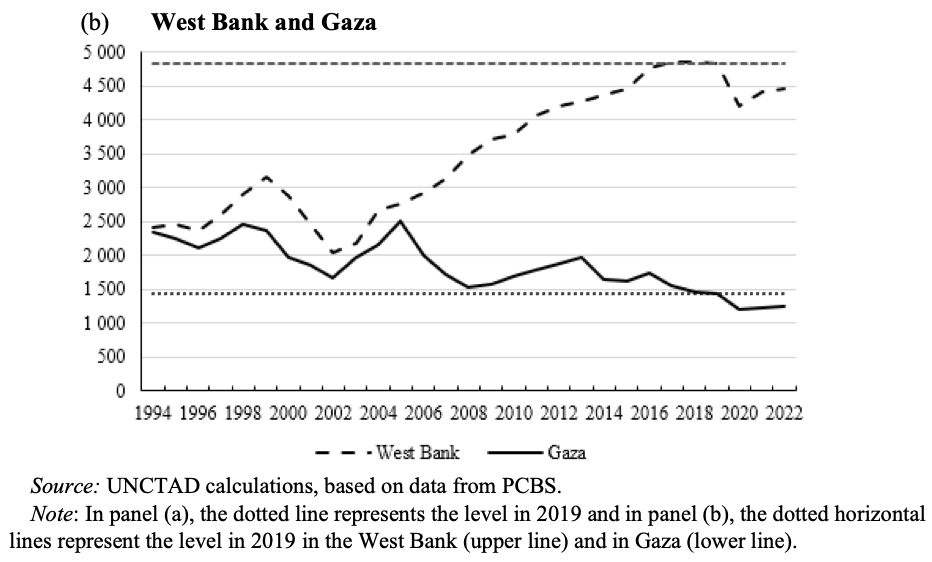
Speaking of economic development, Gaza's economy was on par with the West Bank's before Hamas got into power. Once Gazans elected Hamas, United Nations data (see below; UN, p. 2) show that economic growth in Gaza declined. The U.S. State Department recognizes that "businesses in Gaza have reported instances where Hamas courts and officials have employed coercion or have otherwise acted outside the legal system when engaging with private business." In layman's terms, an economy with corruption, bribes, fear, and intimidation break down economic growth. The fact that corruption erodes economic growth is commonly understood in the public policy world, as is illustrated by this research from the International Monetary Fund and Transparency International (also see Gründler and Potrafke, 2019Bai et al., 2013).


If there is a reason that Gaza has prison-like conditions, look at how Hamas rules Gaza. Per this report from Freedom House that examines Gaza's political freedom, Hamas is a corrupt organization that quashes the people's political and civil rights. Women, gay people, and whatever non-Muslims that may exist in Gaza's borders are oppressed. If Hamas did its job of governing over the Gazans instead of pouring its resources to kill Jews, maybe, just maybe conditions in Gaza would not be so dire. 

Postscript: Before there was the alleged "open-air prison," the argument over settlements, or so-called "occupied territories" (they are actually disputed territories), the majority of Arabs in the Levant region have hated Jews. As I brought up before, there have been multiple times where the Arabs were offered "land for peace." Palestinian statehood has been offered in exchange for recognizing Israel's right to exist and renunciation of violence. Apparently, co-existing with Jewish neighbors was and remains to be too big of an ask for most Arabs in the Levant region. 

Yes, Israel imposed a blockade and beefed up its border security. However, Israel did so in response to Hamas' terrorist activities that have become more and more of a national security threat to Israel. Labeling Gaza an "open-air prison" ignores Hamas' raison d'être of destroying Jews to the point of neglecting the needs of everyday Gazans. It neglects that most Gazans still support Gaza enough where Hamas has a higher approval rating in Gaza than President Joe Biden has in the United States. It avoids the reality that Egypt also has a border wall on its border with Gaza because Hamas is a threat to all of its neighbors, not only Israel. 

Calling Gaza an "open-air prison" is nothing more than a cudgel that attempts to shift all the blame to Israel while attempting to render Hamas and Gazan citizens as guileless victims. Yes, Gazan citizens lamentably face high levels of unemployment, poverty, and less mobility than other citizens in the world. Conversely, it is not so immobilizing to constitute as a prison, as is seen by mobility data of Gazans to and from Israel, Gazan migration data, and data of goods flowing in and out of Gaza. The extent to which Gaza is prison-like is primarily due to oppressive rule of Hamas, followed by the Gazans who voted Hamas in power and the Arab nations that refuse to help the Palestinians. While there is enough blame to go around, we should shift most of it to where it is due: in the direction of Hamas. 

Monday, January 8, 2024

Israel Should Not and Probably Will Not Accept a Ceasefire: January 2024 Edition

It has been about three months of fighting in Gaza since Hamas attacked Israeli civilians on October 7. Needless to say, there has been a growing voice of disapproval towards the Israeli counteroffensive in response to Hamas' carnage from October 7, 2023. Last month, a large majority in the United Nations General Assembly voted in favor of a ceasefire. A month later, there is still no ceasefire. That would explain why King Abdullah II of Jordan is pressing U.S. Secretary of State Antony Blinken for a ceasefire, even in spite of the fact that this is very same King has refused to accept Gazan refugees. 

The premise of the call for a ceasefire is to stop the rising death toll, the continued displacement of Gazans, and to allow for humanitarian aid in Gaza. While that sounds all well and good, there are a number of reasons to be against the idea of a ceasefire. 

1) Past history tells us that ceasefires do not work. Ceasefires have been attempted multiple times between Hamas and Israel. If a ceasefire were a lasting mechanism to bring peace, we would have seen positive results by now. At best, a ceasefire has been an exceptionally temporary concession. At worst, it does nothing to induce peace talks, which is true given the number of ceasefires since the last attempted peace talks took place in 2013. During the last Gaza War in 2014, what did Hamas do? Violate the ceasefire. The same with 2008. What about April 2007? It broke the truce by firing rockets. Hamas' October 7 attack was a violation of a ceasefire. 

Does anyone else notice a pattern here? Shortly after agreeing to a ceasefire, Hamas breaks the ceasefire. And when Israel decides to retaliate, the Palestinian side blames Israel. Blaming Israel only makes sense if you erroneously view Palestine as the personification of being oppressed and as such a blameless victim that kidnapping, raping, torturing, murdering, and decapitating Israeli civilians is acceptable. This also forgets the inconvenient fact that the Israeli Defense Forces unilaterally withdrew from Gaza in 2005, which is to say that the real oppressor in Gaza is Hamas, not Israel.  

2) If Hamas were given a ceasefire, what would Hamas most likely do? Regroup and rearm. That has been the modus operandi of Hamas, as is illustrated by Hamas doing so in 2009, 2012, 2014, 2019, and 2021. A ceasefire would only be an opportunity for Hamas to replenish its arsenal, rebuild its tunnels, and reorganize its troops. A ceasefire would not bring lasting peace to the Middle East. A ceasefire would serve to lengthen the fighting. If anything, emboldening Hamas, Hezbollah, and Iran with a ceasefire would help ensure a more violent future in that region of the world.

3) A ceasefire ignores that Hamas only wants one thing: the destruction of Israel. Hamas has made its genocidal intents clear. The fact that Palestinian survey data show that most Gazans do not have moral qualms with Hamas' raison d'être or with killing Jews is indeed problematic for those calling for a ceasefire. Plus, Hamas is so hellbent on destroying Israel that it does not care about the wellbeing of Gazans. Otherwise, why would Hamas use its citizens as human shields and launch military operations from civilian sites, thereby maximizing civilian casualties? Hamas has an established history of brutality. If the events on October 7 demonstrate anything, it is that they are more resolute on wiping out the Jewish state than they have been before. Israel is under no obligation to stop firing at an enemy that has made it abundantly clear of its intent. 

4) Why this war is not like the others. In previous conflicts, the goals were to contain Hamas and maximize Israel's regional deterrence. That is because prior to October 7, Hamas was viewed as a second-tier threat. The October 7 attack has shaken Israelis' sense of security to its core. Israelis are still reeling from the horrid attack. To call the October 7 attacks "another 9-11" is a woeful understatement. While Israeli citizens are dealing with political polarization, they are united on at least one topic: the destruction of Hamas. In this war, Israel's goals are to eradicate Hamas, bring the remaining hostages home, and defend its land. Since these goals will take more effort, a ceasefire will squander the military advantages that the IDF has, which the Israeli government cannot tolerate. 

5) Pressuring Israel with a ceasefire could backfire. This point cannot be stated enough. International calls for a ceasefire go beyond being tone-deaf given the context of the region. Calls for ceasefire increase the pressure to destroy Hamas "while it still can." This increased pressure means that the IDF will not be able to complete a slower, more thorough campaign. When a country faces an increasingly existential threat, it is less likely to use restraint. Rather than end the fighting, a ceasefire would very likely increase the magnitude of civilian deaths. Even if the ceasefire were successful, it would probably result in greater fortification of Israel's border with Gaza, as well as restricting humanitarian aid to Gaza. In either case, the calls for a ceasefire do not serve the citizens of Gaza well. 

Postscript. The premise behind a ceasefire is a political framework to secure a more peaceful future. A ceasefire implies that fighting will end and that postwar planning and reconstruction could take place. There are times in history where Muslims co-existed with Jews. Even in 2024, Israel is a nation with 1.7 million Muslims. As already pointed out, most Palestinians are unwilling to live side-by-side with an Israeli neighbor. It is not only Palestinian reluctance that is an issue with regards to a ceasefire. 

Since October 7, eradicating Hamas has become a more essential goal for Israeli national security that has broad support across the Israeli political spectrum, which says something given how much Israelis and Jews disagree on a multitude of other topics. The purpose of a ceasefire is to cease firing of weapons. It is literally in the name of the peace mechanism. Until the threat to Israeli civilians no longer exists, how do you expect Israel to agree to a ceasefire? 

Implementing a ceasefire would be one-sided. The "Ceasefire Now" crowd is not calling for Hamas to lay down its weapons or to release hostages. Nor is this same crowd calling for Hamas to stop withholding humanitarian aid or to stop oppressing its citizens in a totalitarian fashion. It is a call for Israel to lay down its arms and subject itself to other attacks akin to October 7. Israel cannot and will not abide by total capitulation. It would only be a short pause that would only buy time for Hamas to rearm and carry out the fighting. While the ceasefire comes with good intentions from many calling for a ceasefire, the current conditions between Gaza and Israel cannot precipitate a viable ceasefire. While it would not solve everything, destroying Hamas would be a first necessary step to help ensure peace in the long-run. 

Monday, December 18, 2023

For the Umpteenth Time: The Accusations That Israel Is Committing Genocide Are Baseless

Hamas launched a series of armed incursions against Israeli civilians on October 7, 2023. These attacks included kidnapping, rape, torture, and decapitation of Israeli citizens, a brutal day that has resulted in over 1,200 dead Israeli citizens. The fact that they posted their brutality on social media and bragged about it made it all the more abhorrent. Even from the onset, I knew that Israel was going to respond militarily and Israel was going to hit hard. I was worried about waning global support for Israel because the goal of eradicating Hamas was not going to be an easy feat and not achievable in a matter of hours or even days. Given the short news cycle that is stunted by social media, it turns out that I was right. 

It has been a little over two months and many have either forgotten why the Israeli Defense Forces are in Gaza in the first place or simply do not care what happened to Israeli citizens on October 7. Not only is the United Nations pushing for a ceasefire, but an old trope is reemerging. Which trope is that? The reemerging trope is the accusation that Israel is committing genocide. I call it an old trope for two reasons. One is that the accusation of blood libel against the Jews goes back centuries. The second is because accusing Israel of genocide has been going on for decades now. On my blog, I first addressed the accusation back in 2014.

This accusation has a number of problems. One is that it ignores that 377,000 have been killed in the Yemen War and that over 300,000 civilians were killed in the Syrian Civil War, including 3,146 Syrian Palestinians. In an unsurprisingly hypocritical fashion, the pro-Palestinian protestors only lose their collective mind when Israel does anything, including taking a metaphorical breath or sneezing the wrong way. Another issue is that genocide is not synonymous with "action resulting in multiple deaths that I personally find detestable or morally problematic." If words are to mean anything, you do not get to lob around loaded terms solely because you strongly disapprove of current events. The word "genocide" has a specific definition with specific requirements for it to constitute genocide. The United Nations first recognized it as a crime under international law in 1946. The definition below is contained under Article II of the 1948 Convention on the Prevention and Punishment of the Crime of Genocide, which is the standard used in international law. After providing this definition below, I am going to delve into why Israel is not committing genocide.

In the present Convention, genocide means any of the following acts committed with intent to destroy, in whole or in part, a national, ethnical, racial, or religious group, as such: 

(a) Killing members of the group; 

(b) Causing serious bodily or mental harm to members of the group;

(c) Deliberately inflicting on the group conditions of life calculated to bring about its physical destruction in whole or in part; 

(d) Imposing measures intended to prevent births within the group; 

(e) Forcibly transferring children of the group to another group. 


Israel has stated that it does not have genocidal intent. As we see from Article II of the Convention defining genocide, intent is a legal prerequisite to be classified as genocide, vis-à-vis the clause "with intent to destroy." The other major part of the intent stated in Article II is wanting to destroy the group as a group, which is important since every provision in Article II emphasizes the group component. 

The statements made by the government of Israel since October 7 do not constitute genocidal intent. Even when Prime Minister Benjamin Netanyahu made his controversial Amalek reference on November 3, he also made it clear that the goal "is to destroy the brutal and murderous Hamas-ISIS enemy," not the Palestinian people. A few days later, Netanyahu said that civilian deaths are unfortunate and that the blame should fall on Hamas. Netanyahu also disciplined a cabinet member for calling for a nuclear strike on Gaza since that would skyrocket the civilian death toll to unacceptable levels. 

Contrast that with Hamas, which has been blatantly overt since its founding in 1988 about its goals to wipe out Israel and the Jewish people. Shortly after the October 7 attack, Hamas official Ghazi Hamad declared on Lebanese television that Hamas will repeat the October 7 attack until Israel is annihilated. That sounds an awful lot like genocidal intent to me. Plus, the October 7 attack gives us a good idea of what they would do if the IDF decided to lay down its arms. 

The Israeli Defense Force's actions indicate a desire to mitigate harm, not cause it. It would be one thing if Israel were saying one thing while doing the opposite thing. Fortunately, that is not the case here. I can simultaneously recognize that the death of innocent civilians is both an inevitable outcome in war and that such civilian deaths are also a tragedy. That being said, there are several indicators that the Israeli Defense Forces (IDF) is doing its utmost to minimize civilian casualties. 

Before its ground invasion, the IDF called for the evacuation of Gazan citizens by dropping leaflets and online videos, which is something it has done in past incursions. The IDF even held off its ground invasion for a week. The IDF has a practice of calling off a military attack if the civilians remain in the area, with calling off an airstrike in May 2021 being but one example. No other military in human history has given advance warning to the other side of its attacks because it means losing element of surprise, as well as giving enemy combatants the opportunity to escape. A similar consideration goes for Israel's implementation of a humanitarian corridor and daily four-hour pauses of fighting. What frustrates me is that the anti-Israel forces are so hellbent on discrediting Israel that they partake in the mental gymnastics to argue that these measures are genocidal. If Israel were truly intent on genocide, it would give no such warnings or relief to Gazan civilians. The IDF would simply use its military capabilities that ran in the Top 20 of the Global Firepower Index and attack Gaza with everything they have.

You do not need to solely read the IDF's description of how it minimizes harm to civilians in Gaza. As a paper from the Naval War College Review details (Merriam and Schmitt, 2015), the IDF has a track record of minimizing civilian casualties. We can also look at the civilian-combatant ratio to have a metric of how the IDF is performing. The estimated civilian-combatant ratio in the latest Israel-Hamas War is about 2:1, which is comparable to other major wars. This ratio would indicate that the IDF's actions are not beyond the pale when it comes to its goal of targeting Hamas' military installations, especially given the context that I highlight throughout today's piece. 

Israel is responding to a pogrom that was carried out by Hamas. Israel did not start this war. On the contrary! Prior to October 7, the IDF did not have a military presence in Gaza since it unilaterally withdrew from Gaza in 2005. The war was imposed on Israel because a terrorist organization decided to carry out the largest attack on the Jewish people since the Holocaust. Israel is interested in eradicating the terrorist organization Hamas, bringing the remaining hostages home, and defending its people, the latter of which is a right under Article 51 of the Charter of the United Nations. The idea that hunting down terrorists with genocidal intent is genocide is yet another example of jaw-dropping doublespeak that has emerged in recent years. 

Whether reflected in words or deeds, the IDF's military campaign is the opposite of what eliminating Gazans would look like. Given Hamas' genocidal intent (see previous paragraph) and the fact that Hamas has launched at least 11,000 rockets into Israel since October 7, Israel is well within its right to use significant military force to defend its borders, provided of course that it is directed at legitimate military targets, e.g., Hamas' network of 1,300 tunnels. Rather than violate international law, Israel's actions have been informed by the rules of International Humanitarian Law. 

Palestinian population growth disproves the accusation of genocide. The charge of Israel committing genocide is not unique to 2023, but rather an argument that has been made over the past few decades. If Israel were committing genocide against Palestinians over time (in what is referred to as "incremental genocide"), the proof would be in the pudding, i.e., the population statistics. Other genocides that have taken place, whether the Holocaust, the Rwandan Genocide, or the Srebrenica massacre, had notable population declines in the targeted group. 

There would be a similar decline in the Palestinian population if genocide were taking place. What took place in West Bank and Gaza was the opposite. The raw population data show that Israel has not partaken in genocide. In 1950, the population was below 1 million. In 1990, it was 1.97 million and increased to 5.04 million in 2022 (World Bank). Either Israel is comprised of the most incompetent génocidaires on the planet or the much more plausible response is that Israel is not committing genocide. 

Postscript. The IDF has a very tough task. A ground invasion in an urban area (and one of the most densely populated areas on the planet to boot) that has steadily been losing international support.  If that were not enough, IDF's efforts are hampered when Hamas uses its citizens as human shields, launches military operations from civilian sites, and urges Gazans to ignore the IDF and stay put. The Gazan civilian death toll would be lower if Hamas stopped exploiting civilians to improve its public image in the international community. To destroy Hamas and minimize civilian casualties given the circumstances is indeed a tall order for the IDF. 

Yes, Hamas is being pursued aggressively. Israel's actions in Gaza are grave because what happened to Israel on October 7, 2023 was also grave. War is prima facie a nasty business, regardless of the justification. With all the aforementioned context factored in, does it make the IDF's military operations genocide? Absolutely not! If you paint it with that broad of a stroke, any act of war, whether offensive or defensive, whether justified or not, would be genocide. As sad as civilian casualties are, they do not automatically constitute as genocide. 

We have to be able to distinguish between general and/or legitimate types of warfare versus a deliberate policy of mass extermination. To reiterate, genocide has a specific meaning with serious connotations. Throwing around the word "genocide" so capriciously and with such carelessness means that the term loses its moral and legal meaning. It should not be used as a cudgel in a political war against Israel. By rendering the word to such meaninglessness, the framework of international law ends up being undermined:

"A society which does not understand the moral distinction to be drawn between the IDF's campaign in Gaza...and the Holocaust, and uses the same word, 'genocide,' to describe those events, is a society which is simply not serious about morality at all. It is a society which does not understand the difference between tragedy and hatred, or the moral implications of either." 

Some believe that Israel is justified in its actions to uproot Hamas to make sure that they can never harm Israeli civilians again. Others believe that the civilian casualties are too high of a cost to pay. We can get into a debate about whether Israel's response has been measured or excessive, whether their tactics are proper, or where there is room for improvement in how the IDF operates in Gaza. That sort of conversation would be within the bounds of political discourse and dissent. But let's steer clear of loaded terminology that is both inaccurate and does nothing to advance civil society because we should fight for a world in which the meaning of words still matters.

Monday, January 2, 2017

Israeli Settlements Are Not an Obstacle to Peace in the Middle East

Israel has gone through a couple of rough weeks when it comes to the international community chiding Israeli policy. First, the United Nations adopted UN Security Council Resolution 2334, which calls Israeli settlements a flagrant violation of international law. I find the Resolution to be more problematic because it berates Israel for "occupying" East Jerusalem, which includes the Jewish Quarter, the Temple Mount, and the Western Wall. The presence of Jews in Jerusalem and the influence of Jerusalem on Judaism predates Islam. Saying that the Jewish people have no connection to Jerusalem is as inaccurate as it is asinine. I wouldn't expect anything less from an organization that inaccurately and disproportionately maligns Israel while turning a blind eye to the travesty in Aleppo. The fact that the United States abstained, instead of asserting its veto power, has been criticized as another example of Obama being anti-Israel. I'm just glad that under the Pacific Settlement of Disputes, UN Resolution 2334 is merely a recommendation and not actually binding international law. UN Resolution 2334 also does not replace UN Resolution 242, which is quite frankly a relief, although it attempts to modify it.

It gets even better when a few days later, Secretary of State John Kerry goes on for 45 minutes about how Israeli settlements are an obstacle to peace while barely mentioning any culpability of the Palestinians, as if they have been angels all this time. How about we go into why John Kerry is dead wrong in his assertion that Israeli settlements are an obstacle to peace between Israel and Palestine?

  • The issue with settlements dates back to 1967. Not only are settlements predated by the Six-Day War of 1967, but also the War for Israeli Independence. Arab leadership had been trying to destroy the Jewish state before the first settlement was even built. Let's not forget that when Jews were forbidden to live in the West Bank from 1949 to 1967 (i.e., there were no settlements), Arab leadership refused to make peace with Israel.  
  • As I have explained before, the West Bank is not occupied territory, but is a disputed territory. Given that Jordan never had legal title of the West Bank from 1949 to 1967 (i.e., Jordan was illegally occupying the West Bank, and whose illegal occupation was formally recognized by Pakistan) and was not legally considered the sovereign at the time, this means that Article 49 of the Geneva Convention, which prohibits the forcible transfer of people from one state to another, does not apply due to Article 2 of the Geneva Convention not applying to Jordan. Even UN Resolution 242 does not stipulate the extent of Israeli withdrawal from the disputed territories, which once again means that Israel is not obligated to completely withdraw. Per UN Resolutions 242 and 338, until meaningful peace can be achieved and terrorism ceases, there is no legal basis to bar Jewish settlers from being in the West Bank. 
  • Palestinian leaders such as Yasser Arafat were able to get to the negotiating table even when settlements were being constructed. Arafat didn't ask for settlements to be halted as a pre-condition for the peace process. As a matter of fact, Arafat signed the Oslo Peace Accord even when settlements in the West Bank were on the rise. There was even a time at the beginning of his term when Mahmoud Abbas participated in peace talks without demanding a settlement freeze. Using the precondition of a settlement freeze really only became prevalent under the Obama administration, and even when there was a settlement freeze in 2009-10, Abbas still refused to negotiate peace. 
  • Israel completely withdrew from the Gaza Strip in 2005, which included removing 8,500 settlers who were previously living in Gaza. You know what that got Israel? Being bombarded with rockets and having to deal with more bloodshed. If settlements were an issue, wouldn't there be peace between Israel and Gaza right now instead of ongoing conflict? Given the vulnerability that Israel would face from withdrawing from West Bank and risking a two-front war, I hardly blame Israel here.
    • In addition to the Israel showing its willingness to relinquish settlements for peace (e.g., 2005 withdrawal from Gaza and the withdrawal from Sinai in 1982), there are examples of Israeli Supreme Court ruling against settlements that were constructed illegally, including MigronAmona, and Netiv Ha'avot.
  • Israel has been able to absorb 1.7 million Arabs into its country of 8.5 million. Aside from the settlers only occupying about 2 percent of the West Bank, there are nearly 350,000 Jewish settlers in the West Bank, which has a total population of 2.7 million. Israel can handle twenty percent of its population being Arabic, but the West Bank is so incapable of handling the reality that 12 percent of its population is Jewish that the only response is to kick all the settlers out? That's called ethnic cleansing, and the fact that the Palestinians want the West Bank to be Judenrein (that's German for "clean of Jews") is absolutely telling about how the Palestinian government feels about Jews. And you know that if the Israeli government were to hypothetically expel its Arab citizens, the international community would have an absolute fit and call it racism, but somehow, the Palestinian Authority gets international sanction. 
    • Looking back at most of the Israeli-Palestinian treaties, the borders would have been drawn up in such a way where about 75-80 percent of the settlement population would have been incorporated into Israel. 


While it is evident that the Israeli settlements are politically contentious, it is equally evident that the settlements are not an obstacle to peace, let alone the main obstacle. If you are looking for some barriers, here are some of the bigger problems facing the peace process: the Palestinian education system that demonizes Jews, a Palestinian government that funds terrorists to attack Israelis, or how about a Palestinian government that cannot even recognize the existence of a Jewish state? A two-state solution only works if both sides are committed to a two-state solution, and based on this fixation on settlements, we know that the Palestinian government is not ready for peace.