Thursday, February 3, 2022

Johns Hopkins Meta-Analysis Is the Latest In Showing Why Lockdowns Are Ineffective and Horrid

As we approach our third year of this pandemic, I cannot help but shake my head at the decline of discourse and debate when it comes to public health issues. Whether it was masks, vaccines, or school closures, what should have been instances of "science informing public policy" became a nasty mixture of fear and politicization. None was as frustrating for me as watching what happened with the lockdowns, especially given how encompassing and onerous lockdowns are. 

I was hoping that voluntary social distancing would have sufficed and that we would not have to implement lockdowns. As early as mid-March 2020, I expressed concern that if implemented, lockdowns would become a major problem. My fears came true on this one. In spite of the fact that most people were voluntarily doing their own social distancing beforehand, lockdowns became a reality. "Stay home, stay safe" became a mantra early in the pandemic. Politicians decided to implement the lockdowns because "we had to do something to stop COVID, and something was better than nothing." The thinking was that if we isolated healthy individuals and minimized in-person contact with other human beings, we would be able to stop or at least significantly slow down COVID transmission. The decision to implement lockdowns went well beyond violating the logical fallacy of the Politician's Syllogism. There are times where doing something is better than nothing, or in this case, that the something you suggest is worse than what you are trying to prevent. 

While sitting at home while in lockdown in early May of 2020, I was emphatic about removing lockdowns. My issues with lockdowns went well beyond those of freedom. I expressed concerns ranging from societally overreacting to the disease severity of COVID and the damage it was causing the economy and healthcare system to the fact that there was no precedent for isolating healthy individuals at this scale. 

Fortunately, we have moved beyond the lockdowns. We have vaccines that are effective at preventing severe cases of COVID. More people have developed natural immunity against COVID. Our understanding of COVID and our treatment thereof has improved. While I am cautiously optimistic that Omicron is contagious to give enough people natural immunity and help us move beyond the pandemic stage, we are still reeling from the effects of the lockdown. It will take years for us to understand the full effects of the lockdowns. A question we can answer now is whether the lockdowns saved lives. 

Last week, the experts at Johns Hopkins University released a meta-analysis of 24 relevant studies (Herby et al., 2022) examining lockdown stringency index studies, shelter-in-place order [SIPO] studies, and specific non-pharmaceutical intervention [NPI] studies. I want to touch upon the NPI aspect before getting into the lockdowns more specifically. The authors found that there was no evidence that "lockdowns, school closures, border closures, and limiting gatherings have had a noticeable effect on COVID-19 mortality. There is some evidence that business closures reduce COVID-19 mortality, but the variation in estimates is large and the effect seems related to closing bars (p. 39)." 

In terms of lives saved by the lockdowns, the Johns Hopkins study says it depends on the type of study you use. "Specific NPI studies also find no broad-based evidence of noticeable effects on COVID-19 mortality." If you look at SIPO studies, their results for lockdowns were "only reducing COVID-19 mortality by 2.9% on average." That means the range for the effects on COVID-19 mortality is 0 percent to 2.9 percent. Regardless of which number on the range you select, this comes with the issue of looking at a subset of people instead of looking at the population at large. 

When I conducted my literature review of lockdown evidence in June 2021, I came across a most intriguing study from economists at the University of South California and the Rand Corporation (Agrawal et al., 2021). Those economists found that for each week shelter-in-place orders were in place, there was a 2.7 percent increase in excess deaths. Combining the 2022 Johns Hopkins study with the USC/Rand Corporation study, not only was forcing people to stay at home ineffective in saving lives, but it caused a net increase in death. This is the part where I segue into the main takeaway of the 2022 Johns Hopkins study, which is a far cry from what lockdown lovers would like to hear:

While this meta-analysis concludes that lockdowns have had little to no public health effects, they have imposed enormous economic and social costs where they have been adopted. In consequence, lockdown policies are ill-founded and should be rejected as a pandemic policy instrument.

If only someone had told us beforehand, we could have saved ourselves a lot of grief. This is where I find the lockdown debacle especially infuriating: we were told beforehand. In September 2019, experts at Johns Hopkins said that quarantining the healthy would very well be the least effective NPI (p. 57). Weeks before the pandemic began, the World Health Organization [WHO] stated that isolating the healthy is not recommended "because there is no obvious rationale for this measure, and there would be difficulties in implementing it (WHO, p. 16)." Instead of "following the science" or deigning to conduct a cost-benefit analysis in order to justify such a policy, politicians across the world ignored the science and wreaked havoc on millions of people's lives. To quote the Johns Hopkins study (p. 43):

Lockdowns during the initial phase of the COVID-19 pandemic have had devastating effects. They have contributed to reducing economic activity, raising unemployment, reducing schooling, causing political unrest, contributing to domestic violence, and undermining liberal democracy. These costs to society must be compared to the benefits of lockdowns, which our meta-analysis has shown are marginal at best. Such a standard benefit-cost calculation leads to a strong policy conclusion: lockdowns should be rejected out of hand as a pandemic policy instrument. 

The difference between the advice that Johns Hopkins experts gave in 2019 and the study they released last week is that we have a strong evidence base of how ineffective and horrid lockdowns are. I am not delving into the specific costs of the lockdowns mentioned above or attempting to monetize said costs today because that is another conversation for another time. What I can say is the following. While there was bound to be some damage done by the pandemic regardless of response, a lockdown was a way to collectively shoot ourselves in the foot and make the problem worse. Whether they were doing it out of the goodness of their hearts or to consolidate their own power, politicians upended the lives of millions and caused unintended consequences that will impact our lives for years to come. 

I hope the outcomes of the lockdowns make us question whether an emergency should constitute a "we should do something" response. Like with any policy, we should ask whether the policy in question is an improvement over the situation one is trying to prevent. With the lockdowns, we can definitively say that lockdowns provided next to no benefit while devastating life as we know it. Mark Twain once said that history doesn't repeat itself, but it rhymes. There will be another pandemic. Let's hope that we learned our lesson from this pandemic and the next pandemic doesn't rhyme with this pandemic by stupidly including a lockdown.

Sunday, January 30, 2022

The Jewish Prayer Modeh Ani Is Much More Than Saying Thanks

How we wake up in the morning can set the tone for the rest of the day. Research shows that morning routines can increase productivity, lower stress, improve confidence, and boost energy levels. Judaism gives us a ritual that helps us as we awaken from our slumber. Upon waking up, Jewish tradition teaches us to utter the following words:

מודה אני לפנוך מלך חי וקים שהחזרת בי נשמתי בחמלה. רבה אמונתך

I give thanks before You, living and eternal king, for You have mercifully restored my soul within me. Your faithfulness is great. 


Part of what I like about this prayer is its simplicity. The blessing has twelve words and yet it has so much wisdom packed into it. The most common interpretation given for this blessing is that it is about starting your day off by expressing gratitude. I do not disagree with this interpretation. I wrote about Modeh Ani and the importance of being grateful about a decade ago. One of the Hebrew words for "Jew" (יהודי) comes from the same verb as "to thank" (להודות). Jewish tradition teaches that a Jew is to say 100 blessings a day (Talmud, Menachot 43b). When I look at the Modeh Ani blessing, I see more significance in the text than simply another opportunity to say "Thank You." Here are some insights that I was able to come up with:


  1. Life is more than just the self. One takeaway from this blessing is the syntax. The verb comes before the subject. While this syntax occurs in biblical Hebrew, I think saying מודה אני instead of אני מודה teaches us a lesson. While there are merits to self-care, the word order reminds us that there is something bigger than us. We need to focus on the loftier aspects of life before we focus on ourselves. 
  2. Confronting one's mortality. This point surrounding one's mortality becomes more salient when we look at what we are thankful for when reciting Modeh Ani. The blessing thanks us for having another day on this planet. Marcus Aurelius said in his text Meditations (2:11) that "you could leave life right now. Let that determine what you say, do, and think." Even if one is young and healthy, waking up to live another day is not a given. This is where the practice of memento mori comes in. Modeh Ani both reminds us that we have a limited time on Earth while emphasizing we should be thankful for the time that we have. 
  3. Awareness. The phrase מודה אני does not only mean "I give thanks." The word מודה can also mean "to acknowledge' or "to rise to the understanding of." We do not only give thanks by saying this prayer. We also rise to the understanding of why we give thanks, and by extension, life's purpose. Awareness is key to life. It would explain why one of the morning blessings in Judaism is to ask G-d for discernment (אשר נתן לשכוי בינה להבחין בין יום יבין לילה).  
  4. Sense of renewal. Each day is a new day of life. Yes, there are things we wake up with that were there yesterday: imperfections, emotional baggage, and problems. Modeh Ani reminds us that we have the opportunity to tackle those problems, to do better, to make this day unique and ours, and to figure out where we are going in life. 
  5. Our past does not define our future. Our brains are wired in a way that alert us to danger and the malaise in life, which comes from our hardwired negativity bias. We can use Modeh Ani to transcend the negativity bias and begin our day in a more positive mindset. Our thoughts have a major influence on how we perceive and live life. We are not tied to natural impulse to look at things negatively. Research shows that gratitude can increase happiness, decrease depression, and improve sleep quality. Per the previous point, that also means we are not tied to our past because the past definitionally is not the present. If times are bad, we can remind ourselves that they can be better. If times are good, we can remind ourselves to appreciate the good while we have it or we can find ways to make it even better. In any case, the status quo is not an inevitability. 
  6. Finding ritual that speaks to us. This is a tangential point, but one that I want to make. This does not have to do with the words of the prayer, but when the prayer was created. While it takes some inspiration from the Talmud and Tanach (Hebrew Bible), the prayer Modeh Ani itself was first used much later at the end of the 16th century C.E. I would have thought that the Modeh Ani prayer dated back to biblical or talmudic times, but it is not. It is relatively new within Jewish history. It is both interesting and comforting to find rituals that were created in more modern times that still fit within the mold of Jewish tradition. It also makes me think of our own capacity to create rituals that are both meaningful to modern times and our experiences while still being characteristically Jewish.
  7. A call for being more compassionate. In the blessing, we state that G-d returns our soul to us "with mercy" (בחמלה). Assuming we take the the theology in this prayer literally, G-d does not give us another day based on our merits, but rather His mercy. I can quibble about whether "why bad things happen to good people" or "why do good people have to die." But let's take it literally for a moment because Judaism teaches us an important lesson: that we are created in His Image. This form of imitatio Dei, known as בצלם אלקים, means that we aspire to take on G-d's virtues. If G-d gives us another day because His compassion, we too should find ways to be more compassionate in life. 
  8. Being trustworthy. When we end the blessing with רבה אמונתך ("your faithfulness is great"), we are establishing a sense of trust in G-d. This ending implies that one is to entrust G-d to return the soul the following morning. Since we are to imitate G-d, it means that we should find ways to be more trustworthy in our interpersonal relations. 
  9. Trusting ourselves. If G-d is Sovereign of the universe and G-d can trust us, that should mean that we should be able to trust ourselves. He gave us the ability to live life to the fullest, to succeed, and the tools to handle adversity. Speaking of adversity....
  10. Gratitude is not solely for the good times. The phrase רבה אמונתך comes from Lamentations 3:23. The Book of Lamentations has much calamity, including raping, pillaging, and murder. In this text, it seems as if G-d has abandoned the Jewish people. But the end of the Book of Lamentations remind us that even the bad times do not last forever. It does not mean that we ignore or neglect the calamity or problems in our lives. Modeh Ani teaches that instead of dwelling or wallowing, we are meant to use gratitude, awareness, compassion, and steadfastness to get through the bad times, as well as enhance the good times with these virtues. 

Friday, January 21, 2022

Will Omicron Finally Have People Lose Faith in Cloth Face Masks?

In spite of mixed messaging at the beginning at the pandemic, most public health officials have recommended throughout the pandemic that people wear face masks to help slow the rate of transmission of COVID-19. What should have been a simple scientific question of efficacy became marred with politics. The pre-pandemic understanding of face mask usage was that healthy individuals masking up did nothing to stop spread (Desai and Mehrotra, 2020). It became apparent early on in the pandemic, at least for me, that N95 and surgical masks were more effective than cloth masks.  But maybe COVID was different from past respiratory infections. At the beginning of the pandemic, it made more sense to take on the precautionary principle until we knew what we were dealing with, both in terms of the disease burden of COVID and the effectiveness of masks. 

Some facets have changed and others have stayed the same since the beginning of the pandemic. One notable aspect of the face mask debate that has not changed is that the evidence base for cloth face masks is still low (see my analysis on the existing face mask research here, here, here, here, and here). As I pointed out in December, face masks have been shown to somewhat slow down droplet transmission, but lacks correlative evidence in terms of affecting infection outcome. While I was supportive of a temporary face mask mandate at the beginning, my agnosticism on face masks went from in favor of the mandates to being against them by the time that the Delta variant reared its ugly head. Given the low evidence base, I cannot state that they do not work, unlike with ineffective and harmful lockdowns. At the same time, I cannot say that they do work either. At best, the cloth face masks had minimal impact on COVID transmission. A University of Minnesota review of face masks concluded that "it should be well-known by now that wearing cloth face coverings or surgical masks, universal or otherwise, has a very minor role to play in preventing person-to-person transmission. It is time to stop overselling their efficacy and unrealistic expectations about their ability to end the pandemic." At worst, wearing the face masks was performative and an attempt to force compliance with government fiat to keep people in line. 

Whichever scenario it may be, I can say that two major features have changed since the beginning of the pandemic. One is our ability to respond to COVID is better for two reasons: improved treatments and vaccines. Vaccines are especially important because they are the single-most important public health measure that has helped reduce severe COVID cases, COVID hospitalizations, and COVID-related deaths. 

The other facet of this pandemic that has changed since the beginning has been the variants have been more transmissible. Delta was more contagious than the Alpha variant. I personally did not think that it would be probable, but there was a strain that is even more transmissible: Omicron. 

Thankfully, the preliminary data show that the omicron variant is less likely to hospitalize than Delta. Its increased infectivity show that it still remains a threat to healthcare systems in the short-run. But if the United Kingdom and nations in southern Africa, the places furthest along in the omicron wave, are an indication of anything, the omicron wave very well could drop as quickly as it rose. Omicron's high transmissibility can also mean that enough people will incur natural immunity that it can, combined with vaccine immunity, put us at a place of herd immunity, as the Lancet points out (Murray, 2022). 

But what about until we reach the point where the pandemic becomes endemic? Are the masks doing anything to help slow the spread of omicron or have we reached the point where cloth face masks are a form of public health theater or virtue-signaling? Arguments against cloth face masks only seem to have gotten stronger with the latest variant, and experts are starting to understand that cloth masks have minimal to no positive impact. CNN medical analyst Dr. Leana Wen, who has been strict with COVID-related public health measures, said last December that cloth face masks are nothing more than facial decorations and are not appropriate to fight COVID. The Kaiser Foundation admits that cloth face masks are not going to cut it with Omicron. The Mayo Clinic has begun requiring patients and visitors wear more effective masks in lieu of cloth masks. Although the CDC does not bother to quantify the effects, its latest mask guidance finally admits that cloth face masks are less effective than other mask alternatives.

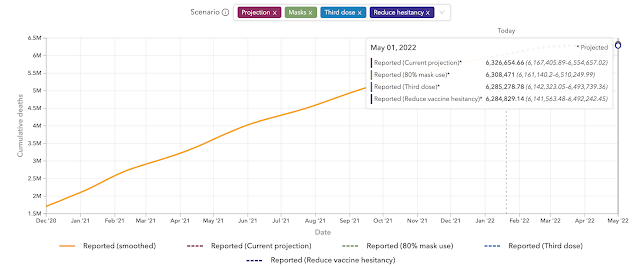
The projections at the University of Washington's Institute for Health Metrics and Evaluation (IHME) show a minimal impact. IHME has the COVID death count at 5,955,911 as of January 5, 2022. With its current projections, it predicts the global death toll will increase to 6,326,655 people. IHME projects that even with 80 percent face mask usage, it will reduce global deaths by 18,183. This means that at best, masks could reduce COVID deaths over the next four months by 4.9 percent. This would imply that face mask usage will have minimal impact, certainly relative to what face mask proponents would wish for. 


What does this all mean? Have we finally met a virus so transmissible that face masks make little to no difference? Can we accept that COVID is here to stay? England has at least realized the futility of face mask mandates and has lifted their mask mandate. Sweden never had a face mask mandate; it dropped its face mask recommendation last summer. The United States seems to be going in the opposite direction. Although the U.S. government had been hoarding 750 million N95 masks, it is looking to finally ship them out. That is subpar timing considering that the New York Times declared a couple of days ago that Omicron is in retreat. Yet one of Biden's campaign promises was to "shut down the virus." If I had to guess, the Biden administration is doubling down to seem tough on that campaign promise, although the upcoming midterm election cycle might change the administration's tune in the upcoming weeks. 

I cannot predict which direction the Biden administration is going to take. If I were to be cynical enough, I would surmise that Biden will declare victory over COVID shortly before the November elections to give the Democrats running for re-election the best chance. On the other hand, intransigence, lack of political will, and fear might keep this country on the stringent end of public health measures. 

I pointed out back in October that this pandemic will not formally end until we as a society can start to accept risk again. If the Biden administration's continued response to this pandemic and face masks is an indication of anything, it means that we as a society most likely have the majority of 2022 to deal with the fear-mongering, the inaccurate insistence that we can eradicate COVID, and the continued moving of goalposts to some unattainable utopia. The continued emphasis on face masks, in spite of highly questionable efficacy, signals that the U.S. government will be in pandemic mode after the metrics improve. I wonder how many more months or variants it will take for the COVID fear-mongers to realize the folly of their take on the pandemic. Time will tell, but given the Biden administration's handling of the pandemic, I am not optimistic. 

Monday, January 10, 2022

New Mandatory GMO Labeling in U.S. Will Not Do Any Favors (And Will Probably Make Matters Worse)

Genetically modified organisms, or GMOs for short, have been a source of controversy over the years. Those who derisively criticize foods with GMO ingredients as Frankenfoods have pushed for GMO labeling. Their dream has come true. In 2016, Congress passed the National Bioengineered Food Disclosure Standard (NBFDS). This Standard states that there is to be a national mandatory standard for labeling GMOs as "bioengineered." At the beginning of this year, the Standard took into effect and products made with genetically modified ingredients are legally required to be labelled as "bioengineered."  As nice as it sounds to keep consumers well-informed, mandating GMO labels comes with its own share of issues. 


GMOs Are Not Bad for Your Health

When I criticized the state of California for trying to pass a similar law in 2012, one of my main arguments against such a labeling scheme was that GMOs do not present unique risks to an individual's health. My argument holds as much today as it did a decade ago. GMOs are as safe as any other food. If you need proof of that, here are some examples of medical experts confirming that very point:

  • The World Health Organization states that "All genetically modified foods currently available on the international market have passed safety assessments and no effects on human health have been shown as a result of consuming GM foods."
  • After reviewing more than 900 studies, the National Academies of Science concluded that "no differences have been found that implicate a higher risk to human health and safety from [current] GE foods from their non-GE counterparts (2016, p. 19)."
  • In the European Union, they all but ban GMOs. Even so, the European Commission looked at multiple studies over 25 years to realize that "biotechnology, and in particular GMOs, are not per se more risky than e.g. conventional plant breeding technologies (2010, p. 16)."
  • Pew Research surveyed 3,748 scientists from the American Association for the Advancement of Scientists. Pew found that 88 percent of scientists surveyed agree that GMOs are safe to eat. Contrast that with the 37 percent of U.S. adults who believe that it is safe. 
  • Italian researchers conducted a meta-analysis of 6,006 studies (Pellegrino et al., 2018). Aside from showing that there is greater crop yield with GMOs, GMO crops have lower rates of mycotoxins, fumonisins, and thricotecens, all of which cause economic loss and harm to humans and animals. In other words, this meta-analysis argues that GMOs are healthier.
  • In March 2020, the USDA said that "GMO foods are carefully studied before they are sold to the public to ensure they are as safe as the foods we currently eat. These studies show that GMOs do not affect you differently than non-GMO foods."

GMO Label Laws Are Unnecessary

If all of that empirical evidence and advice from premier medical organizations is not enough to sway you, the U.S. Department of Agriculture admitted in 2018 that NBFDS "is not expected to have any benefits to human health or the environment." The very government agency that is to enforce this GMO labelling knows that its GMO labeling regulations will have no effect on human health. So much for "following the science!"

However, it is more than the health implications to show that mandatory GMO labels are useless. According to the Center for Food Safety, 75 percent of food in the U.S. contains GMOs. If GMOs are really that pervasive and commonly used, what practical function would such a label have? That concern seems to have played out in practice. As researchers from University of Wisconsin-Madison, University of Amherst, and Cornell University concluded in a November 2021 paper, "In the presence of existing non-GMO labels, mandatory labelling did not have any additional effect on demand (Adalja et al., 2021)." When Vermont briefly had its state-level GMO labeling scheme, a University of Vermont researcher found that GMO labeling laws actually decreased opposition to GMOs (Kolodinsky and Lusk, 2018). 


Repercussions for Agricultural Sector

Not only is the science nearly unanimous on the fact that GMOs are not uniquely bad for one's health. Finding ways to limit GMO production will mean harming the agricultural sector. Genetically engineered crops are commonly used for such species as corn, soybeans, alfalfa, cotton, and canola. The American Enterprise Institute illustrates how less of these technologies limits crop production (Brester, 2018). Using alternatives would mean needing to use more water, land, and other inputs to keep up with global food production. A trio of Danish researchers similarly concluded that the European Union's current GMO laws hinder Europe's agricultural production (Christiansen et al., 2019).

Undermining Science and Scientific Credibility

We have had enough bad scientific advice and restrictions surrounding the COVID pandemic, whether that has been lockdowns, travel bans, mask mandates, or school closures. The missteps of the CDC and FDA had resulted in greater mistrust in public health, with about half of Americans not trusting these institutions. This Standard continues to erode trust in public health advice because it ends us legitimizing bad science. The Standard compels companies to engage in a form of speech that misleads customers in thinking GMOs are bad. 


Cost of GMO Labeling Scheme

Not only has the USDA admitted that the GMO regulations will do nothing to help with health or the environment, but that these regulations will cost taxpayers. The USDA calculated that the costs of NBFDS would "range from $598 million to $3.5 billion for the first year, with ongoing annual costs between $114 million and $225 million." Is this a lot in the grand scheme of things? No. Remember that the U.S. GDP for 2020 was $20.9 trillion and that the federal government spent $6.8 trillion in fiscal year 2021. Even using the higher estimates of the Standard's costs (i.e., over $5 billion over the next decade), they seem like drops in the bucket in comparison to the U.S. economy. At the same time, we are talking about a labeling scheme that does nothing to protect consumer health and does harm to the agricultural sector. Paying one cent is too much, never mind spending millions. 


Conclusion

One of the main purposes of food labels is to warn the consumer about potential health risks. Why create a GMO label if the science is telling us there is no unique health threat caused by GMOs? Why are we spending taxpayer dollars to undermine health expertise, as well as the agricultural sector? If a producer wants to voluntarily label their products "GMO-free," that is their prerogative. However, the U.S. government has no business thrusting such a pointless labeling scheme on to the American people.

Monday, January 3, 2022

Are Biden's Tariff-Rate Quotas on European Steel an Improvement Over Trump's Steel Tariffs?

One of the most irritating parts about the Trump presidency and his attempt to "Make America Great Again" was his protectionism. Trump's favorite weapon of choice in his attempts to restrict imports from other countries was the tariff. The tariff that had considerable impact was when he made the decision in March 2018 to implement a 25 percent tariff on steel. This tariff was not only placed on China, but also on U.S. allies in Europe. Trump's argument for the tariffs was that he was helping out the U.S. manufacturing industry. When I criticized Trump's steel tariff, I pointed out how it would cause net job loss, increase prices for the U.S. consumer for multiple goods, create negative macroeconomic effects, increase the likelihood of trade wars, and do next to nothing to prevent the decline in U.S. manufacturing that Trump was trying to minimize. A year later, I illustrated how the results of Trump's tariffs aligned with economic theory. In other words, in spite of Trump's assertion that we would be doing so much winning, the American economy and the American people did anything but win as a result of his tariffs. 

Given how evident the damage caused by Trump's tariffs, I was hoping that Biden would have done the simple, yet effective policy reversal by eliminating Trump's tariffs. Instead of reducing the tariff rate to 0 percent, Biden made a different agreement with the European Union: a tariff-rate quota (TRQ) system on steel and aluminum. The TRQ acts as a hybrid between a tariff and an import quota. To clarify the trade jargon here, a tariff is a tax imposed on imports entering a country. An import quota is a limit of a quantity of a certain good that can enter the country. In the case of a TRQ, anything below the threshold is either taxed at a reduced rate or is duty-free. If the quantity of imports exceeds the agreed-upon threshold, then a larger tax is imposed on the goods that surpass that threshold. Essentially, a TRQ is a two-tier tariff system. To get a summary of the economics of TRQs, you can read what the U.S. Department of Agriculture (USDA) published here.

Here is how Biden's latest TRQ works. As of January 1, 2022, a TRQ on steel and aluminum coming in from the European Union went into effect. The Trump-era tariffs for steel imported from other countries still remains in effect. Under this TRQ, the annual import volume on steel from Europe is 3.3 million metric tons (MMT). The TRQs are based on a first-come, first-serve system. The first 3.3 MMT of steel that enters the United States from the European Union will not be subject to tariffs. If the imports exceed the 3.3 MMT quota, any subsequent steel imports will be walloped with the 25 percent tariffs. 

The question to ask ourselves is whether Biden's TRQ was an acceptable trade policy choice. As we see from the chart provided by the USDA report below, much of the answer to that question will depend on whether steel imports are high enough to make the quota binding or not. I worry for a few reasons that steel imports would exceed the quota. One, European countries will be incentivized to import steel earlier than later so they can get the discounted rate. Two, steel import data show that the annual average imported from 2017 to 2019 would have rendered this quota binding. Three, the American Iron and Steel Institute found that U.S. steel imports increased 44.6 percent from November 2020 to November 2021. Four, the World Steel Association projects that steel demand is only to increase through 2022. 

Steel industry trends combined with economic incentive signal that 2022 steel imports would most probably exceed the limit in the TRQ. What we cannot know at this time is by how much. Even so, we know based on previous tariffs that any of the imports beyond the quota will be subject to the 25 percent tariffs. In theory, Biden's TRQ sounds like an improvement over the Trump's policy because it would mean fewer goods subject to high tariffs. It also reduced trade tensions between the United States and the European Union, as well as remove previously existing forms of EU tariff retaliation. However, I take issue with Biden's TRQ for a number of reasons.

  1. The tariffs under Section 232 were intended for exigent national security reasons. While Trump had spurious reasoning for his usage of Section 232, Biden is not even hiding his reasoning for the reckless usage of Section 232: climate change.
  2. Speaking of flaunting certain violation of norms, Biden's TRQ violates the World Trade Organization (WTO) rules. More specifically, the most favored nation (MFN) principle in WTO agreements states that if a member reduces export restrictions on one country, it has to do so for all countries. If some of the most prominent members of the WTO cannot follow its own rules, it undermines the validity of the WTO.
  3. This violation of WTO norms not only has the potential to harm relations with other such countries as the United Kingdom, Japan, and South Korea. Biden kept the Section 232 tariffs on these allies because he claimed that the tariffs are good for national security. If we extended the same deal (or even a better deal) to these nations, we could also help ease the bottleneck in our supply chains.    
  4. There are 54 distinct quotas, which means more enforcement and red tape. The complexities within the quota score-keeping mean more politicking and more rent-seeking. This will also make it more difficult for domestic producers who rely on imported steel and aluminum inputs to find what works best for their business. Larger steel- and aluminum-using domestic firms will be at an advantage because they will have the manpower to navigate the paperwork and the bureaucracy to get the import quota rights. 
    • As economist Anne Krueger makes clear, "Because they [European firms] will not have to sell more cheaply to offset what used to be 25 percent, they can instead raise their prices on their exports within the quota quantity." What was once tariff revenue for the U.S. government is now revenue for European producers of steel and aluminum. Larger steel- and aluminum-using domestic producers will also be in a better position to seek financial relief (much like we saw in the Trump administration), which means an erosion of competitiveness and productivity growth throughout multiple markets. 
  5. Supply and demand are changing constantly. There is no bureaucrat who has the clairvoyance to predict how the markets are going to play out and which quota would be acceptable. As domestic demand increases, the percent of foreign steel as a share of the market increases. Given that the quotas set are below average of import levels from 2017-2019 and demand is projected to increase, the quotas currently in place will most probably be restrictive in terms of growth for the multiple industries with steel as an input.  
  6. As the Coalition of American Metal Manufacturers points out, U.S. steel-using manufacturers are losing business to competitors in other countries because the protectionism does not allow them to have access to the raw materials necessary to stay competitive in the global market. While limiting supply and driving up prices helps domestic steelmakers, it hurts downstream producers that use steel as an input, which ultimately hurts U.S. consumers. 
  7. A TRQ is definitionally a two-tier tariff system. As such, one does not get rid of all the costs of tariffs by switching it with a TRQ. Even with the best implementation, one merely minimizes the distortionary, negative effects of tariffs (see here, here, and here for my past analysis on the harm of tariffs). Whether we are talking about tariffs, import quotas, or tariff-rate quotas, they all distort the competitive market for the worst. 
Conclusion: I did not think it would be possible for a president to do a comparable amount of damage to trade as Trump did, but then along came Biden. What the net effects of the TRQs are still unknown because it depends on how well implementation goes. While Biden's move solved some problems with the TRQ, it also caused others. Biden could have simply removed the tariffs and allowed free trade to flourish. Instead, he opted for a more convoluted form of protectionism entangled with bureaucracy and red tape. Whether it was Trump's misguided attempt to punish foreign nations or a misguided attempt at climate change policy, it is ultimately U.S. consumers and downstream manufacturers that pay the price for this nonsensical trade policy. One thing has been made abundantly clear in recent U.S. trade policy: neither the Republican Party nor the Democratic Party presently care to help out the American people by making trade freer.

Wednesday, December 29, 2021

Recap of Top Libertarian Jew Blog Entries for 2021

This time of the year is a time of reflection on what has transpired during the current calendar year. Last year, I was hoping for less craziness than there was in 2020. Between the pandemic, economic downturn, and social unrest, last year was unhinged. While 2021 was not as bad as 2020, 2021 still had more than its fair share of insanity. 

As the pandemic continued into its second year, it remained a major topic in the media and among political pundits. On my blog, the pandemic was a topic that accounted for over a third of my blog entries for the 2021 calendar year. I was hoping that it would have been less considering that safe and effective vaccines were made available (see April 2021 analysis here). There was a brief moment in which the CDC said that the unvaccinated could go around doing normal activities unmasked. My response to that CDC recommendation in May was that the CDC has botched messaging throughout the pandemic and that going back to normal means ignoring what the CDC has to say by enjoying life regardless. Maybe now, we could stop people telling us to "follow the science" while ignoring the science. That was wishful thinking on my part. 

We went from "two weeks to flatten the curve" to "wait a little longer to help hospitals" to "wait until we have a vaccine" to "get enough people vaccinated." But along came the Delta variant, and with that, the goalposts moved once more. To keep Delta in check, President Biden called for vaccine mandates. I covered the topic no less than four times this past year in which I pointed out the problems with vaccine mandates (see here, here, here, and here). 2021 was also a year in which we procured enough data to conclude that the lockdowns were both ineffective and harmful from a public health standpoint. And let's not even get into the unhelpful travel bans or mask mandates (see here and here). All of this lunacy made me realize that the pandemic will not come to an end when COVID-related hospitalizations or deaths get low enough, but when we as a society get used to accepting risk once more. 

But don't you worry. There was enough craziness to go around that the pandemic did not need to hog all the spotlight. 

  • Cancel culture was another major news item. Take the Dr. Seuss controversy in which the Dr. Seuss Foundation cancelled the publication of six of Seuss' less-known works. I came to multiple conclusions on that debacle, most notably that the woke Left are the moral prudes of our time and that a small group of emotionally fragile and intellectually weak individuals should not have their sense of being offended determine what is acceptable for the rest of us. 
  • In a similar vein, there was cancel culture controversy surrounding comedian Dave Chapelle's Netflix special The Closer. He made jokes offending all sorts of people, but the jokes that got the most ire were those on the theme of transgender individuals. You can read my analysis here, but I was reminded of the value of comedy, the importance of free speech, and that the fragility of the woke Left is both at odds with learning to agree with those disagree with you and the essential pillars that make up a free, democratic society. 
  • In terms of economic disarray, I offered my takes on the supply chain crisis and the shortages in the labor market. 
  • And let's not forget the debacle with the Kyle Rittenhouse trial. While the woke Left tried to make it about race (which is odd considering the case was about a white guy shooting four other white guys in self-defense), it showed how little many on the Left believe that there is a such thing as a "good guy with a gun." The spoiler here is that defensive gun usage (DGU) is way more prevalent than the Left would care to admit. 
  • But if we do want to get into the topic of race, I tackled the topic of critical race theory (CRT). Contrary to what the Left would like to believe, CRT is not about simply about having a dialogue about race or making sure we are not ignoring the nastier parts of history. CRT is a simplistic, fatalistic worldview that believes that U.S. institutions are inherently racist and [one of] the only attributes of a human being that matters is the color of one's skin. 
  • On the brighter side of race relations, Juneteenth became a federal holiday. I wrote a piece on why we should all celebrate Juneteenth in the United States.
I wish you all a Happy New Year! May it be less out of whack than 2020 and 2021 were. 

Wednesday, December 22, 2021

Fauci Is Dead Wrong About Indefinitely Needing Face Masks on Airplanes

Dr. Anthony Fauci, who has been the Director of the National Institute of Allergies and Infectious Diseases (NIAID) since 1984, has played a major role in advising the U.S. public on pandemic measures. He has also been off the mark on numerous occasions. Here are but a few:

  • In February 2020, Fauci wrongly predicted that COVID would most probably have a fatality rate of 0.15 percent, which would have been on par with the common flu. In a matter of a few weeks, Fauci went from thinking the risk was minuscule to being supportive of lockdowns, albeit only for two weeks. It ceases to shock me how quickly "two weeks to flatten the curve" turned into months. He continued to push for strict lockdowns in the latter half of 2020. He was continually critical of states on multiple occasions that decided to open "too early." The scientific evidence ended up vindicating those states by showing that lockdowns are ineffective and harmful.
  • Fauci was wrong when he thought that schools should be shut down because he went under the erroneous assumption that allowing children to go to school would be superspreader events. It turns out that the science showed that COVID is a minuscule risk to children. 
  • Fauci admitted openly that his goalposts of herd immunity were not based on science, but "what the public was ready to hear." 
  • His flip-flopping on masks has been astounding. In February 2020, Fauci said "there is no reason whatsoever to wear a mask." He changed his mind in April 2020 supposedly because he was worried about the supply of face masks. Fast-forward to January 2021 where he went as far as saying that even the vaccinated should wear two masks, even though Fauci admitted in May 2021 that a vaccinated person wearing two masks was tantamount to pandemic theatre. 

I could list more not-so-endearing Fauci moments, but I want to move on to Fauci's latest faux pas. This one took place on a December 19, 2021 airing of ABC's This Week (transcript here). When asked if we will reach a point where we do not have to wear face masks on airplanes, Fauci's response was "I don't think so." In Fauci's mind, those who travel on airplanes will be wearing face masks for the foreseeable future. This response is problematic for a number of reasons. 

Let's begin with the efficacy of face masks generally. The pre-pandemic understanding behind face masks was that "face masks should not be worn by healthy individuals to protect themselves from acquiring respiratory infection because there is no evidence to suggest that face masks worn by healthy individuals are effective in preventing people from becoming ill (Desai and Mehrotra, 2020)."

At the beginning of the pandemic (i.e., May 2020), I was mildly supportive of a temporary face mask mandate. In spite of the mixed evidence that we had at the time, I figured a temporary measure that had low costs and potentially high benefits was good advice at the beginning of the pandemic when we had less understanding of face masks in the context of COVID. I started to change my mind as the pandemic progressed. 

About one year into the pandemic, the World Health Organization (WHO) said in December 2020 that "there was only limited and inconsistent scientific evidence to support the effectiveness of masking healthy people (WHO, 2020, p. 8)." A month earlier, the revered Cochrane examined multiple studies on the transmission of influenza-like diseases and found "there is low certainty evidence from nine trials that wearing a mask may make little to no difference to the outcome of influenza-like illness (Jefferson et al., 2020)." The WHO and Cochrane findings began my process of truly questioning face masks.

I continued to be begrudgingly supportive of face masks, but then came accessible vaccines. Looking at the vaccine process and the clinical data, I found that vaccines were safe and effective. Vaccines are much less riskier than contracting COVID. By the time we reached August 2021, I wrote a piece illustrating why we do not need face mask mandates. Aside from not being significantly responsible for lower case rates, I also argued that vaccines are a way more effective tool in fighting this pandemic than face masks. We also have to factor in that vaccines greatly reduce severe COVID cases, COVID-related hospitalizations, and COVID-related deaths (Scobie et al., 2021). It makes less sense to talk about COVID cases when vaccines have further severed the relationship between cases and disease severity. 

If that were not enough, a literature review from the Cato Institute shows that, as of November 2021, the available evidence of face mask efficacy is of low quality (Liu et al., 2021a). While masks are shown to reduce some measure of droplet transmission, what has not been demonstrated with available clinical data is a correlation with infection outcomes (Liu et al., 2021b). As a fun side note, CNN medical analyst Dr. Leana Wen said earlier this week that cloth masks are little more than face decorations in the face of a variant as contagious as omicron.

More specifically, the evidence for face mask usage in airplanes is even more scant than face masks generally. The 2020 Harvard study is not based on the gold standard of randomized controlled trials, but was done through modeling. An Irish case study of an international flight to Ireland suggests that in-flight transmission was the only possible solution (Murphy et al., 2020). Here is another case study, this one being a two-hour, domestic Japanese flight (Toyokawa et al., 2020). In spite of these studies, the evidence base is still that of low certainty. The evidence base for face masks slowing COVID transmission, whether in the general sense or specifically on airplanes, is weak.

I would like to talk about the risk of contracting COVID while on an airplane. What is the risk of flying the friendly skies during this pandemic? To quote the medical journal JAMA Network from October 2020, "the risk of contracting coronavirus disease 2019 (COVID-19) during air travel is lower than an office building, classroom, supermarket, or commuter train." Southwest Airlines CEO Gary Kelly testified in front of Congress saying that high-efficiency particulate air (HEPA) filtration systems capture well over 99% of airborne pathogens and converts the air every two to three minutes. The aforementioned comes from a finding in a 2020 Department of Defense study showing how low-risk riding in an airplane is. How low-risk? How good of a job are HEPA filtration systems on a plane? According to the DOD study, the HEPA filtration systems do such a good job that the risk of COVID is lower than being in one's private home or being in an operating room (see Figure below). Out of all of the indoor places one can be, being inside an airplane is actually one of the safest. 


Fauci does not care about how low the risk is on an airplane. He said as much in the ABC interview by stating that "Even though you have a good filtration system, I still believe masks are a prudent thing to do." Fauci is an eighty-year-old man for whom the only level of risk that is acceptable appears to be zero risk. After all, Fauci did say in that ABC interview that we cannot return back to normal until we finish this. 

Fauci does not care about how little evidence exists to support or refute mask-wearing. Fauci does not care about how mass vaccination has made COVID more manageable. He does not care that air filtration in an airplane is so high-quality that in terms of COVID-related risk, it is safer to be in in airplane than it is in an operating room. It does not matter that flying in an airplane without a mask is a low-risk activity. Fauci does not want us to go back to something resembling a pre-pandemic normal. What he cares about is fear of COVID and that we share his fear until the day we die.

Risk is a part of life. We do not have the luxury of living in a bubble and eliminating risk. Fauci analogizing the fight against COVID to fighting the Axis powers in WWII is another example of showing how out of touch he is. The U.S. government has declared a War on Terror, War on Drugs, and War on Poverty. Remind me again how well those "wars" are going. COVID is not going to go away. As I brought up in October, this pandemic will not truly end until we as a society can accept risk once more. If we cannot let up on pandemic regulations in the safest of conditions, such as wearing face masks on airplanes, what hope do we have of leaving the pandemic behind us? 

We should not give into fear. We should also not continue to push health regulations that have little to no evidence to support it, as is the case with face mask mandates. We cannot mask our way out of the pandemic. As the Cato Institute brings up, since the effectiveness of masks is uncertain, we should focus on practices that we know to be effective: vaccines, better ventilation systems, and discouraging crowding in closed areas (also see University of Minnesota review of masks here). I do not know whether President Biden will extend the face mask mandate on airplanes beyond the current mid-March expiration date. I certainly hope not. What I do know is that when government bureaucracy is entrenched with hypochondriacs, fear-mongers, and the most risk-averse who claim to follow science but effectively ignore the science, we end up in a dystopian society that values fear above else. This mentality that leads so-called experts to say we need to indefinitely wear face masks on planes to avoid the smallest of risks is no way to move forward and sure is no way to live.